


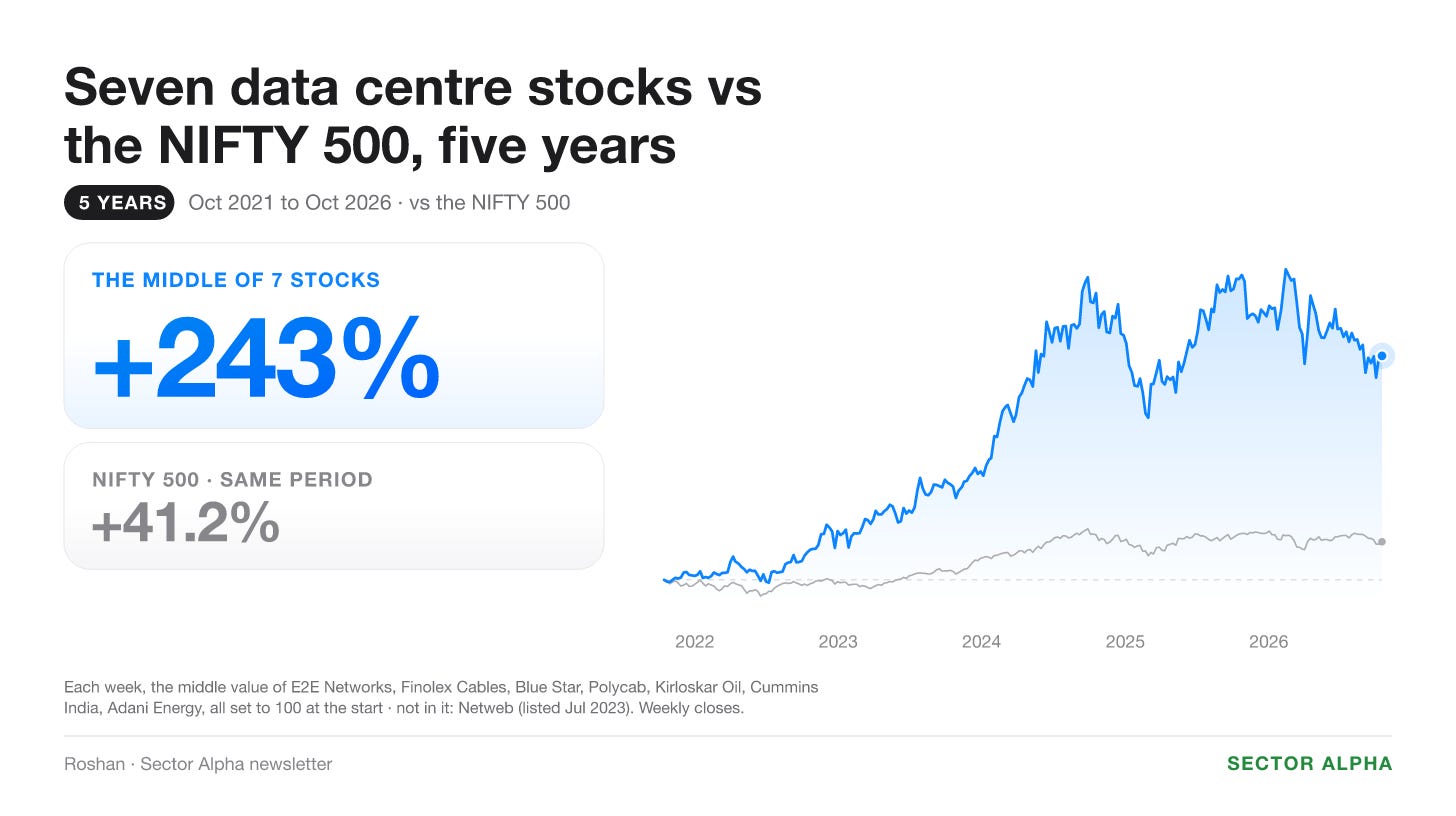
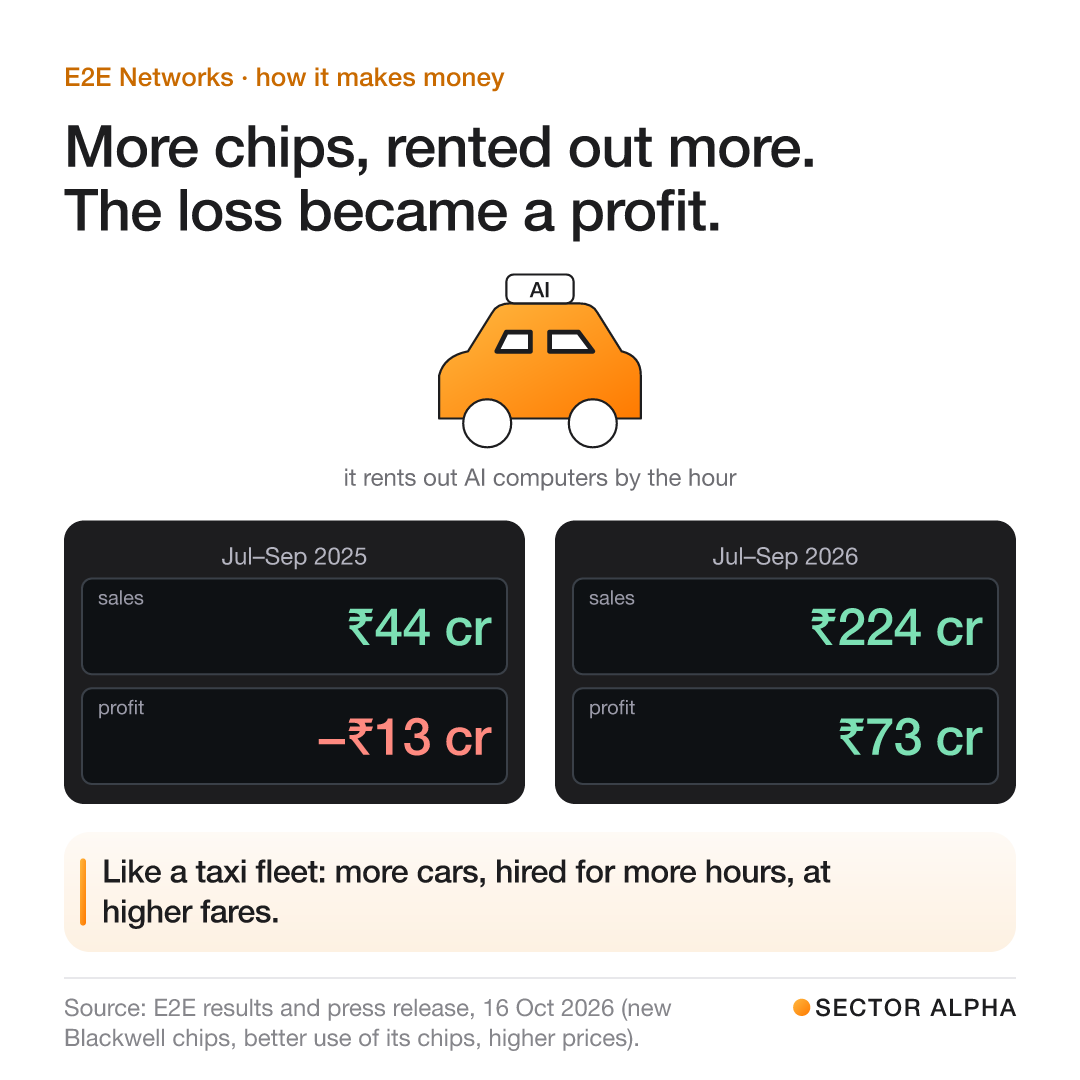
E2E networks rents out AI computers by the hour. in july to september 2025 it lost ₹13 cr. in july to september 2026 it made ₹73 cr. its share rose 64.1% in three months
cummins india makes the backup generators those buildings need. its data centre generator sales more than doubled in a year. its share fell 17.6%
those two sit at either end of twelve listed companies that earn from data centres. from 16 july to 16 october the NIFTY 500, India’s 500 biggest companies, fell 4.1%
four of the twelve went up. eight went down, six of them by more than the index. by my math, the one in the middle of the list fell about 4.7%, close to the index. as a group they didn’t win anything. the spread inside it is the story, E2E at the top and adani energy at the bottom, down 19.2%
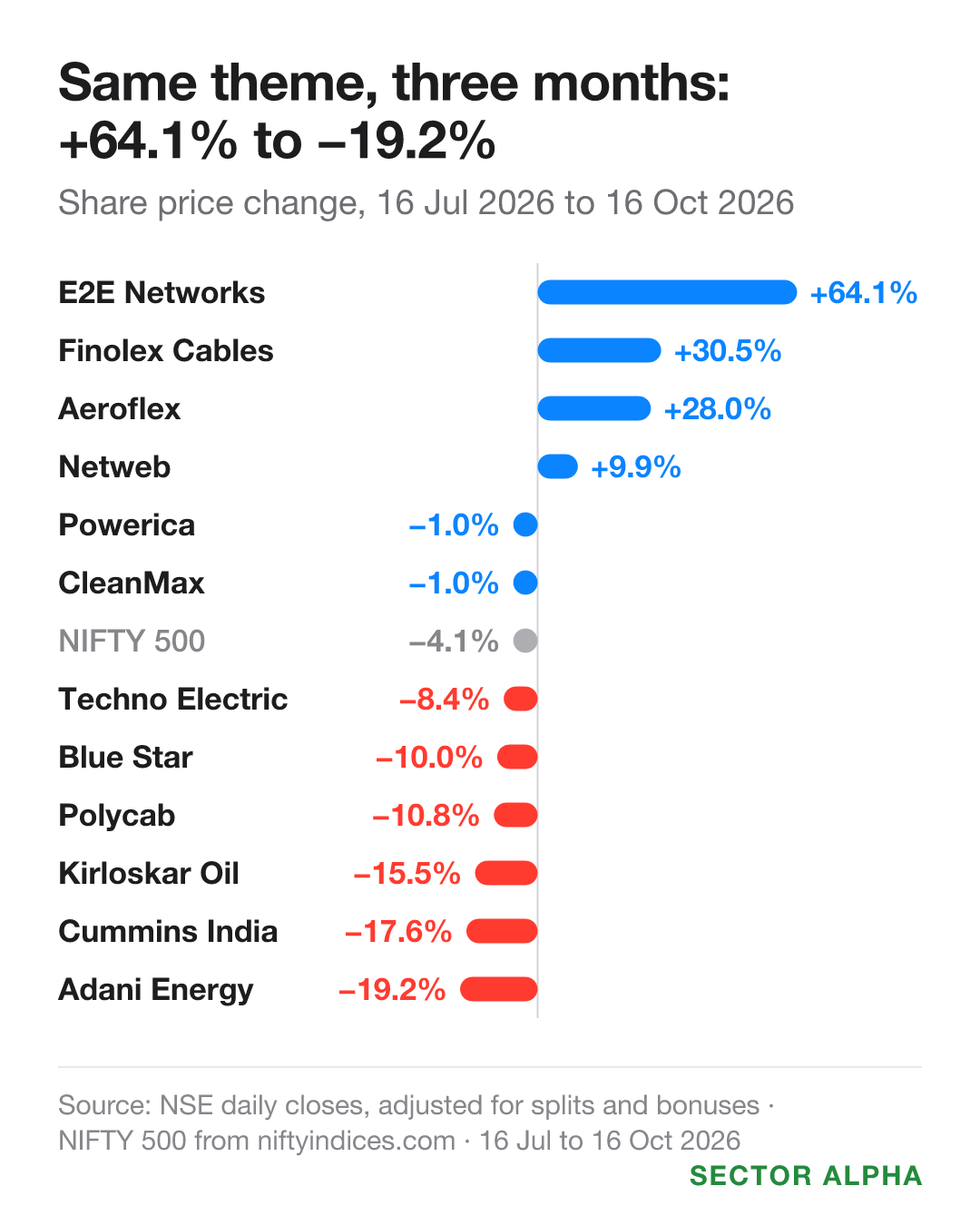
by my reading, what sorted them was profit in april to june 2026. where it jumped, the share went up. cummins, kirloskar and blue star sold more but kept the same profit or less, and went down
polycab and adani energy grew profit and fell anyway, for reasons that have nothing to do with data centres
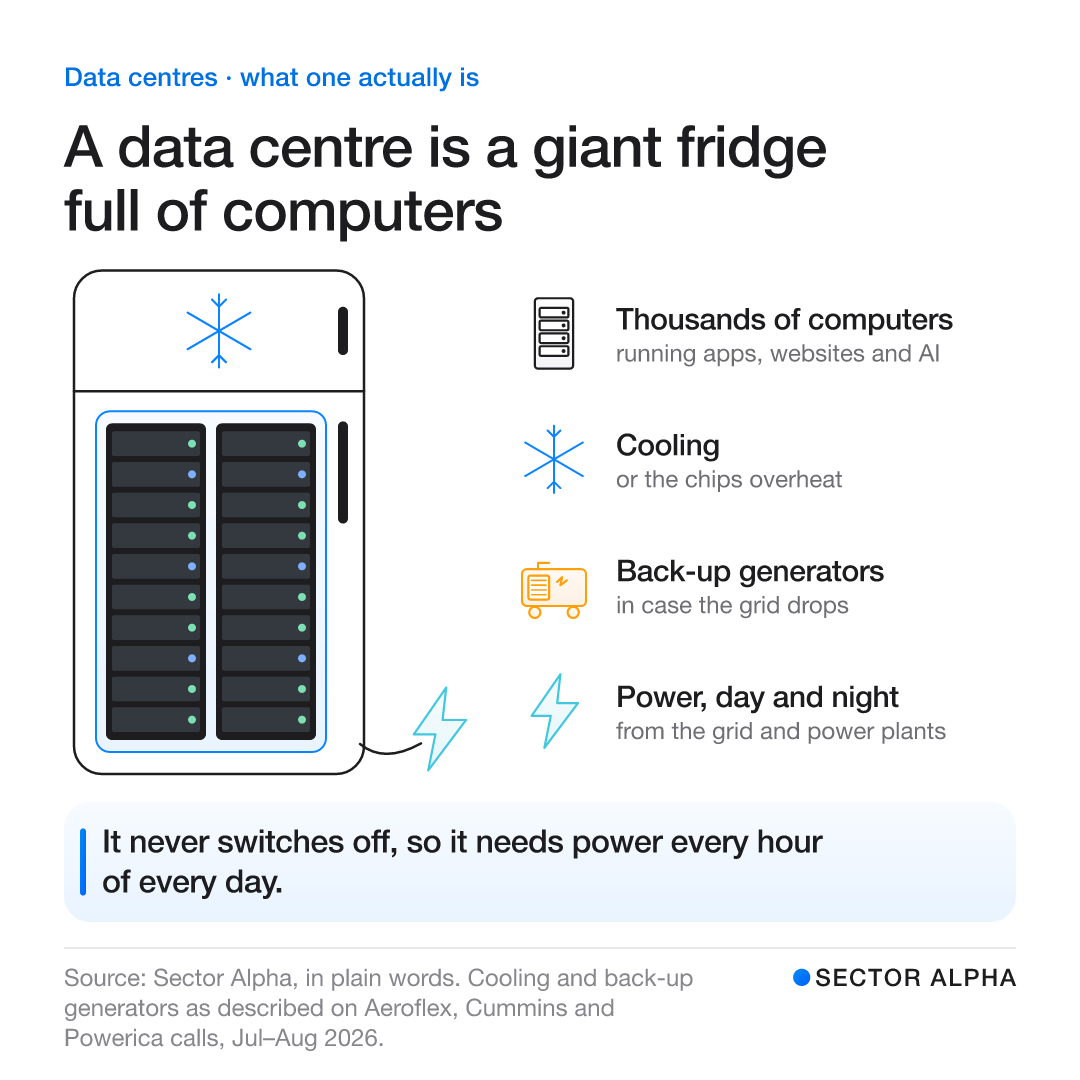
a data centre is a huge building full of computers that run apps and AI, cooled and powered every hour of the day. everyone knows more are coming. what i wanted to know is who’s already being paid for them, and who gets to keep any of it
how many companies bring it up
by my count, 187 listed companies said “data centre” on their april to june results calls, out of the 1,161 calls i could read, across 86 industries. by my count the quarter before it was 191, and 141 before that
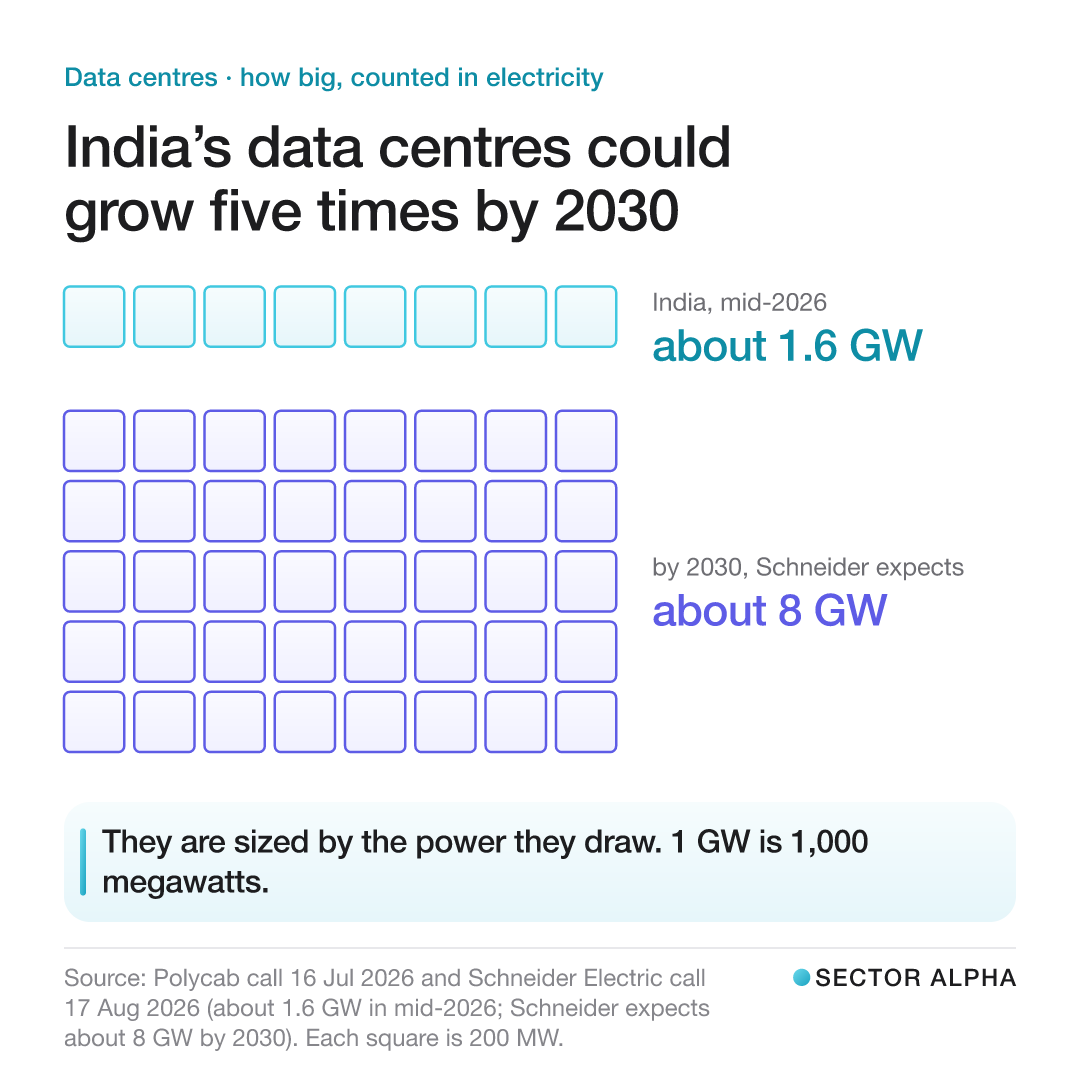
data centres are sized by how much electricity their computers can draw. a megawatt (MW) is a million watts, and a gigawatt (GW) is a thousand megawatts
india had about 1.6 GW this summer. polycab and schneider both used that number. schneider expects about 8 GW by 2030. airtel alone wants to go from 120-130 MW to 1 GW
where one megawatt’s money goes
the building comes first. adani enterprises put construction at about ₹70-75 cr a megawatt
polycab says each megawatt needs about ₹3.5 cr of cable. aeroflex says 40-odd cooling skids go in, units that pump coolant around the chips. then generators big enough to run the whole place if the grid drops
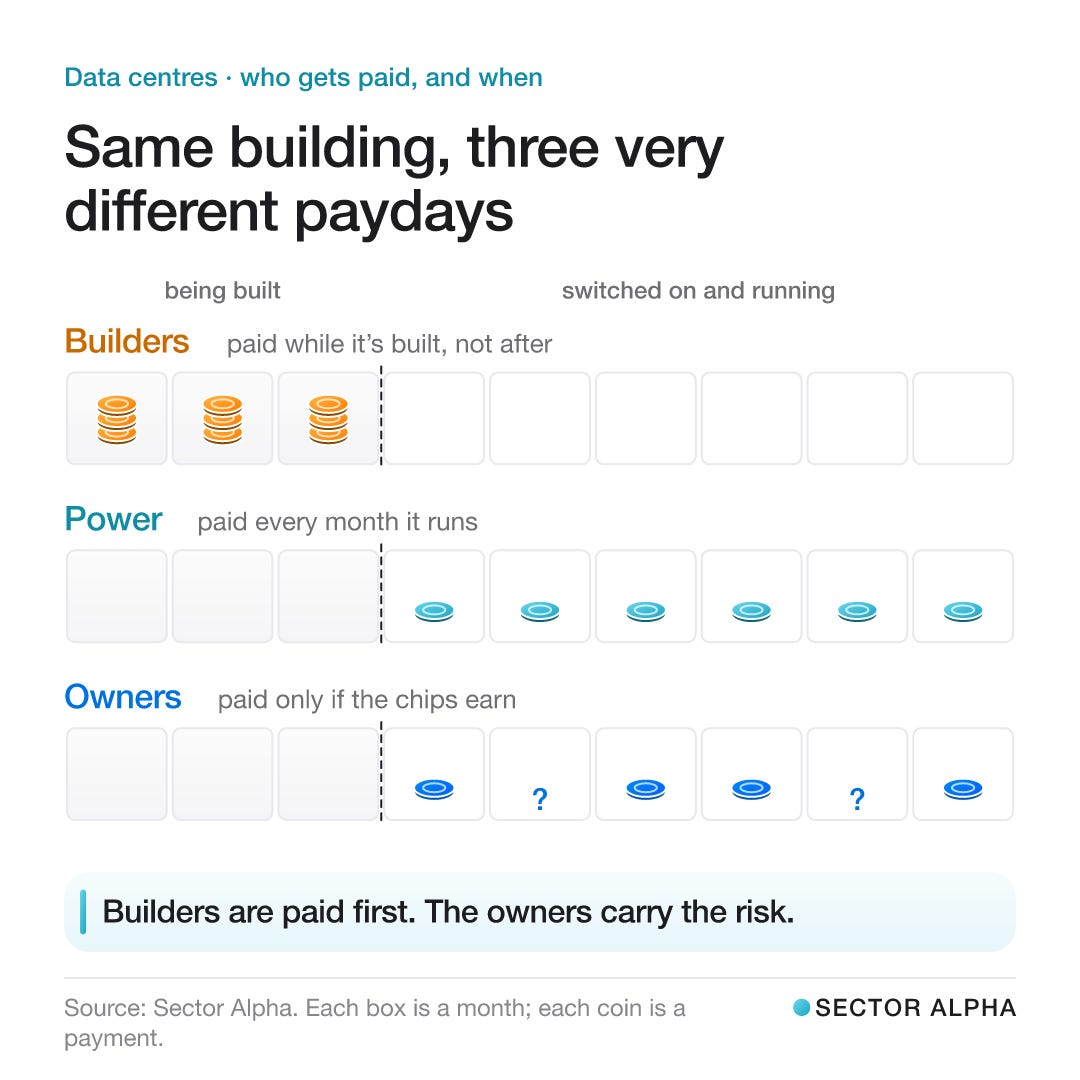
all of that is paid once, during the build
then the power. cleanmax, which sells clean power to data centres, laid out the maths. 1 GW of computers needs about 1.4-1.5 GW of power, all day and all night. from sun and wind that takes about 6 GW of plants plus batteries, around ₹40,000 cr. by my math that’s about ₹40 cr for each megawatt
the power plants get paid every month for as long as the computers run
and then there are the owners, who own the computers inside and rent out computing time. their money only comes if the chips earn it
the companies below follow the money in that order
the builders
finolex cables
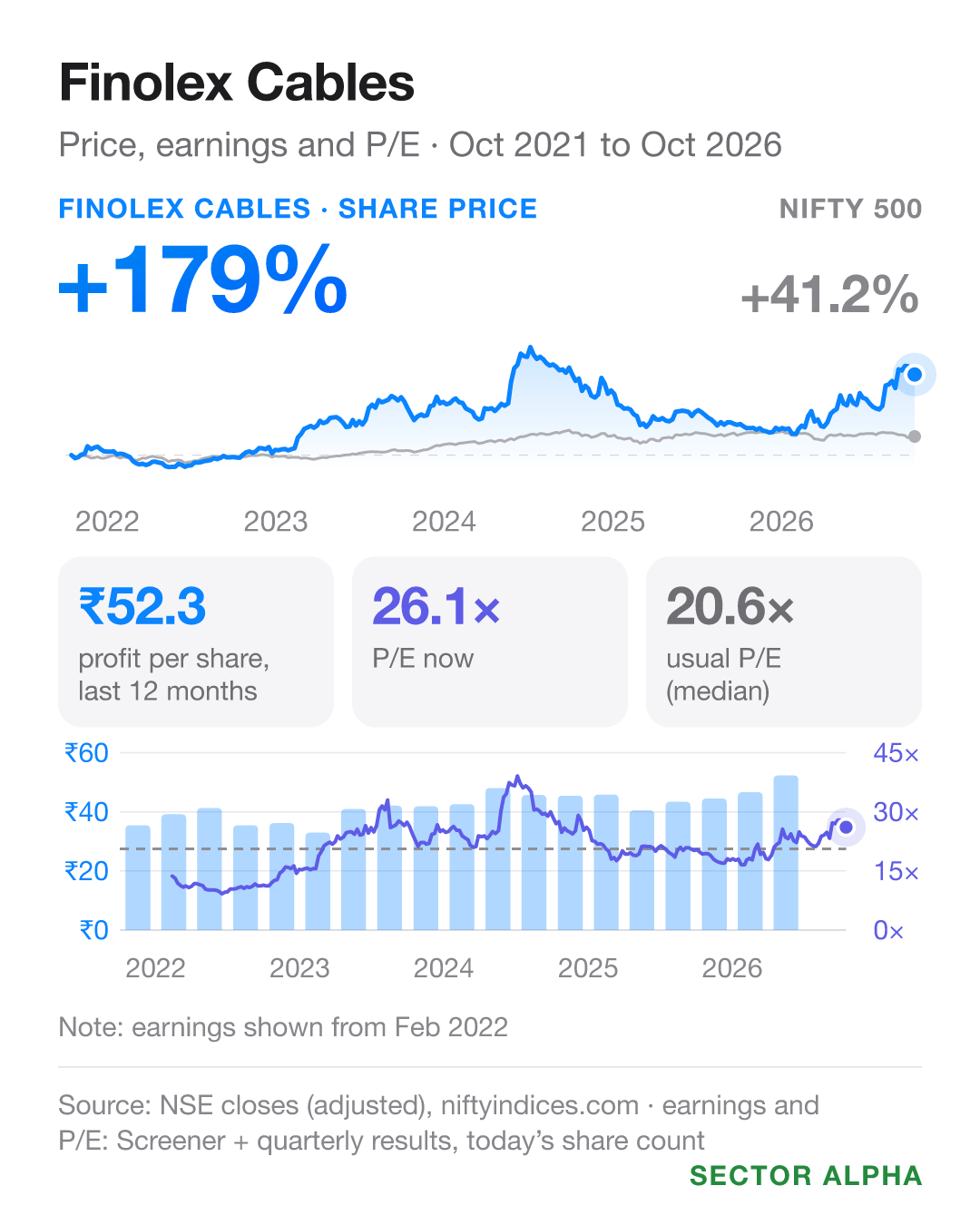
finolex cables rose 30.5%, most of it after its 11 august results, when profit jumped 53% to ₹249 cr from ₹163 cr
its data centre piece is fibre cable. communication cables went from ₹109 cr to ₹176 cr in a year, with close to 30% kept as profit, and management put that down to a global rush for fibre from data centres. about ₹30-40 cr of the ₹176 cr was exports, and it expects india’s own data centres to follow
₹176 cr is under a tenth of its ₹2,013 cr of sales, though. ordinary electrical cable selling more did most of the work
management itself told people not to multiply the fibre quarter by four. part of that margin came from stock bought earlier at lower prices. cash coming in still lags profit too
by my math, earnings per share, a year’s profit split across each share, rose about 12% in the three months. the price rose faster, because people went from paying about 22 times a year’s profit on 17 july 2026 to 26 on 16 october 2026. finolex has mostly sat around 21. over five years the share almost tripled while the earnings bars rose much less
aeroflex
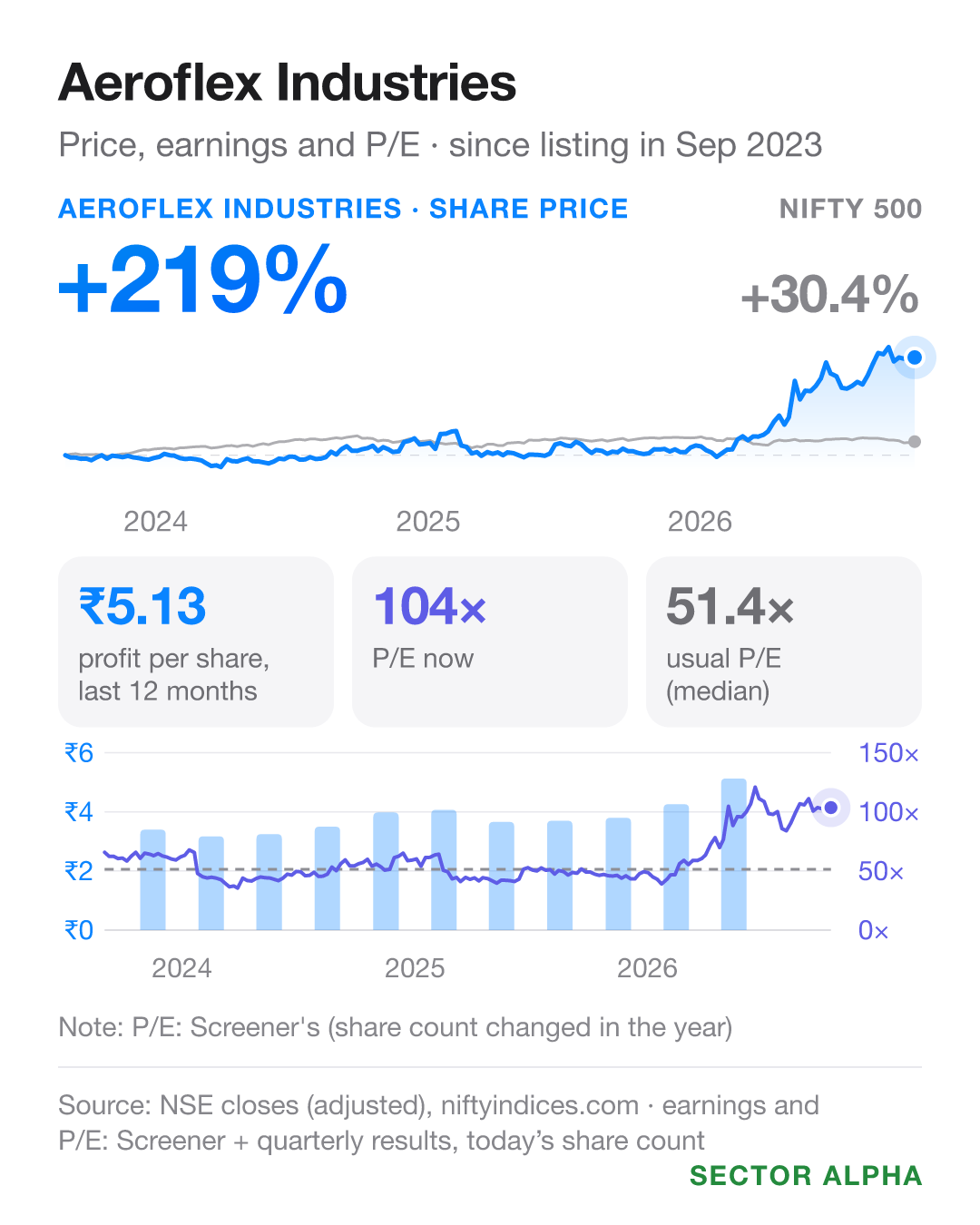
aeroflex makes those cooling skids. ₹32.4 cr of them in april to june, 23% of its sales. the share moved in august and early september after profit nearly tripled, and ended up 28%
it’s taking capacity from 6,000 skids a year to 9,000, and plans 15,000. by my math, at 40-odd a megawatt, 15,000 skids is roughly 375 MW a year
₹19 cr of profit on ₹145 cr of sales. a year ago it was ₹7 cr on ₹84 cr
there’s an income tax demand of about ₹42 cr over an old loan waiver, raised in march. that’s close to a year’s profit, ₹56 cr last year. it plans to appeal and says it doesn’t expect a material hit. still open
the chart has two chapters. by my math, in these three months it was mostly profit, with earnings per share up about 20% and the P/E only a little higher. before that, between 16 january 2026 and 17 july 2026, the P/E had already more than doubled, from 43 to 98. on 16 october 2026 the share was about 104 times a year’s profit, about twice the 51 it usually trades at
powerica
powerica builds generator sets around cummins engines. at the end of july it had ₹900 cr of data centre orders in hand, out of ₹1,700 cr of generator orders, to deliver over 12 to 18 months
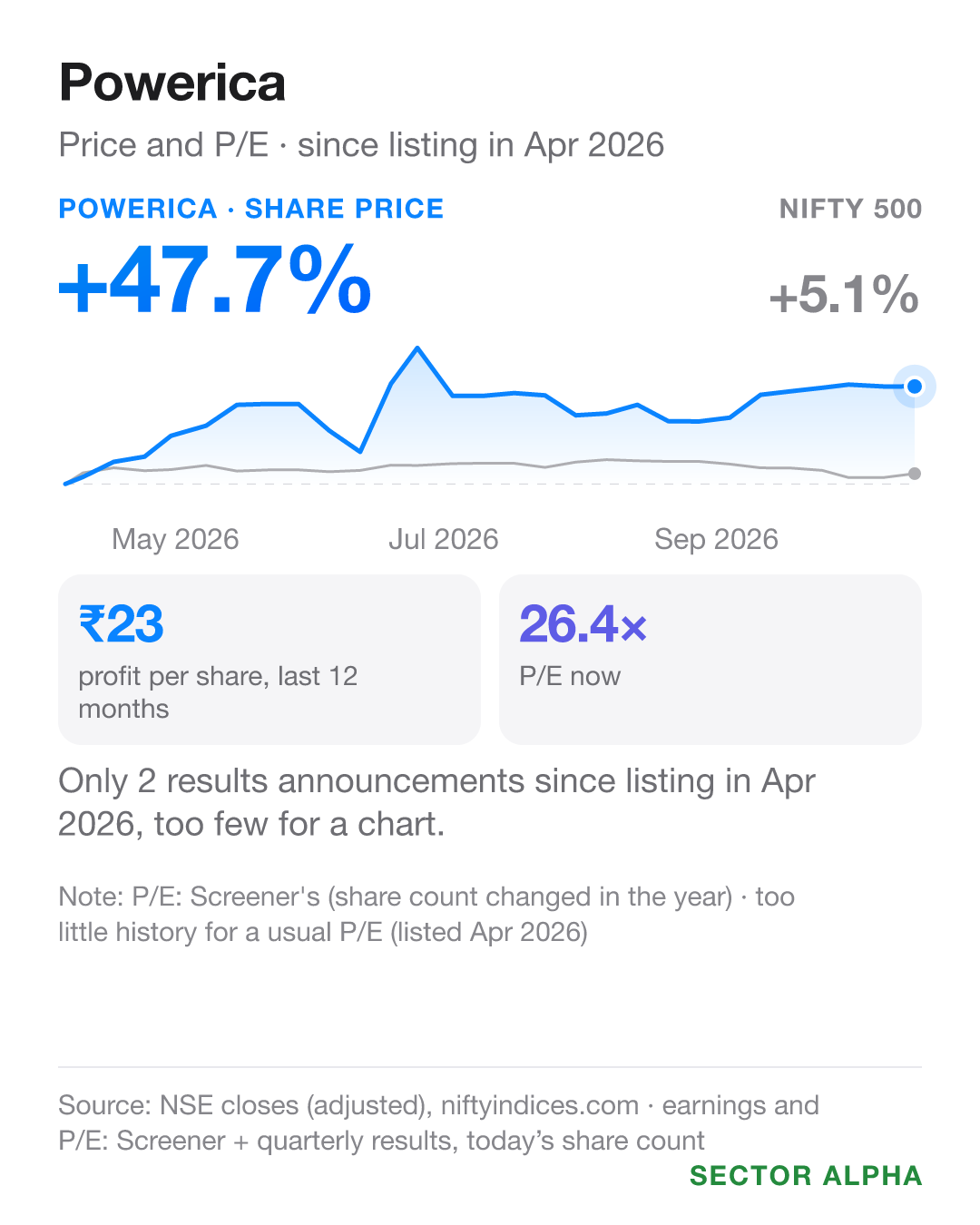
the share went sideways, down 1%, while profit grew 25%, ₹51 cr to ₹64 cr, on sales of ₹780 cr against ₹616 cr
those orders are turning into sales. the generator margin was squeezed in april to june 2026, because older orders were priced before metal costs rose. management expects it to improve from the december quarter, as new orders come in at new prices. that quarter will show it
it only listed in april, so two results is all there is, too few for a chart. profit over the last four quarters was ₹291 cr, against ₹163 cr for the year to march 2025
polycab
polycab lost 10.8%, most of it in the first week of september, after ultratech, india’s biggest cement company, started making wires and cables
its own profit was growing fast. april to june ₹797 cr against ₹600 cr. july to september, out with its 15 october call, ₹990 cr against ₹693 cr
polycab’s data centre business is cable, ₹3.5 cr a megawatt, a bit over half normal power cable and the rest fibre. it doesn’t say how much of its sales that is
by my math, earnings per share rose about 10% in the three months while the P/E slipped from about 47 on 17 july 2026 to 39 on 16 october 2026, a little under the 42 it normally sits at. go back further and the earnings bars climb almost every quarter, with the share climbing alongside
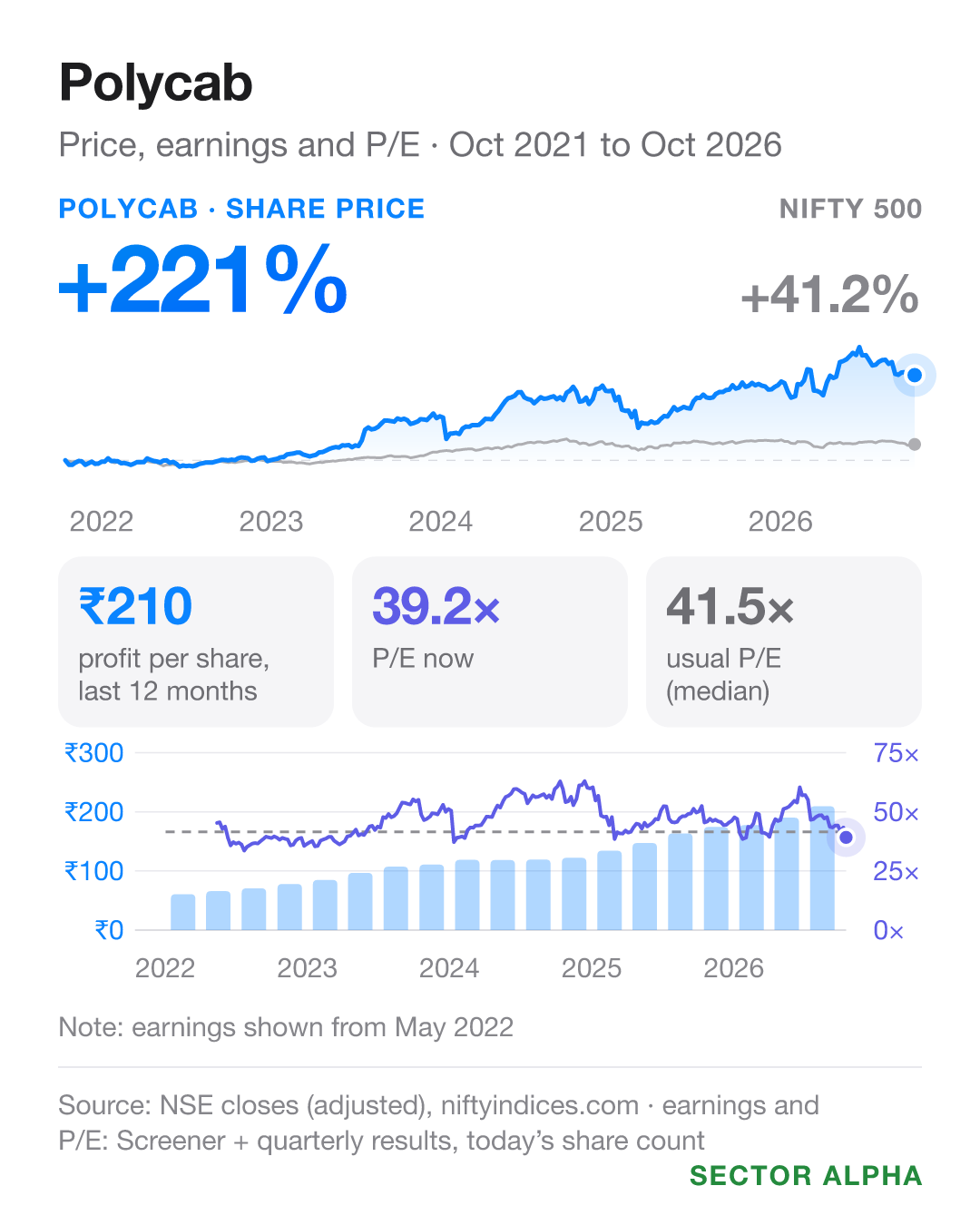
by my count, by 9 october 2026 it had closed six weeks running below its average price of the last 200 days. lots of traders watch that line, and weeks under it usually mean a share has lost favour for a while
blue star
blue star’s data centre business was the good news. about ₹1,500 cr of data centre orders in one quarter, around ₹3,000 cr expected for the full year, and about ₹1,400 cr of revenue from it in the year to march 2027. it wants ₹4,000 cr of yearly data centre sales by march 2029, around a fifth of the company
the room AC business around it was the bad news, and it won. profit fell 15%, ₹121 cr to ₹103 cr. by my math sales grew 13%. it blamed metal costs, a summer that started late and ended early, and old room ACs piled up at dealers
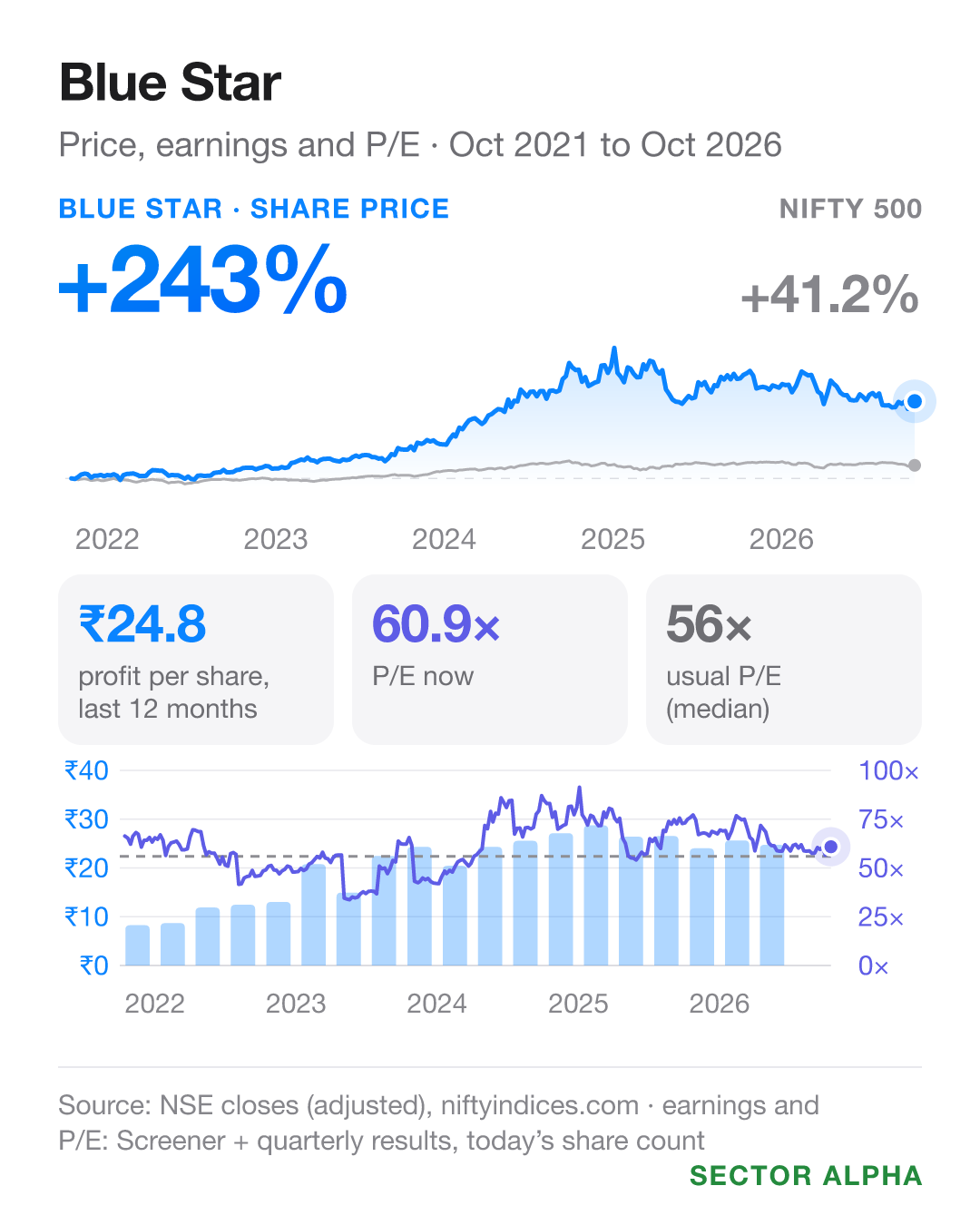
the share fell 10%, almost all of it the week of its 6 august results
this chart is the simple one. by my math, earnings per share fell about 3.5% over the three months and the P/E barely moved, 62 on 17 july 2026 to 61 on 16 october 2026, against 56 normally. the price followed profit down
kirloskar oil engines
kirloskar oil engines won its first big data centre order in april to june, about 192 MW. it didn’t give a rupee figure
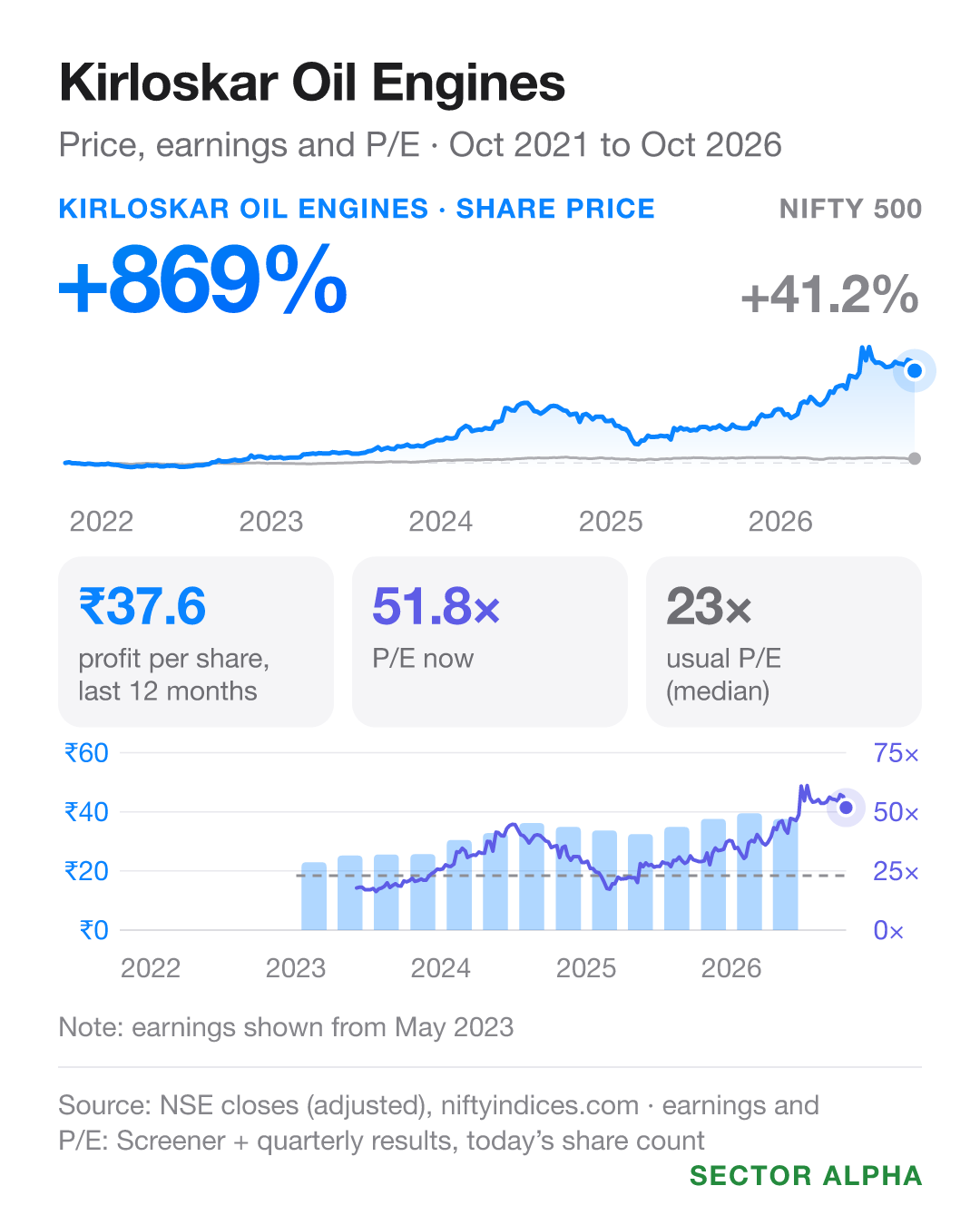
profit still fell 20%, ₹139 cr to ₹111 cr, on sales up 13.5%. the share ended down 15.5%, about half of it in the week to 16 october 2026
by my math, though, a year’s profit per share slipped only about 5%. most of the fall was the P/E, about 56 on 17 july 2026 down to 52 on 16 october 2026. that’s still more than twice the 23 it has typically traded at
cummins india
cummins india fell 17.6%, more than any other builder. it slid from its 5 august results, when profit came in flat, ₹609 cr against ₹604 cr, and its managing director, Shveta Arya, said she was leaving
it also gave the biggest data centre number of anyone
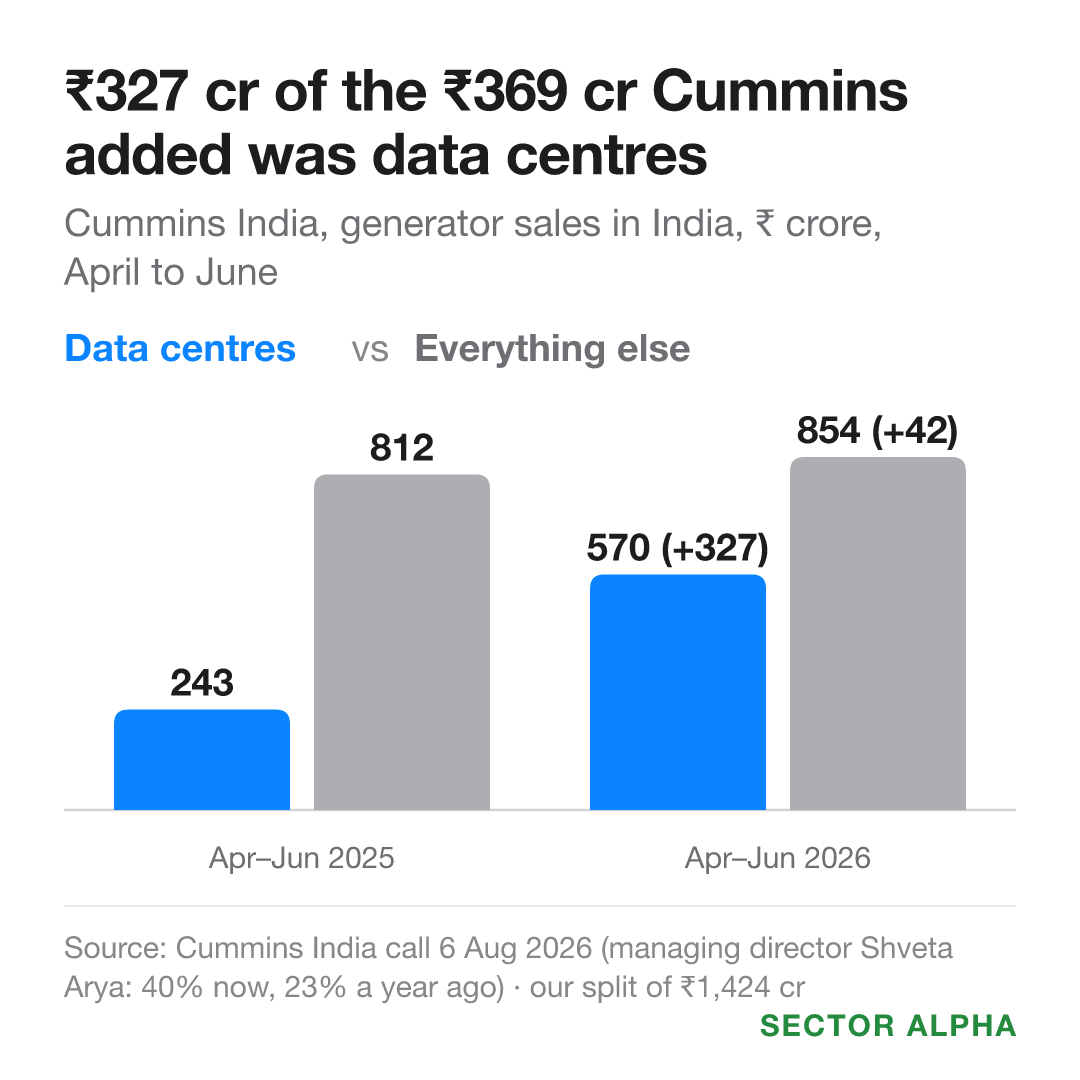
cummins sold ₹1,424 cr of generators in india in april to june, up 35%. an analyst asked how much of that went to data centres. the managing director said 40%. a year earlier it was 23%
by my math, data centre sales went from about ₹243 cr to about ₹570 cr, and everything else it sells for power in india went from about ₹812 cr to ₹854 cr
by my math, of the ₹369 cr it added, ₹327 cr was data centres, and the rest grew about 5%
the whole company sold 18% more, ₹3,426 cr against ₹2,907 cr. profit from operations went the other way, ₹624 cr down to ₹616 cr
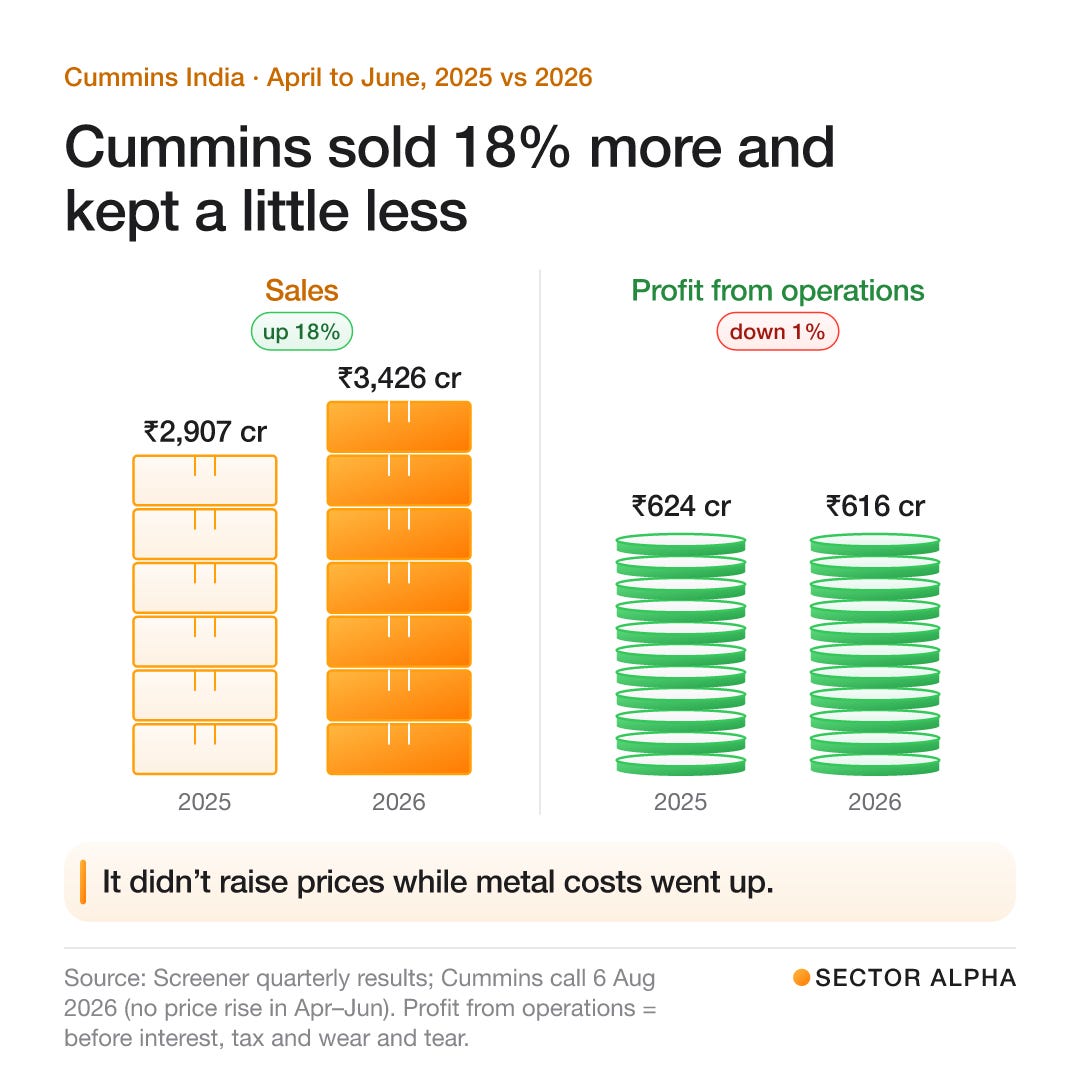
it didn’t raise prices while metal costs went up. data centre pricing, she said, is “an order-to-order discussion with customers”
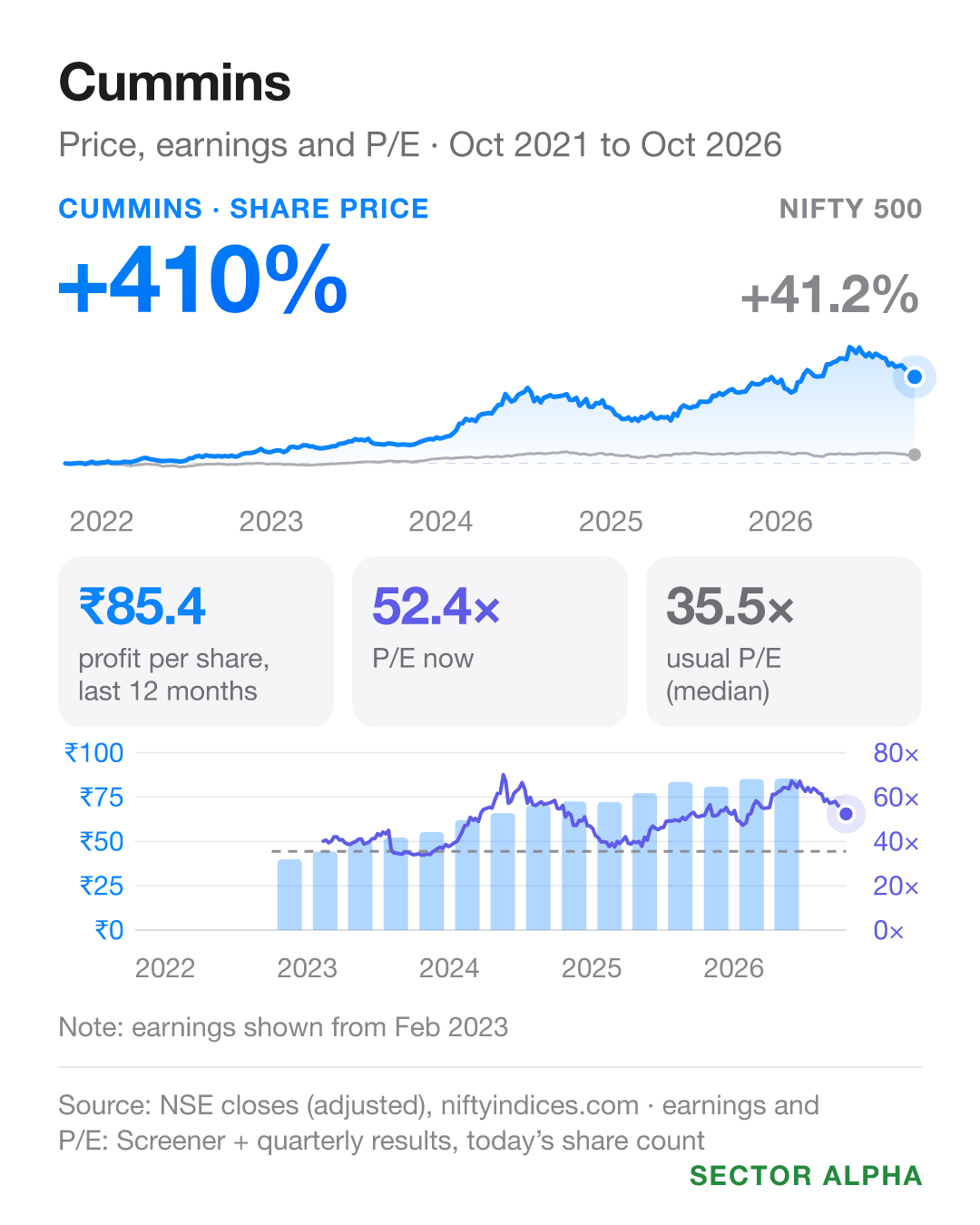
by my math, earnings per share didn’t move in the three months, about ₹85 both times. the whole fall was the P/E, 62 on 17 july 2026 down to 52 on 16 october 2026, still well above where it usually sits, 35.5. the earnings bars kept rising. only the P/E line turned
cummins said it faced “a little bit of supply constraint”. quality power said it is “still struggling” on data centre bids of around $100 million, because its delivery time is about 12 months
in a building rush, whoever makes the part everyone is queuing for can hold its price. being busy doesn’t do that. the supplier who can’t deliver just loses the bid
power, paid for years
cleanmax
cleanmax sells clean power to data centres and says it has about 35% of the big cloud companies’ power business in india. of the power names, it’s the one data centres are already paying
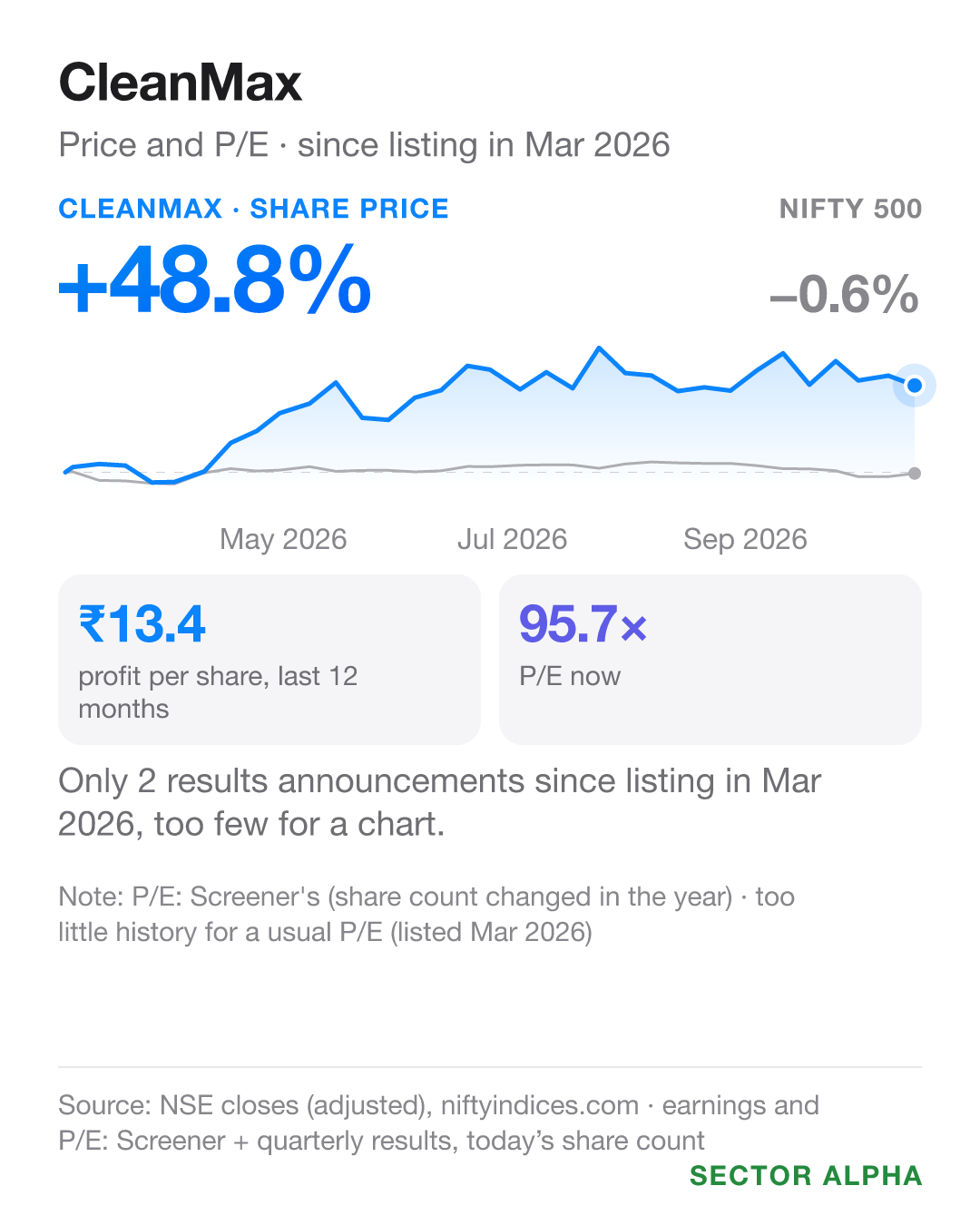
it listed in march, so the chart is short. yearly profit nearly doubled, ₹86 cr in the year to march 2026 to ₹157 cr over the last four quarters. the share went sideways, down 1%
adani energy solutions
adani energy solutions was the worst of the twelve, down 19.2%. most of it went in the first week of september, when adani group shares fell together
profit grew, ₹539 cr to ₹1,237 cr in april to june, and data centres had little to do with it. in april to june it handled about 13 billion units of electricity. asked how much of that comes from data centres, the answer was “very negligible”. one contract, about 20-25 MW
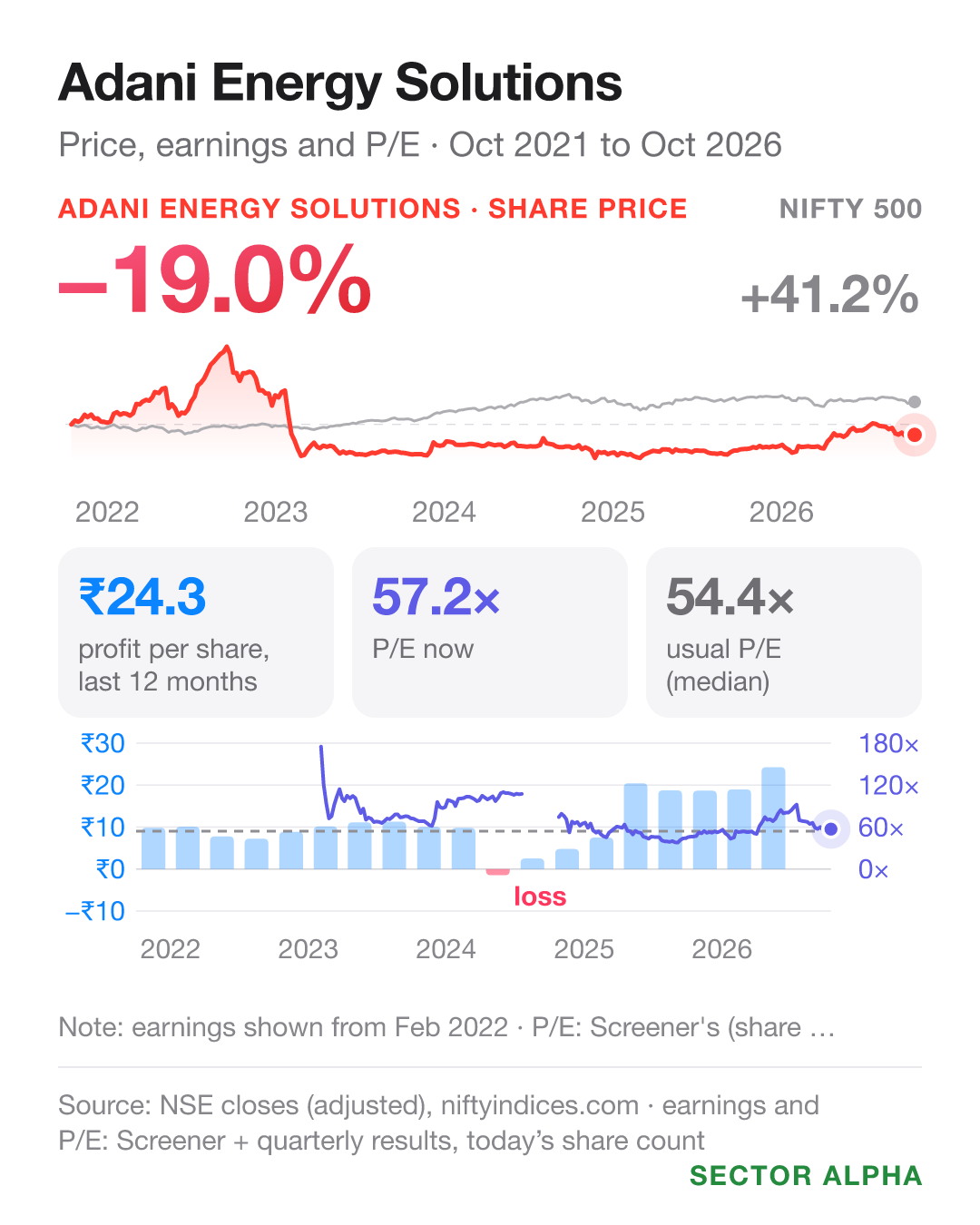
on 17 july 2026 people paid about 92 times a year’s profit for it. by 16 october 2026, 57, even though earnings per share rose about 28%. that’s around where it has mostly been, 54
the grid is still waiting. GE vernova T&D said government estimates put AI, data centres and electric vehicles together at about 30 GW of extra peak demand over the next 5 to 6 years. a lot of those lines and transformers haven’t been ordered yet
the owners and their chips
E2E networks
E2E networks rents out computing time on AI chips. every rupee it makes is data centre money. the share jumped after its 21 july results showed a profit where there had been a loss, and it finished the three months as the best of the twelve
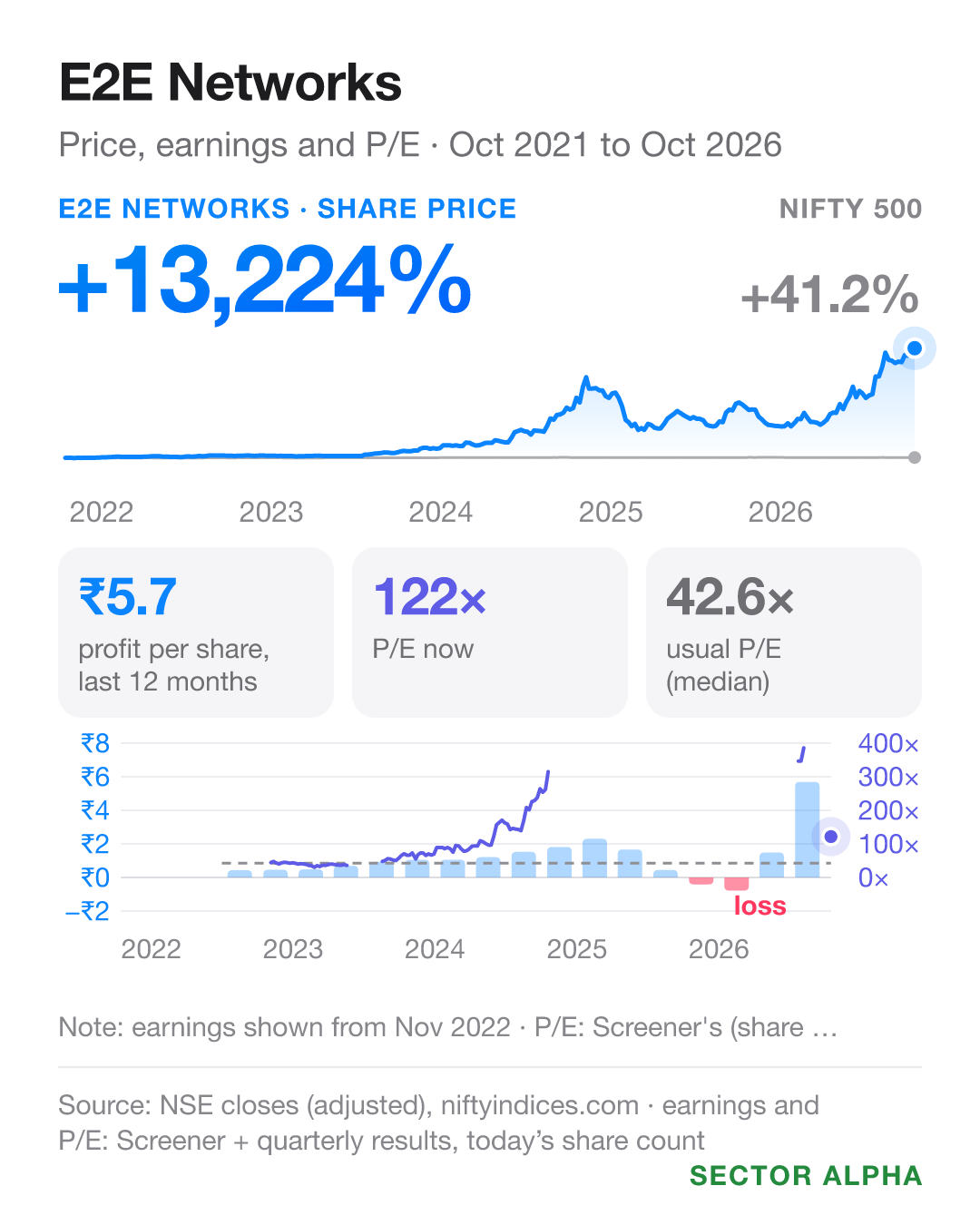
april to june profit was ₹44 cr, from a ₹3 cr loss a year earlier
july to september landed right at the end of this window. revenue ₹224 cr from ₹44 cr, and the ₹73 cr profit
the company put it down to its new blackwell chips, nvidia’s newest generation, plus fuller use of the chips it had and higher prices
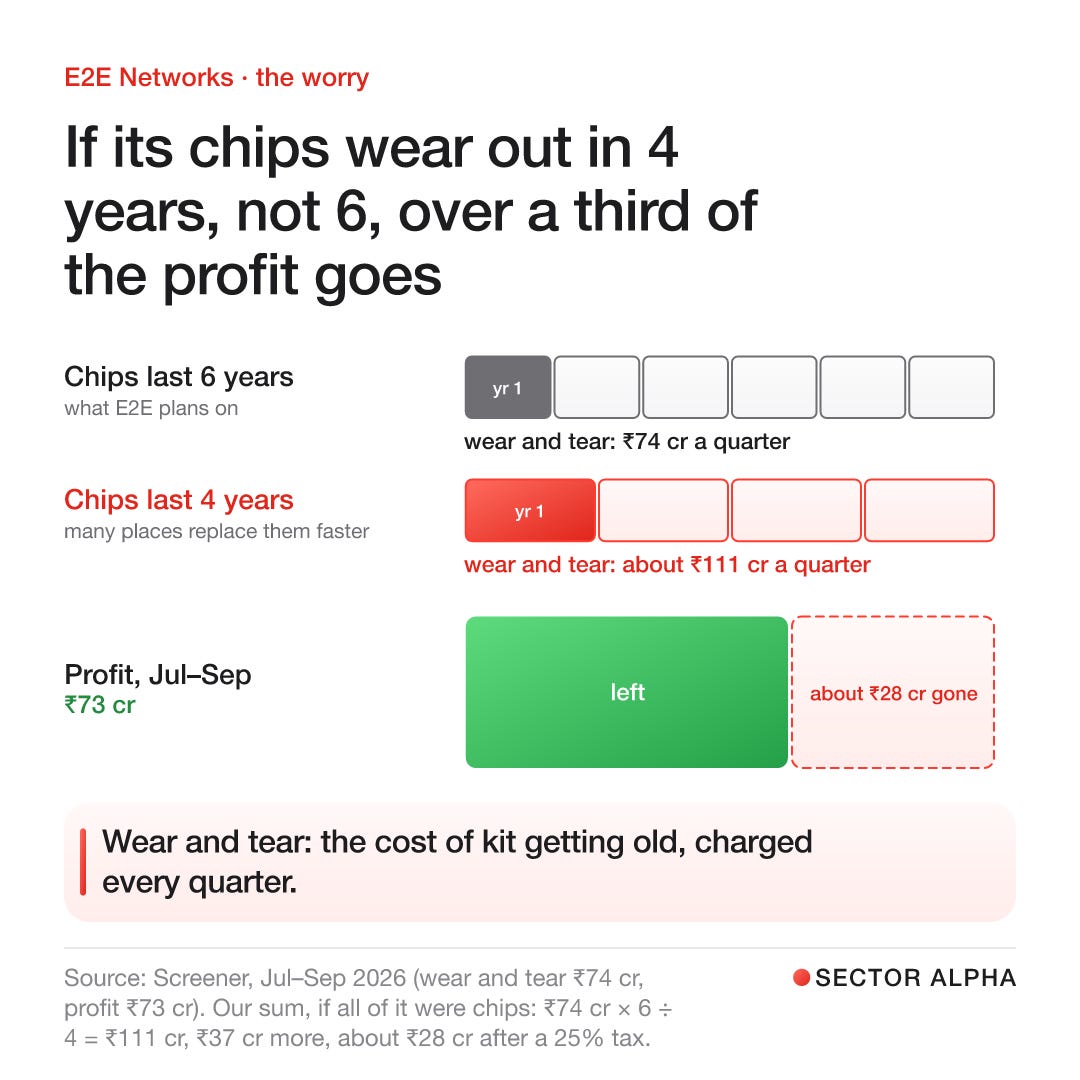
the chips are what bother me. e2e’s founder said they plan on at least a six-year life for every generation of chips. plenty of places replace them faster
if the ₹74 cr of wear-and-tear charge e2e took that quarter were all chips, and they lasted four years instead of six, the charge would be about ₹111 cr. by my math that’s ₹37 cr more. by my math, after tax roughly ₹28 cr, over a third of the ₹73 cr profit
and asked in july for a target for its monthly revenue, the founder said it doesn’t give one
netweb
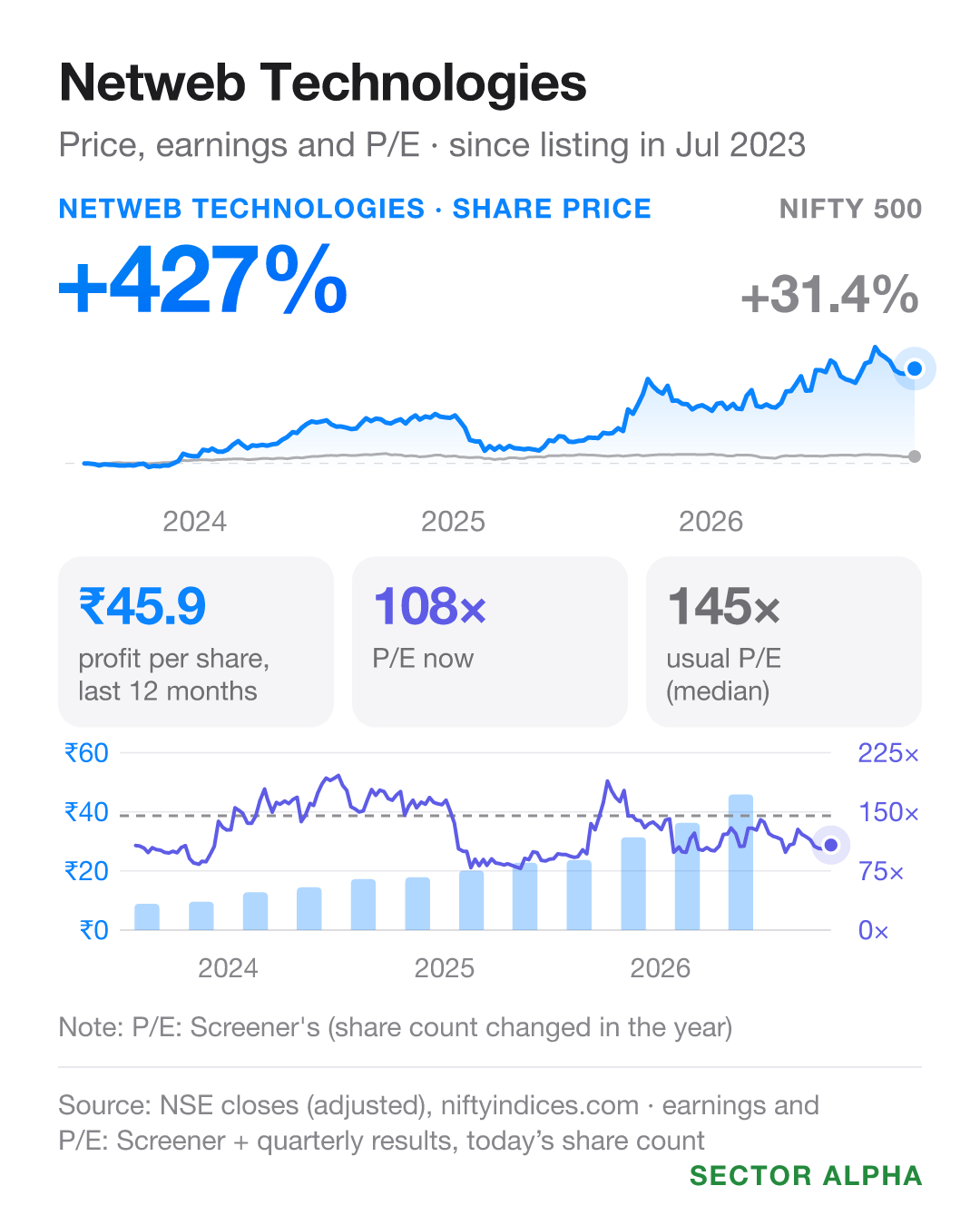
netweb builds the high-end computers and AI servers that go inside, without saying how much of it is for data centres. sales nearly tripled, ₹301 cr to ₹820 cr, up 172%, and profit went from ₹30 cr to ₹85 cr
the share rose after those results on 28 july, then gave most of it back in september. up 9.9% for the three months
delivery is slipping. in july it said an order takes 16 to 20 weeks. it used to say 8 to 12
netweb’s share rose less than its profit. by my math, earnings per share up about 26% in the three months, the P/E down from about 117 on 17 july 2026 to 108 on 16 october 2026. since listing in 2023 it has mostly sat around 145
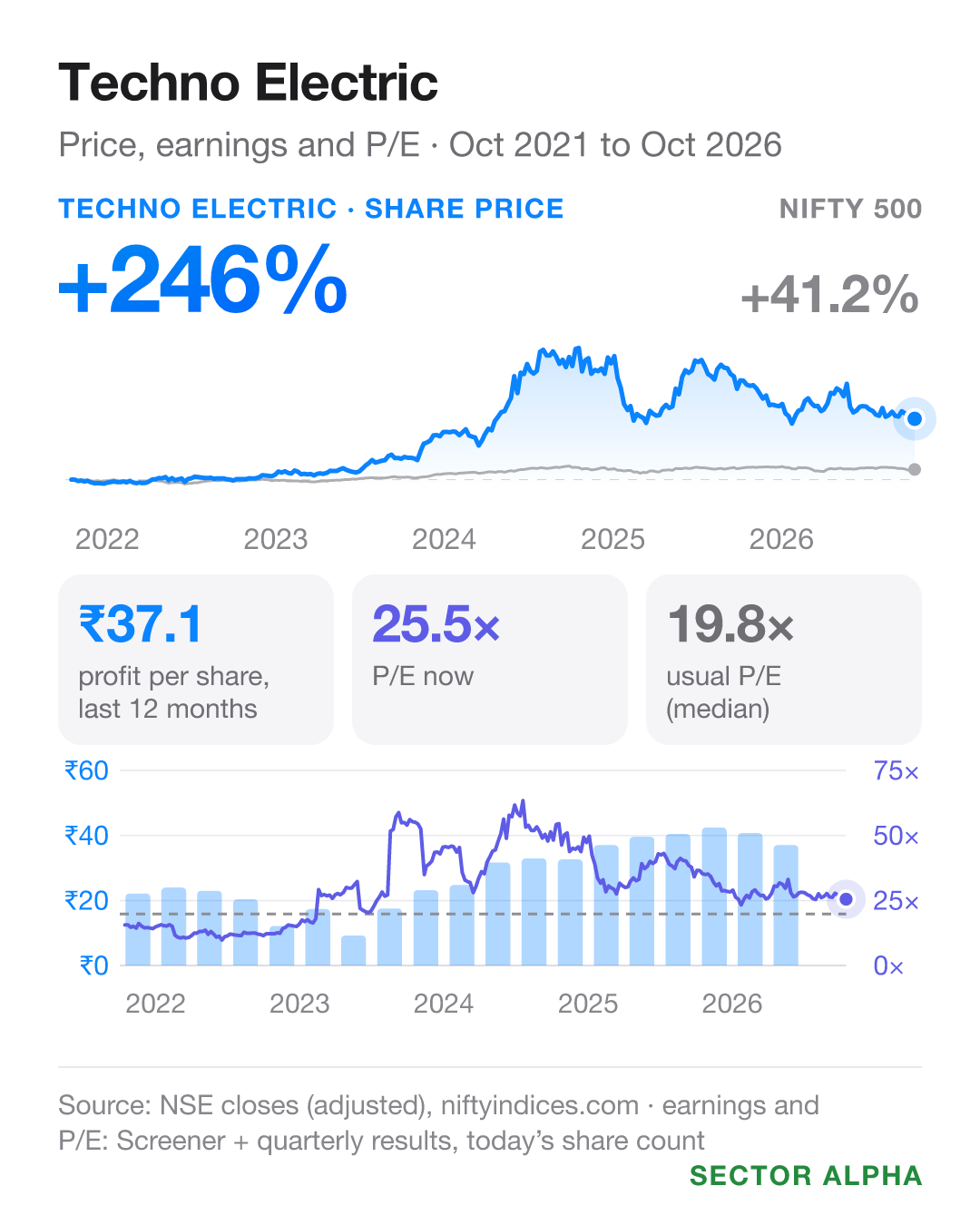
techno electric
techno electric builds power systems, and lately data centres that it also runs. it fell 8.4%, mostly the week of its 12 august call, after profit dropped
april to june profit was ₹93 cr against ₹136 cr. operating profit actually rose a little, ₹92 cr to ₹100 cr, so the drop came from further down the page
its data centre plans run slower than people hoped. in may it said a first 0.5 MW piece at noida would start by june 2026. in august it said noida got its building approval in july and is working towards the final quarter of the year to march 2027, without mentioning the 0.5 MW piece. it still hopes for about ₹40 cr of data centre sales that year. in may an analyst said they used to aim for ₹100 cr. management said it never gave that number
here the share followed profit. by my math, earnings per share down about 9%, the P/E from about 27 on 17 july 2026 to 25.5 on 16 october 2026, still a bit above 20, where it usually is
the other two listed owners went opposite ways. black box up 4.5%, anant raj down 10.8%
none of the owners i read is short of demand. netweb’s delivery time doubled and techno is still waiting on noida. they’re short of chips and time
who gets pushed back
a hospital or a factory that needs a generator can end up waiting behind a cloud giant
and anyone counting an order before it’s booked gets burnt. GE vernova T&D got shareholder approval for a US data centre order of up to ₹1,300 cr. by august none of it was booked. the customer had changed the location and the state
what to look up in november
cummins reports july to september on 4 november. open the call transcript on its website and search “data center”. if it’s near 40% again, the queue is real. if it’s back to 25-30%, april to june was a few big sites landing at once
for any builder, put sales growth next to operating profit growth on the results page. sales up with profit flat says the data centre work pays no better than the old work
for the owners, watch the wear-and-tear line. if it grows faster than sales, the chips are ageing early
how this could go wrong
most of the money behind the chips is american cloud companies. ben inker at GMO said in october that AI spending is crowding out the rest of the US economy and the bubble pops before the cycle turns. if they slow down, the queue empties from the back, and power and the owners feel it first
or the split flips. if cummins and kirloskar show profit rising with sales in july to september, the builders are keeping more of each sale after all. and if the listed owners report a quarter where sales rise but profit falls, the demand has stopped reaching them
every data centre company, ranked, with each one’s quarters, is on my page: sectoralpha.in/sectors/data-centre
— Roshan, Sector Alpha