


Not SEBI registered. Not investment advice. For your own research only.
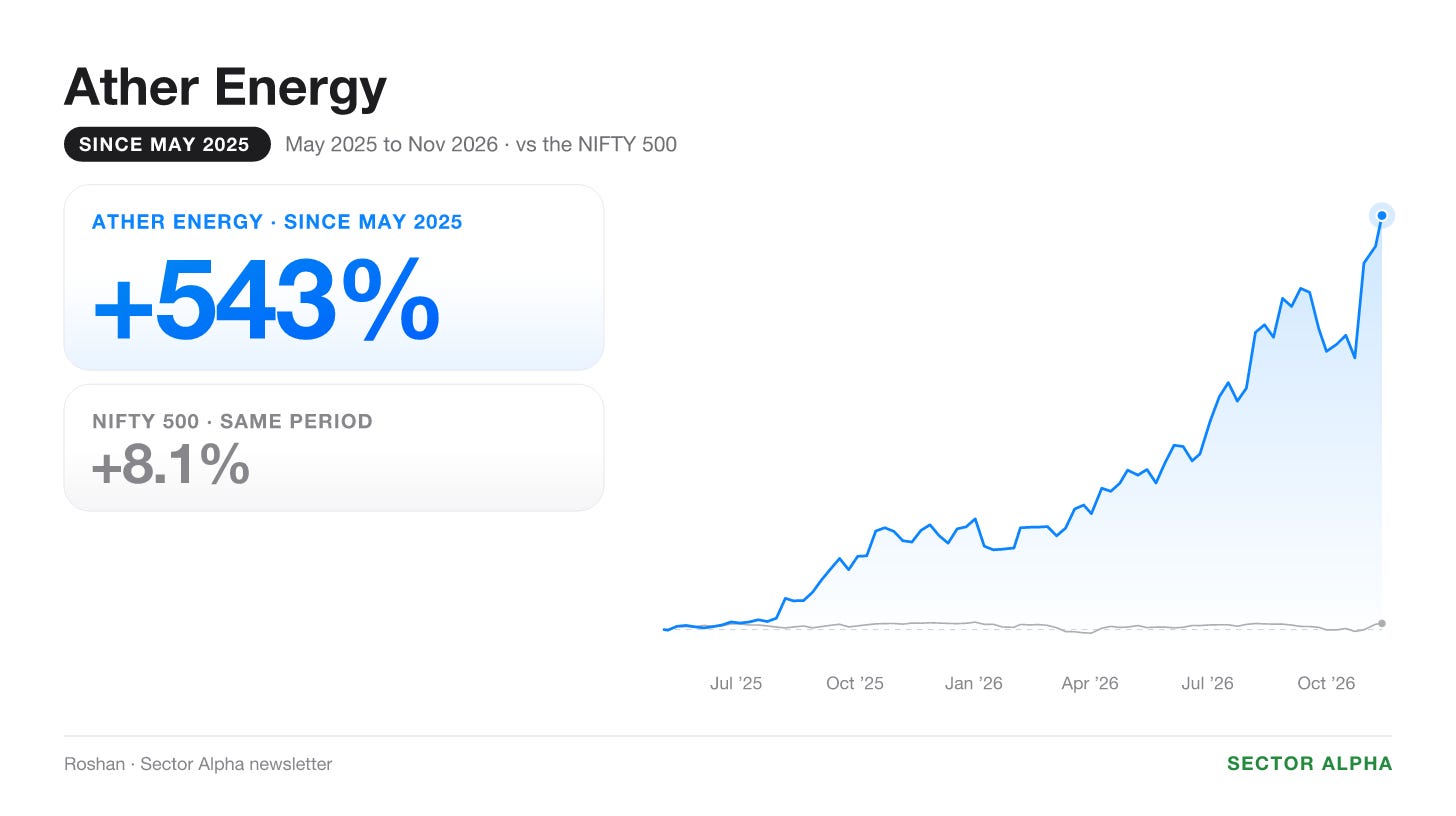
Ather designs and makes electric scooters.
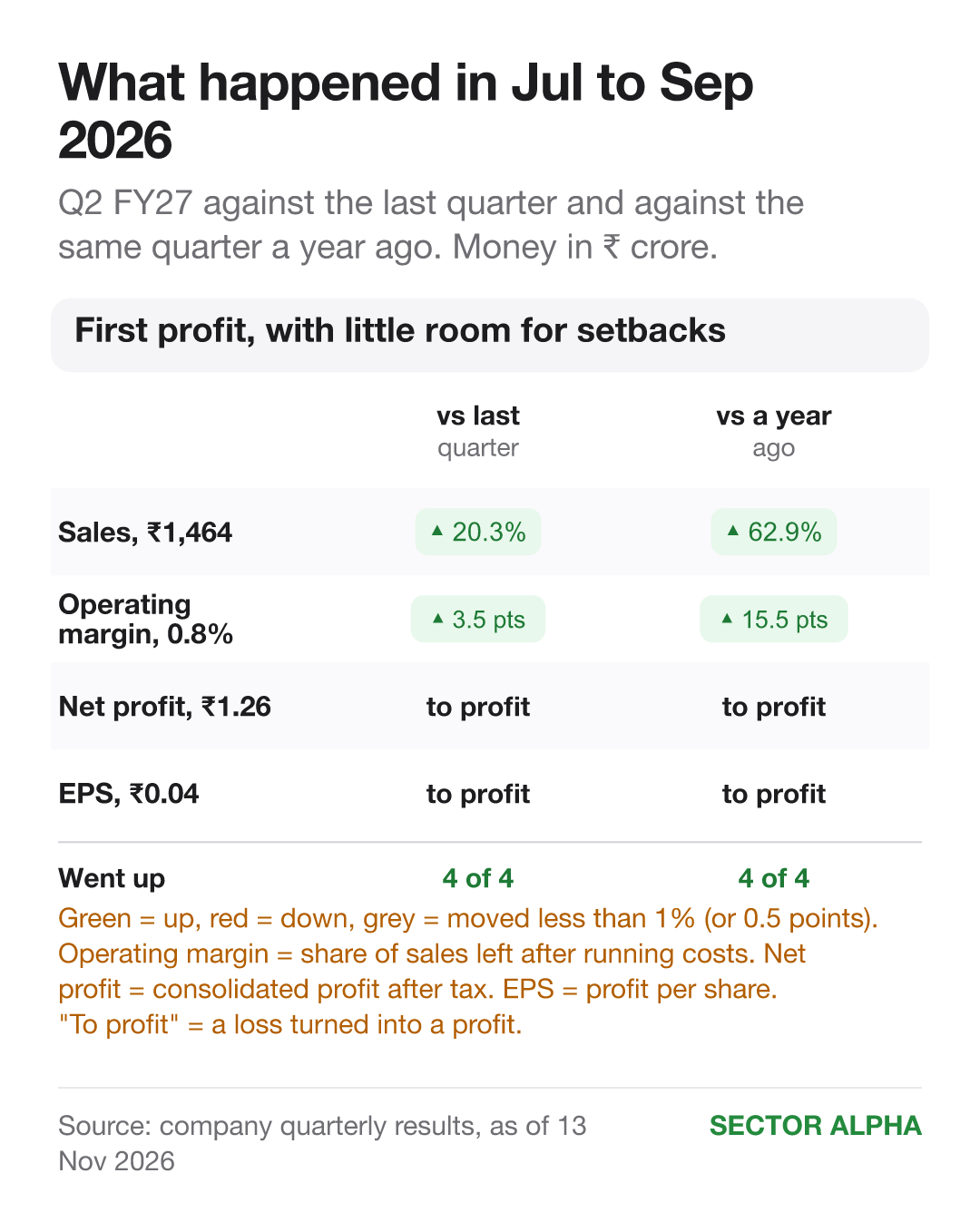
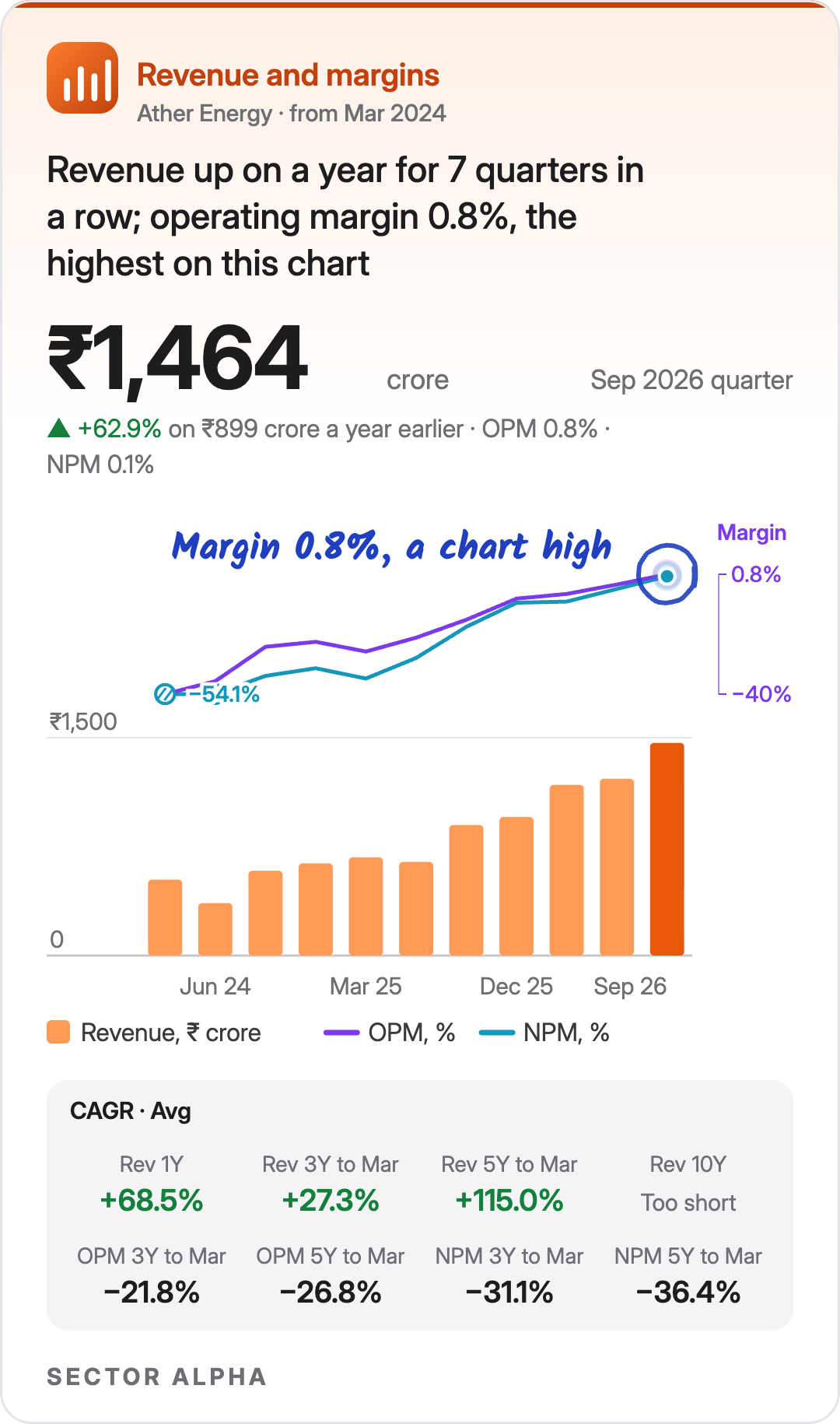
In Jul to Sep 2026 it made a profit for the first time. A tiny one, but a profit.
The reason: it sold far more scooters, each at a higher price, so sales grew faster than costs.
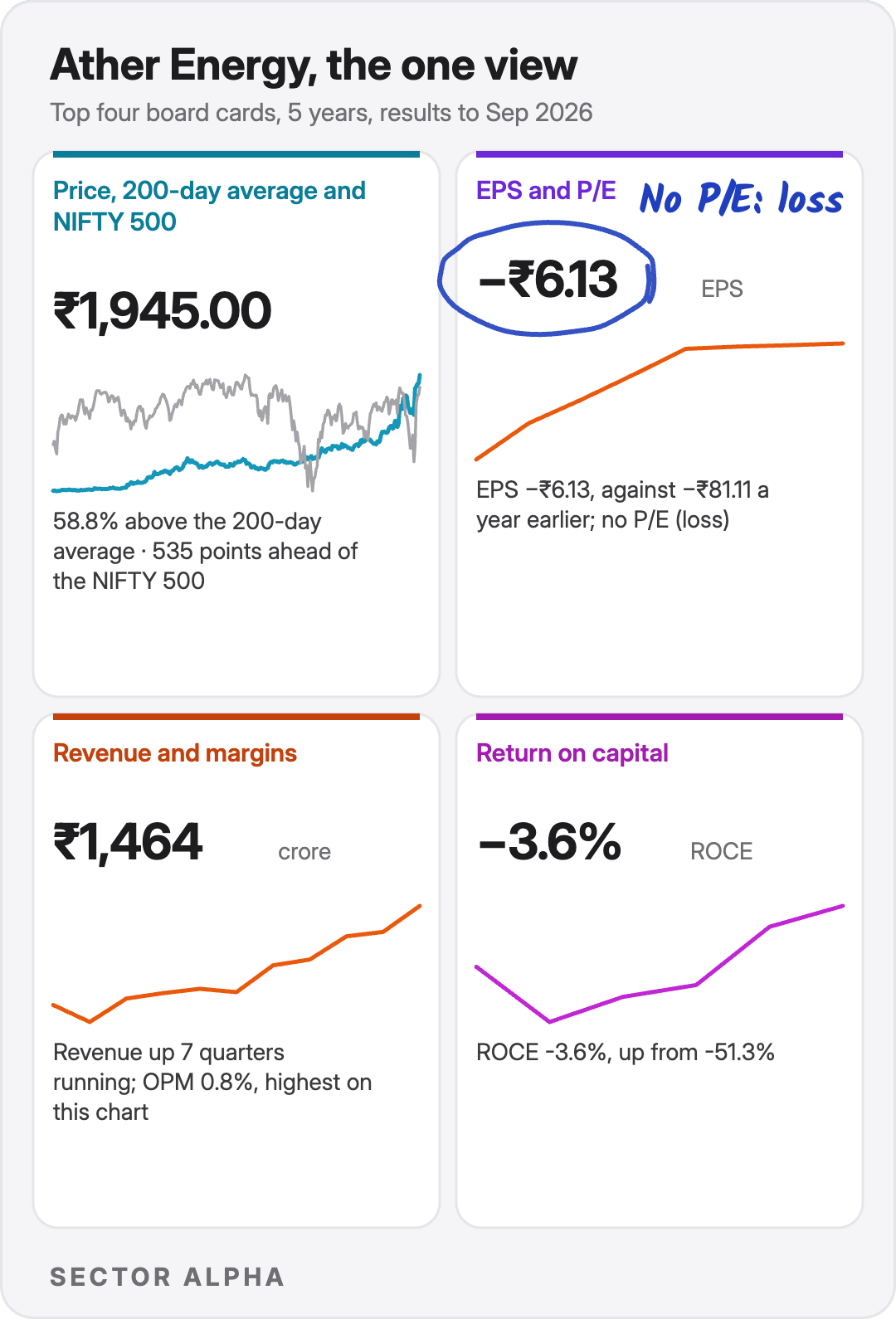
From 13 Nov 2025 to 13 Nov 2026, Ather’s share price rose 204.3%. The NIFTY 500 fell 0.3% over the same dates.
Earnings and P/E
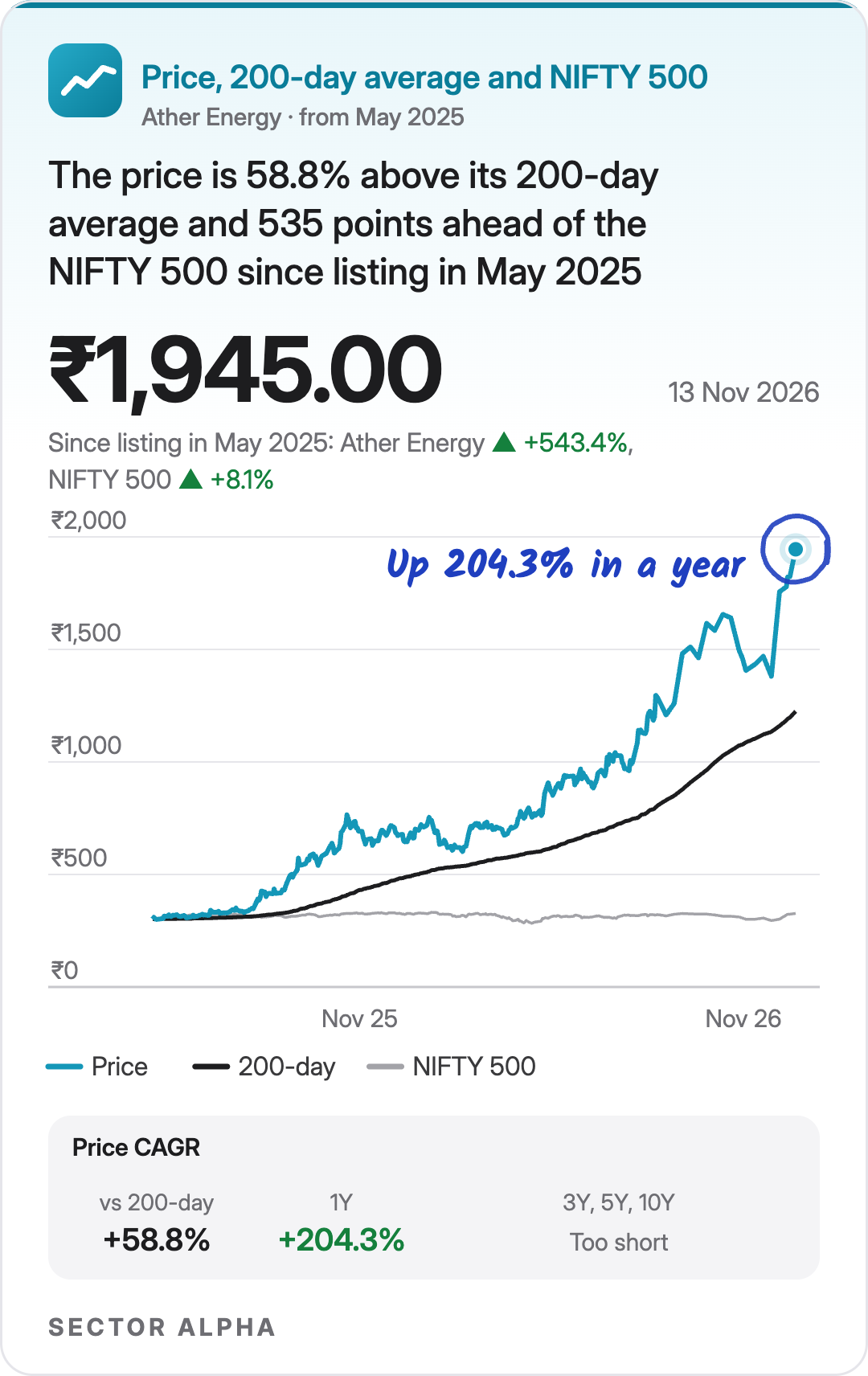
Loss per share, last four quarters: shrank sharply, from about ₹81 to about ₹6.
Share price, same year: up 204.3%.
Ather still made a loss over those four quarters, so there is no P/E on 13 Nov 2026. Part of the shrink is simply more shares: the 2025 listing and the ₹1,300 crore share sale to funds spread the loss over many more shares.
How Ather compares
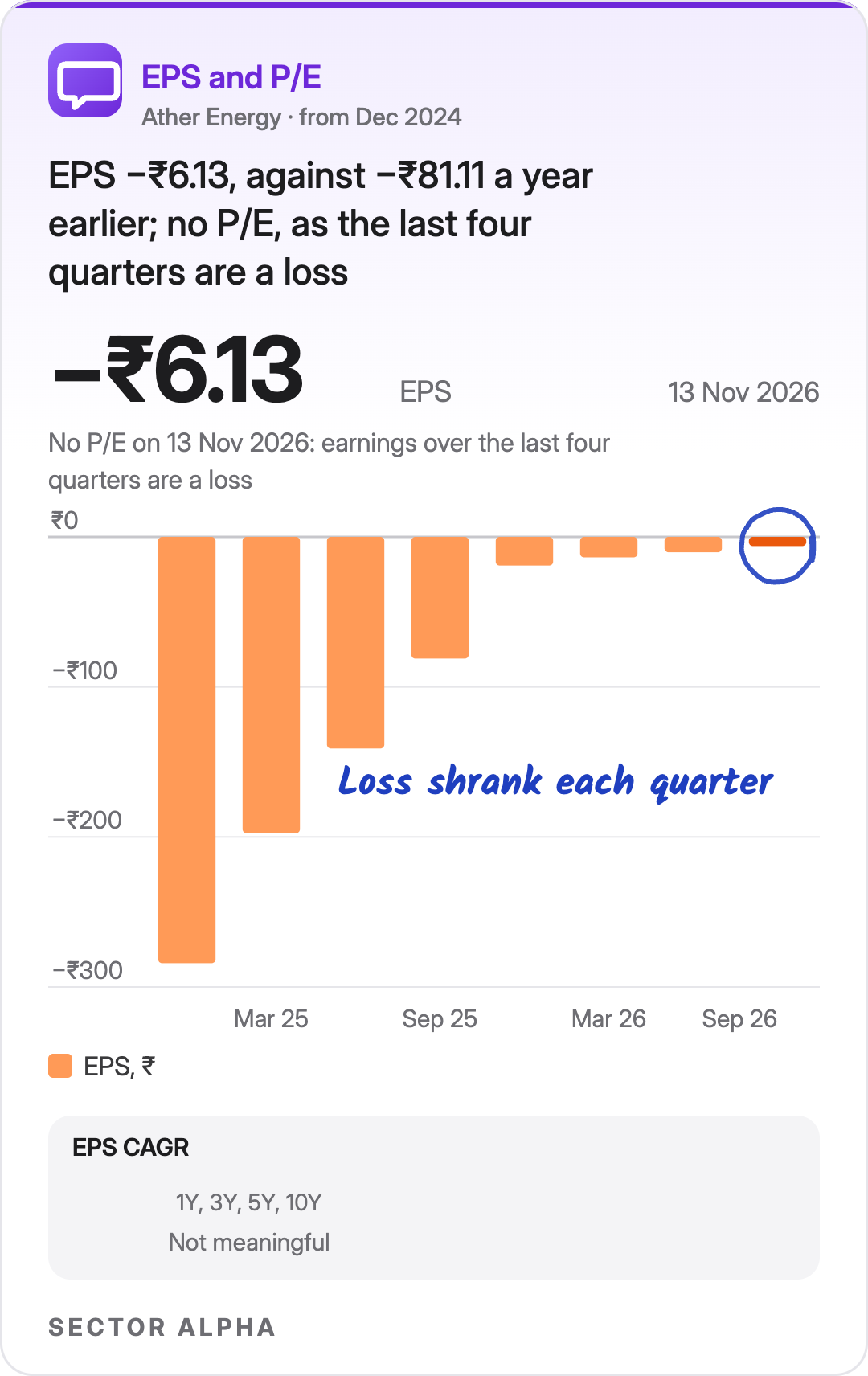
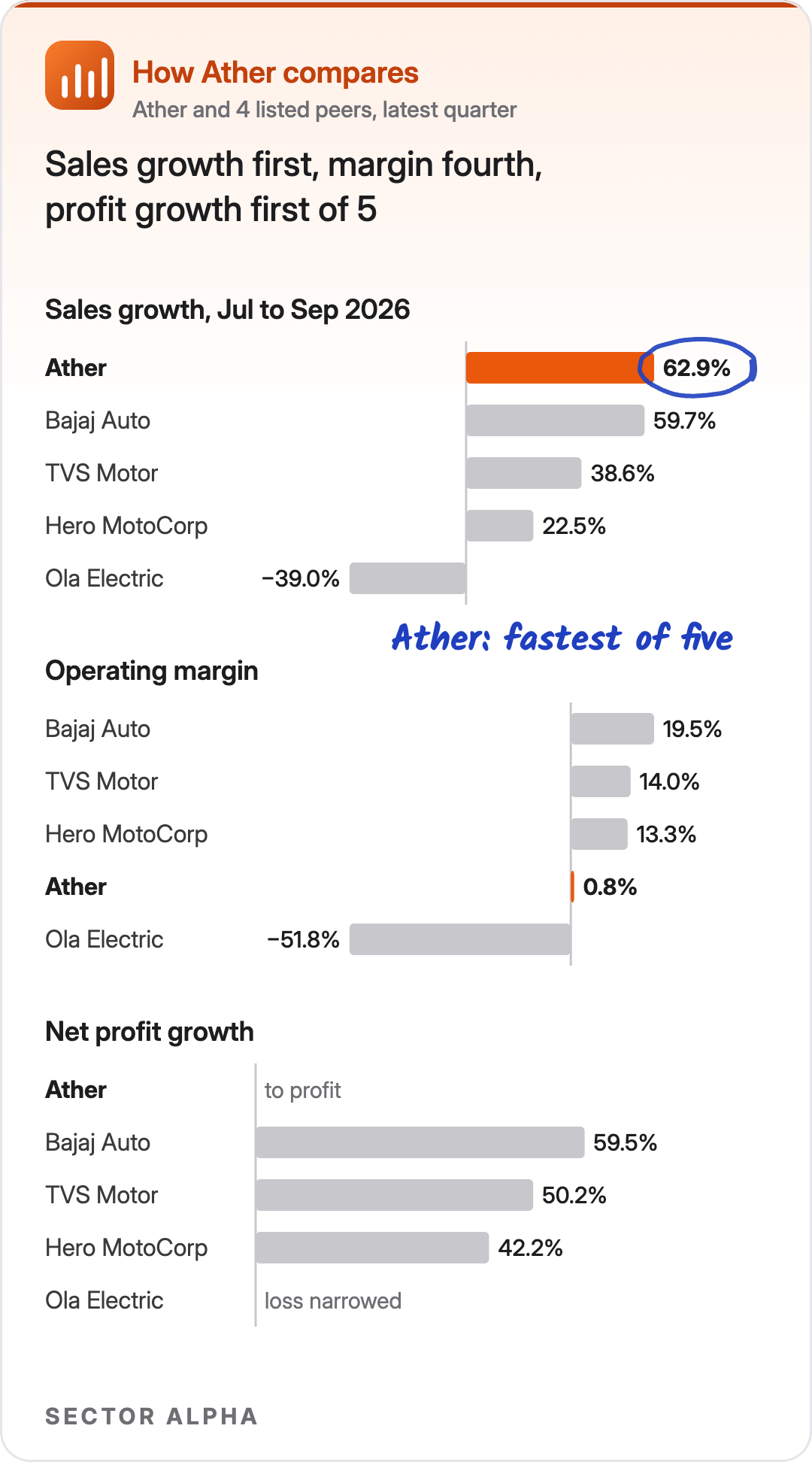
I compare Ather with Ola Electric, TVS Motor, Bajaj Auto and Hero MotoCorp.
Fastest sales growth of the five, just ahead of Bajaj.
Fourth of five on margin. Only Ola is behind.
The only one of the five to turn a loss into a profit.
By my read, the margin gap is about scale: Bajaj, TVS and Hero run big, long-paid-off plants and petrol models, while Ather has only just covered its costs.
The deep dive
What is happening
Sales in Jul to Sep 2026 rose against both Apr to Jun 2026 and a year earlier. Management gave three reasons on the 26 Oct 2026 call:
More scooters. Ather shipped about 93,000 scooters in Jul to Sep 2026, against 65,000 a year earlier, because the Hosur plant made more each month.
Higher price per scooter. The average showroom price rose by ₹14,000 from Jan to Mar 2026, through price rises and selling more of the pricier versions.
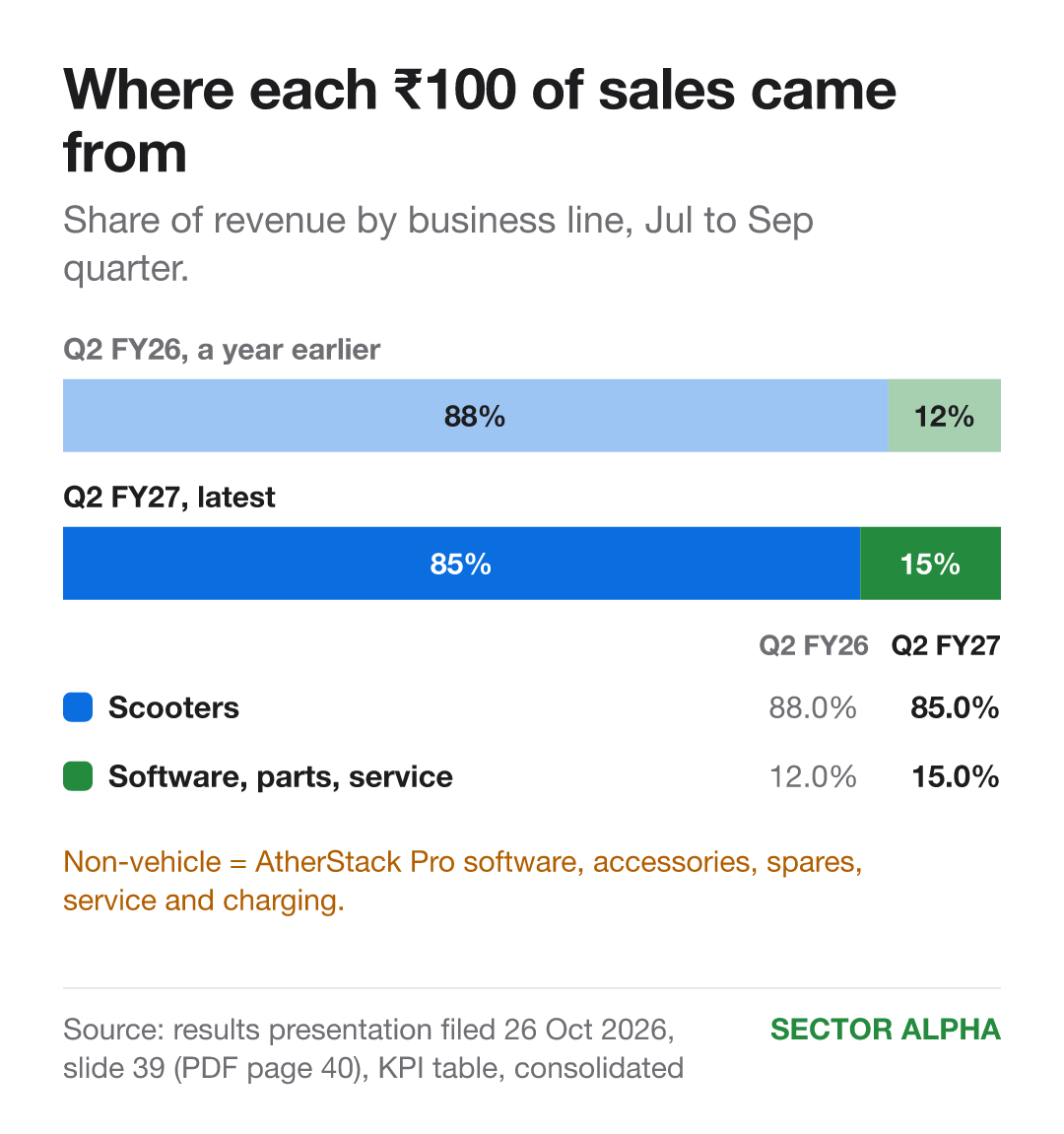
More extras. 94% of buyers paid for AtherStack Pro, its paid software, and income from software, parts and service grew as a share of sales.
The profit itself was only ₹1.26 crore on ₹1,464 crore of sales. The CEO warned it can swing back.
What it makes
Three scooter lines: the sporty 450, the family Rizta and the new Konarc. It also runs Ather Grid, its fast charging network.
Why the extras matter: they earn far more per rupee than scooters. The CEO said AtherStack Pro keeps about 80% to 90% of its price as gross profit, spare parts about 40% to 45%, and accessories about 30% to 40%.
Konarc launched on 29 Aug 2026.
It is built to win petrol scooter buyers: a 14-inch front wheel, metal body, a centre stand and service once a year.
Why margins rose
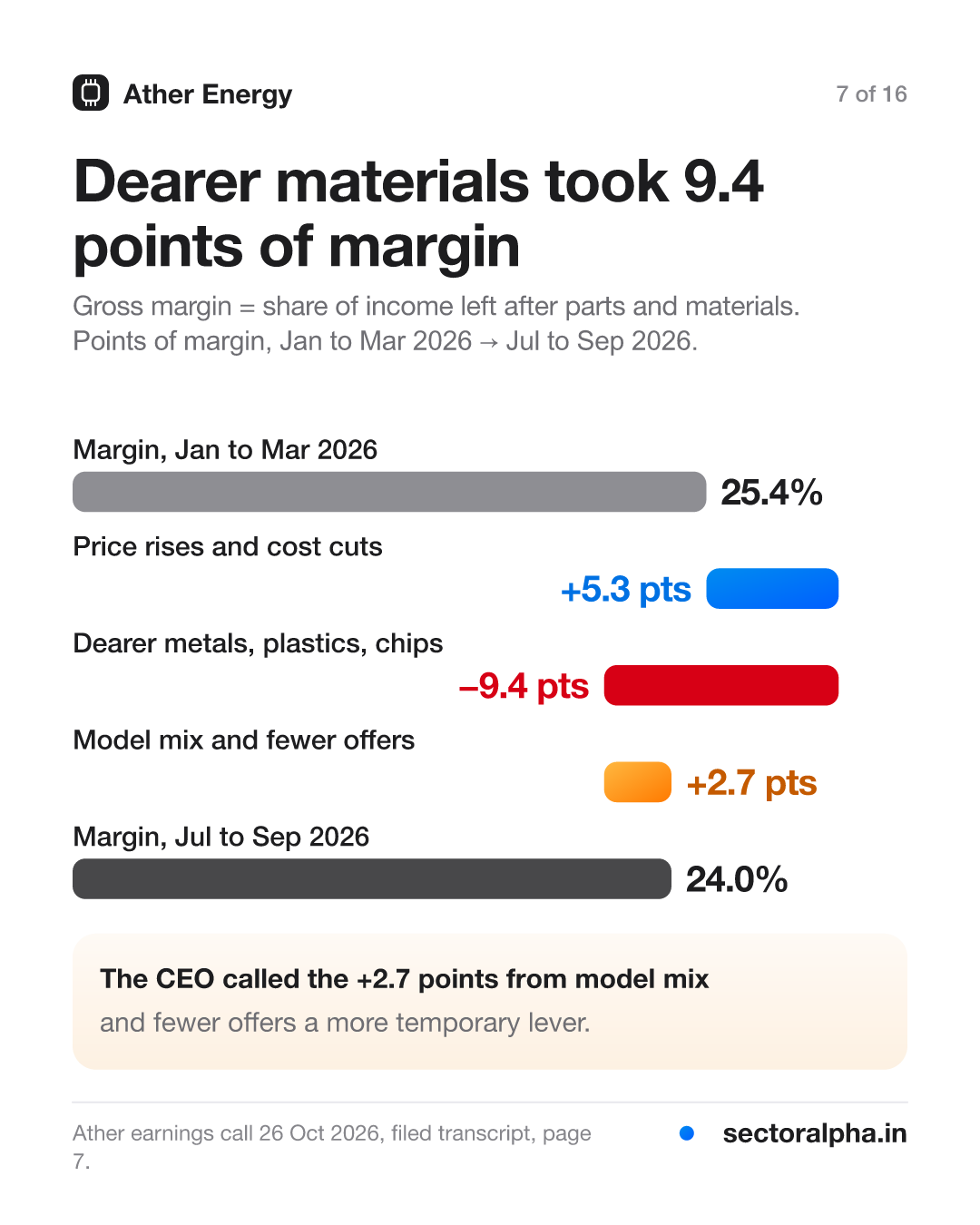
Gross margin, the share of each sale left after materials, rose against Apr to Jun 2026 but is still below Jan to Mar 2026. Three forces pulled on it:
Pulling it up, and lasting: price rises that stuck, and cheaper designs and parts.
Pulling it down: aluminium, copper, plastics and memory chips all cost more. Management blamed the Hormuz crisis for plastics and aluminium, and US stockpiling and AI demand for copper.
Pulling it up, but temporary: with demand above supply, Ather sold more of its richer versions and cut back offers. The CEO called this a lever it uses only while supply is short or costs are this high.
Ather is not raising prices again in Oct to Dec 2026, the CEO said. The next help is Konarc: like for like it already costs a few thousand rupees less to build than a Rizta.
Each quarter vs a year earlier
Sales: up on a year in all 7 quarters that can be compared; the listed history is short. The levers are a plant making more each month and higher prices.
Margin: up on a year in all 7. The CEO called it operating leverage: fixed costs spread over many more scooters.
Profit: up on a year in all 7, from deep losses to a first small profit in Jul to Sep 2026.
The company’s own margin figure is higher than mine because it counts other income. Without it, Ather only just broke even on running costs.
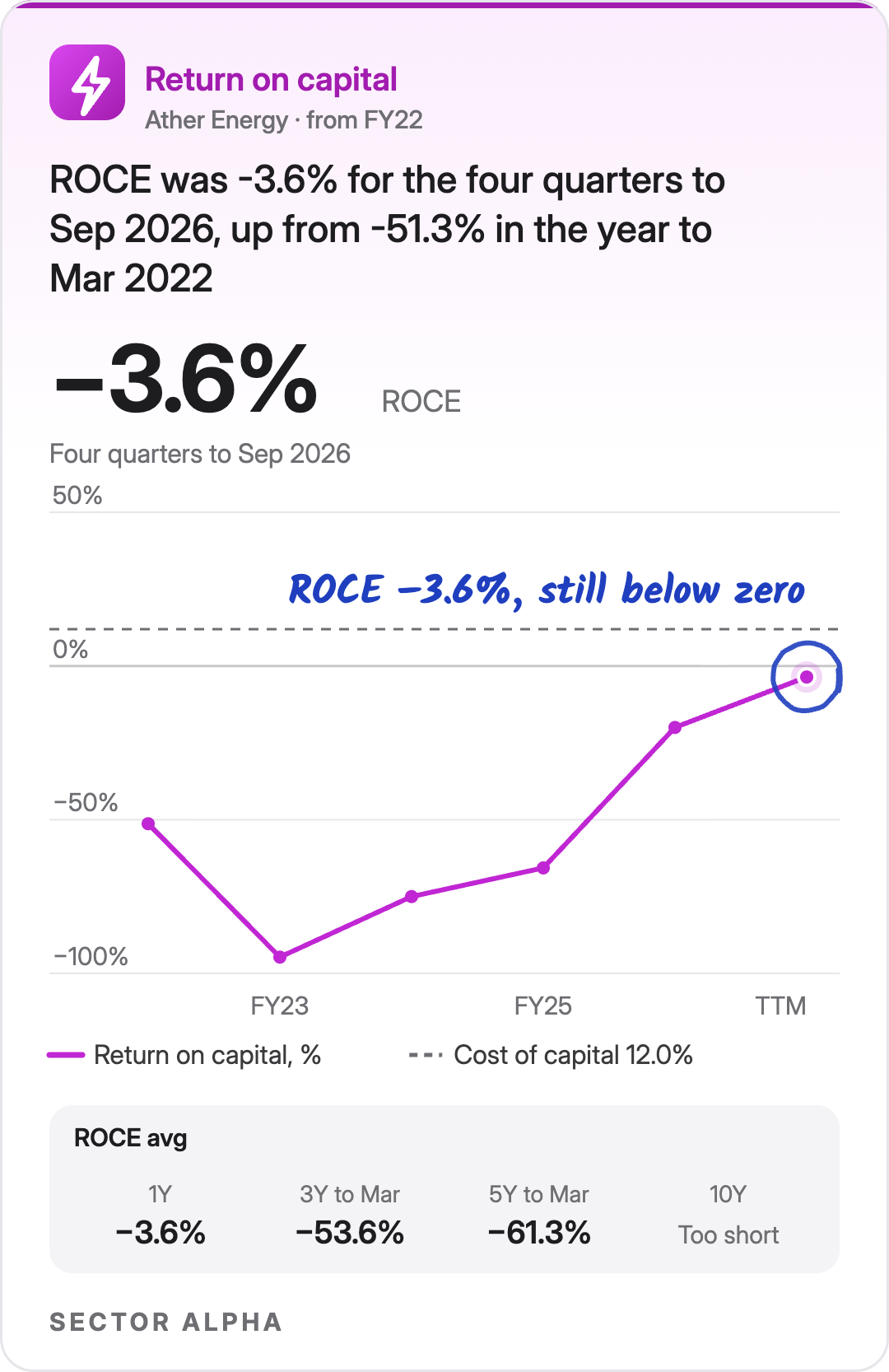
Cash and debt
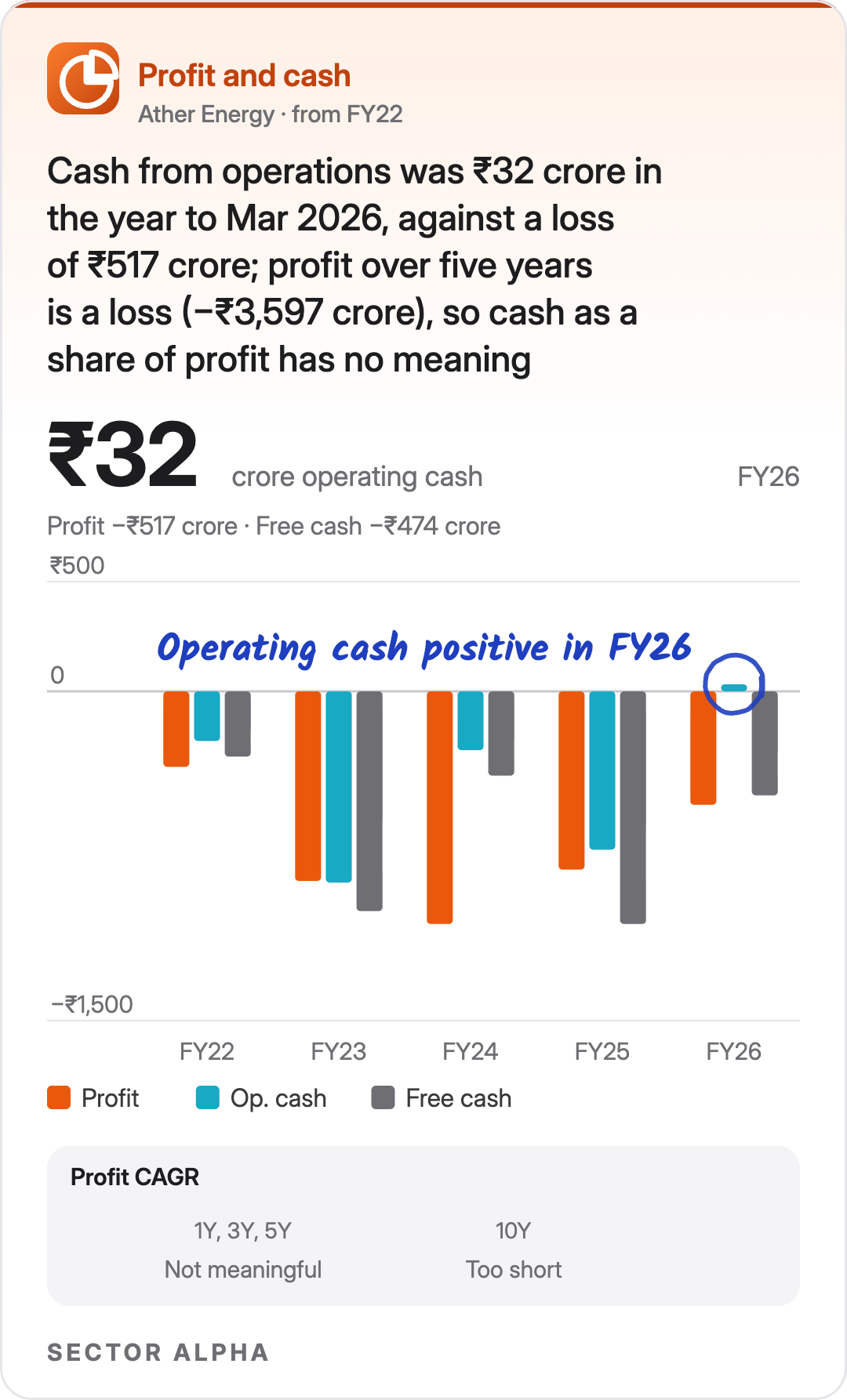
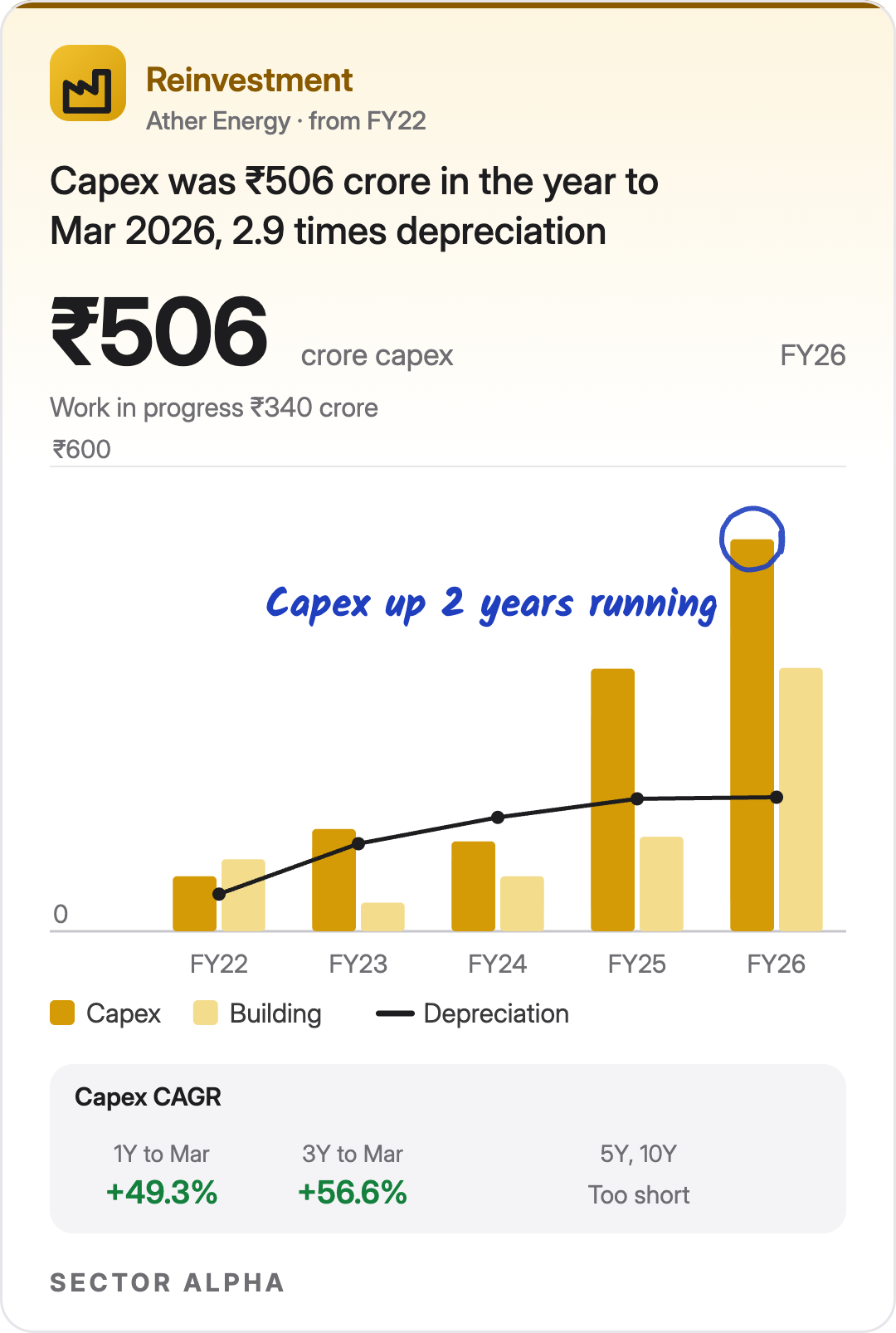
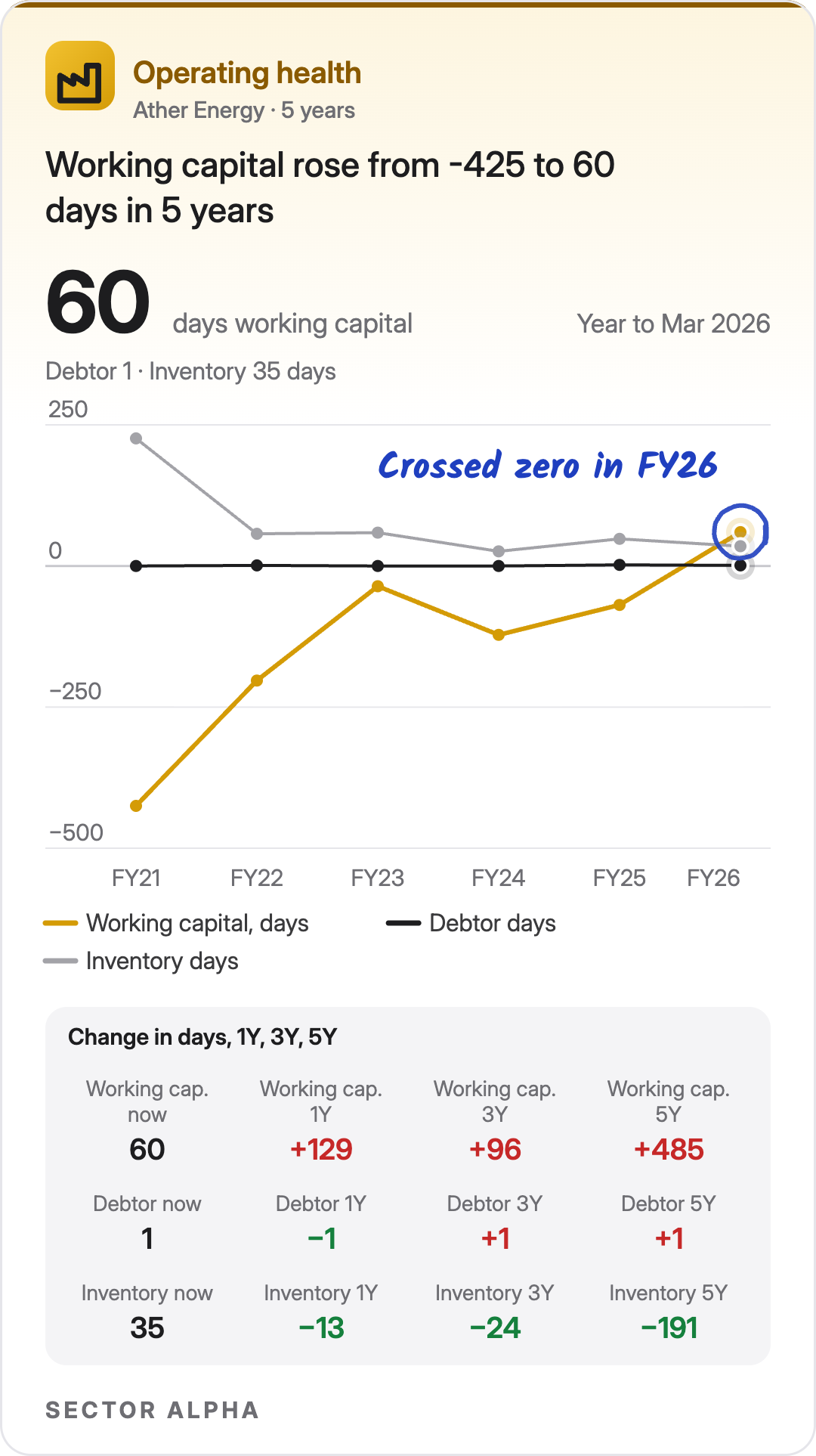
In FY26 the day-to-day business made cash instead of burning it, after burning cash in all six years from FY20 to FY25. But plant spending was many times larger.
Why: Ather is building a second factory at AURIC, in Chhatrapati Sambhaji Nagar. By my read, that plant is where most of the spending went.
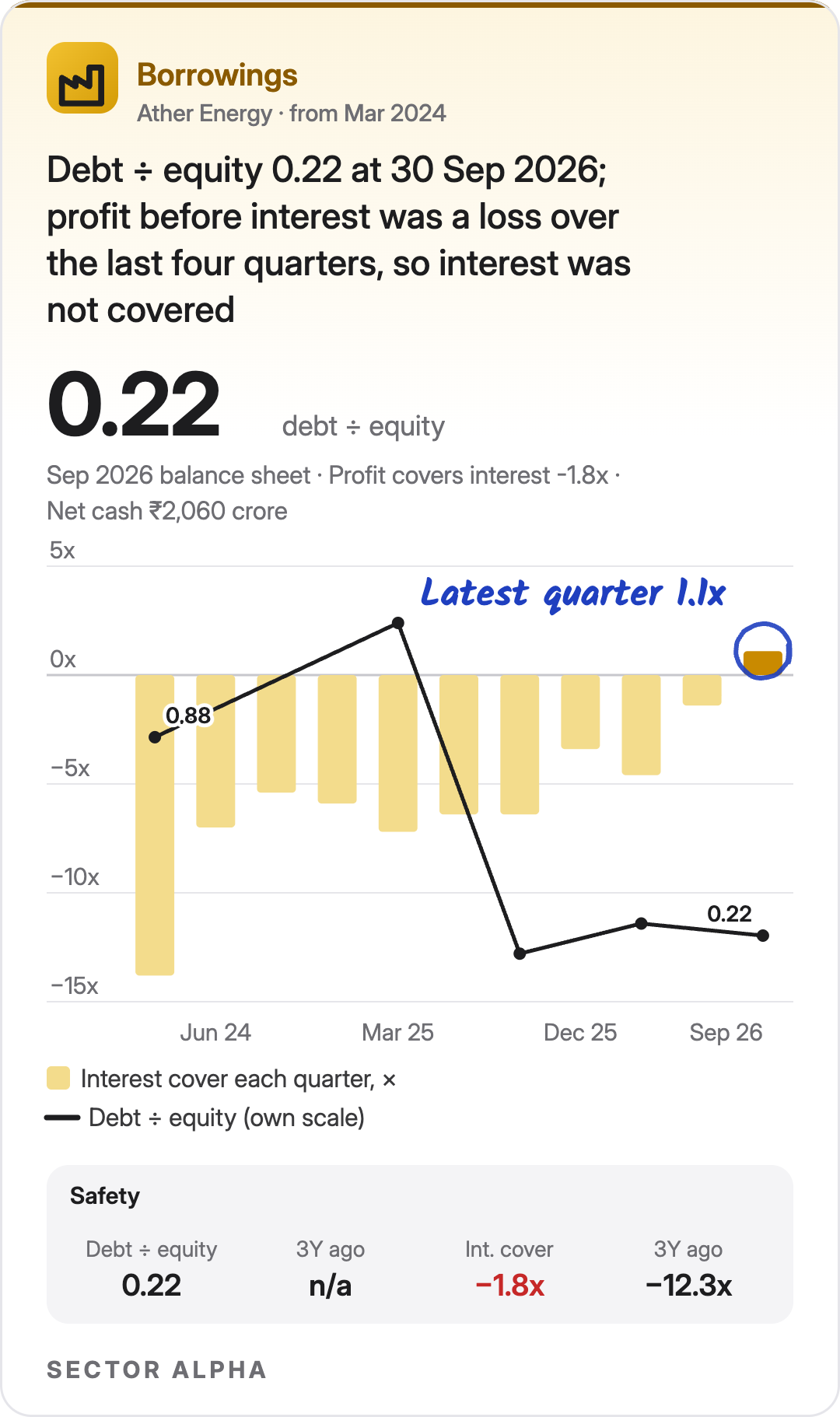
Borrowings rose from Mar 2026 to Sep 2026. Management did not say why on the call.
Debt still fell against shareholders’ money.
Plants and spending
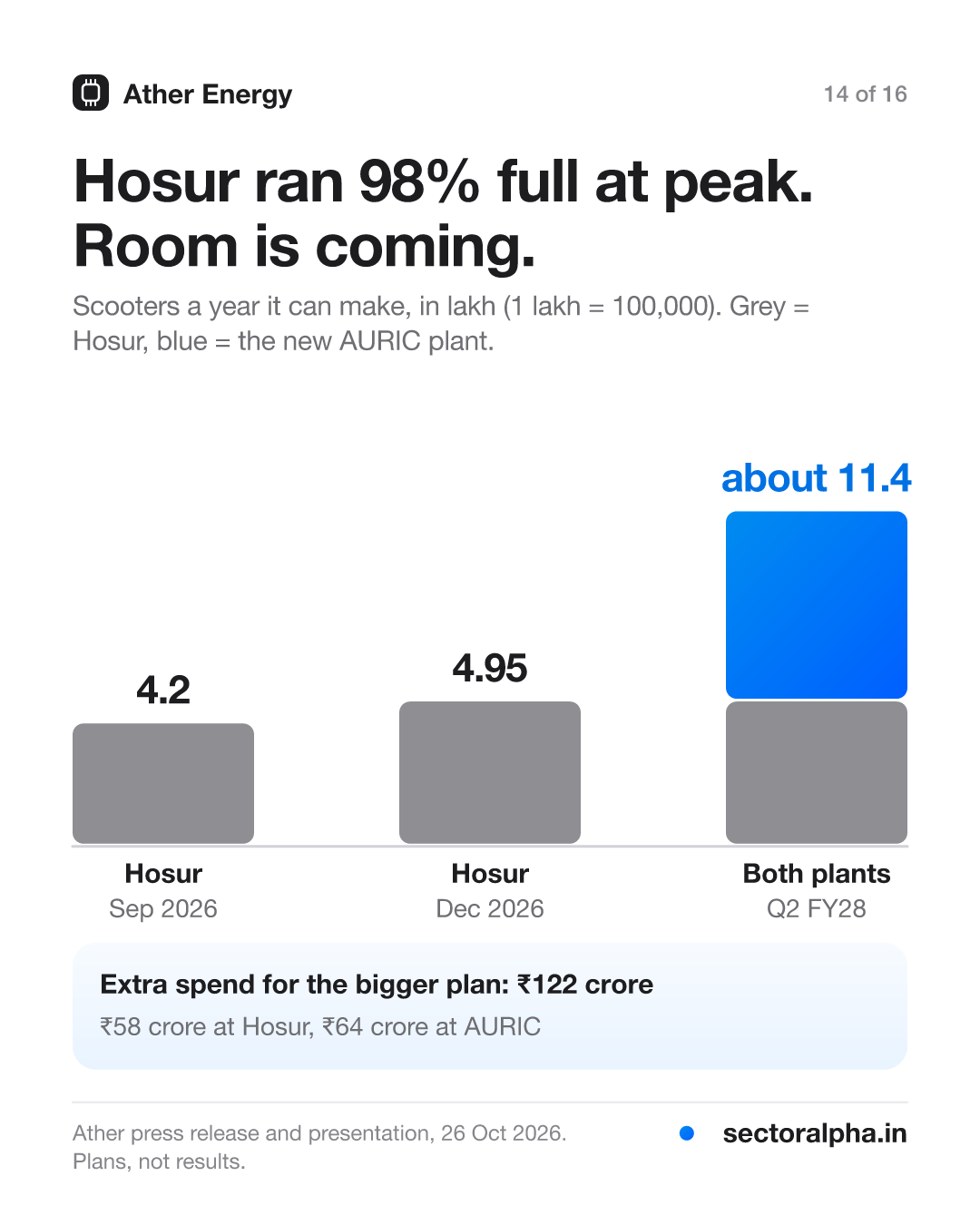
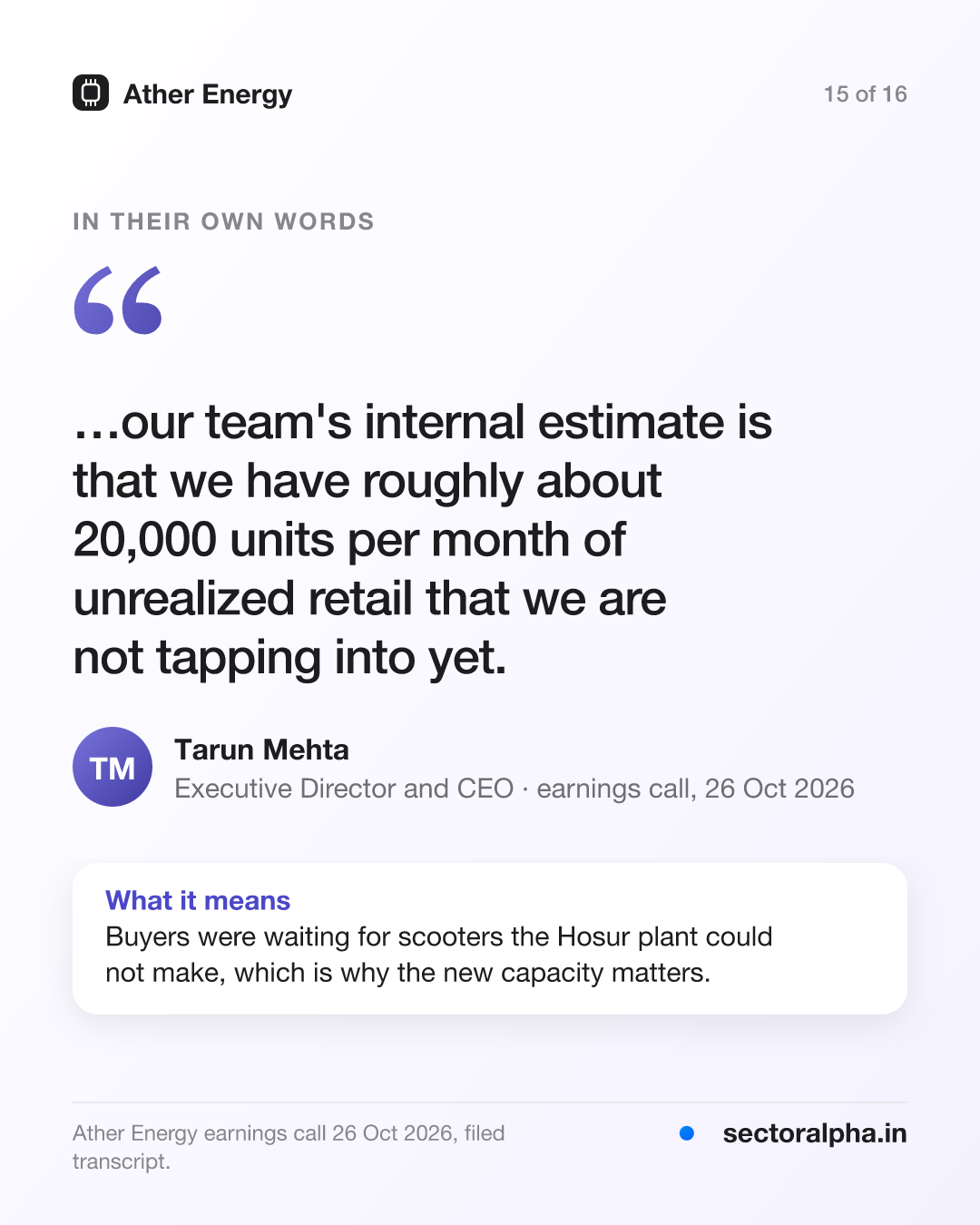
Why it is building more: the Hosur plant is full. The CEO said it is “at its tether’s end”, and that Ather is missing about 20,000 scooters a month of sales it could make.
Even with AURIC’s first phase, there would be little room to grow, the CEO said. So on 26 Oct 2026 the board approved more at both sites:
Hosur: a small addition that goes live in Oct to Dec 2026.
AURIC: machines fully installed by Jan to Mar 2027, and an extra line by Jul to Sep 2027.
The catch: AURIC’s new capacity will take a couple of quarters to run at full speed, the CEO said.
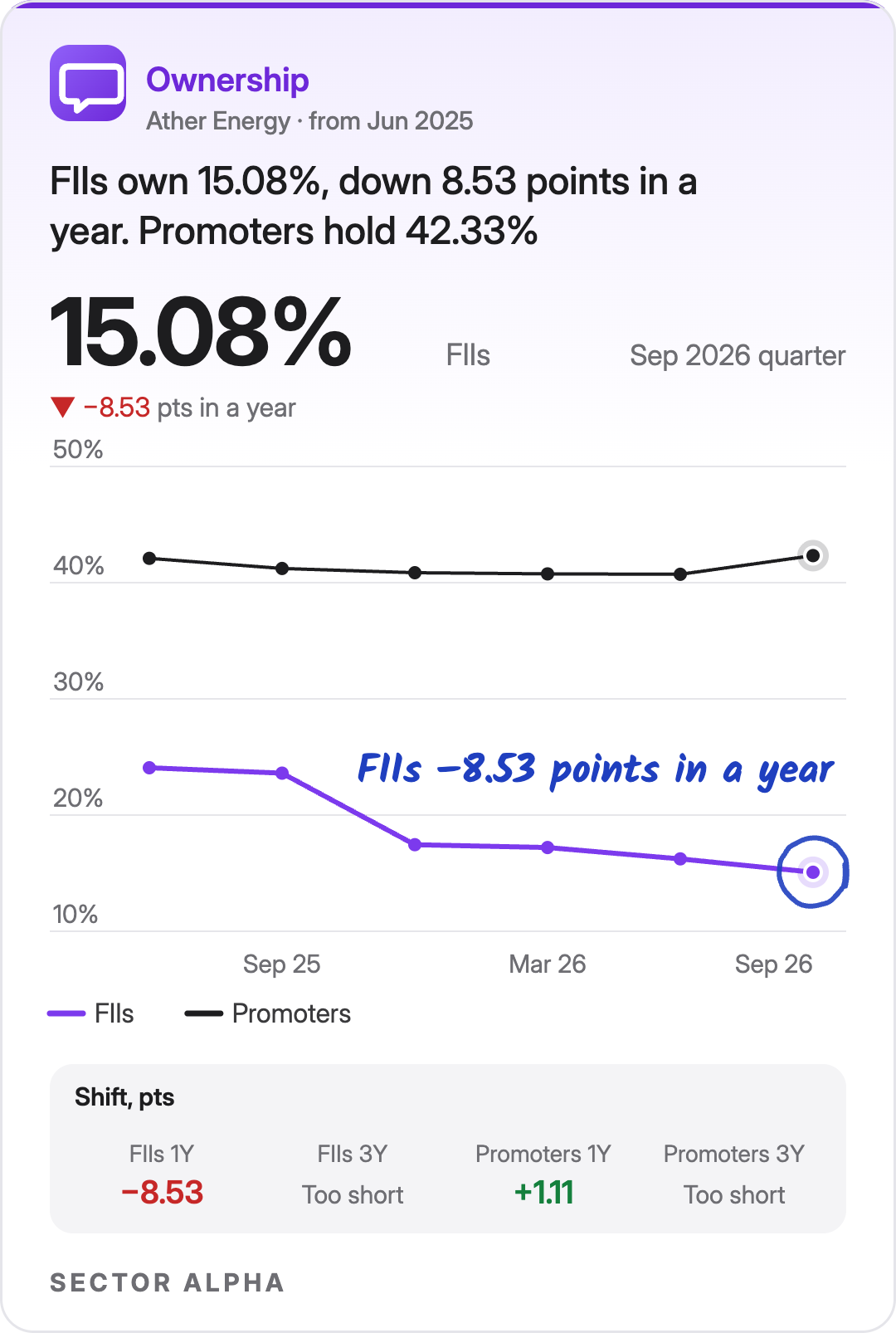
Who owns Ather Energy
Domestic funds and the public owned more in Sep 2026 than a year earlier. Foreign funds owned less.
The number of shareholders more than doubled, from 141,467 to 347,160.
The call did not cover why foreign funds cut their stake.
What management said, what happened
I compared the 3 Aug 2026 call with the 26 Oct 2026 call.
Delivered. Earlier price rises fully showed up: the average showroom price reached ₹164,000 in Jul to Sep 2026.
Delivered. Material costs did not push gross margin down further. It rose against Apr to Jun 2026.
Delivered. Konarc was unveiled at Community Day on 29 Aug 2026. Fewer than 10,000 were sold by 30 Sep 2026.
On track. AURIC trials were due in the festive season. On 26 Oct 2026 they were weeks away.
Raised. Planned yearly capacity went from 9.2 lakh scooters to about 11.4 lakh.
Worse. Price rises were meant to cover further cost increases. Materials rose more than expected.
Why is this happening
Electric scooters went mainstream. In Jul to Sep 2026, more than one in ten two-wheelers registered in India were electric for the first time, the CEO said. Growth was even across the south, middle and rest of India.
Ather is wanted more than the market. Its enquiries roughly doubled, faster than the industry. The CEO credited Konarc for much of the jump.
But it lost share. Ather’s share of electric two-wheeler registrations fell on a year. By my read, that is the full factory: it could not make enough scooters to keep pace.
It held back new stores. Ather added fewer than 50 showrooms in Apr to Sep 2026 so dealers would not sit without stock. It plans to restart within a couple of months of the 26 Oct 2026 call.
Cheaper Konarc comes later on purpose. The entry version, SR1, waits until AURIC is running, by Jan to Mar 2027. Launching it before then would take scarce scooters away from higher-margin models, the CEO said.
In the near term, PAT can go up and down, but definitely worth celebrating this milestone for the business this quarter [Jul to Sep 2026]. Tarun Mehta, CEO, 26 Oct 2026
What he means: PAT is profit after tax. The first profit is real, but small, and it will not rise in a straight line. His focus is selling more scooters.
What to track
AURIC: does production start and build up over Jan to Sep 2027?
Capacity: does yearly capacity reach about 11.4 lakh scooters by Jul to Sep 2027?
Margin: does it hold up as the temporary help fades and material costs stay high?
Konarc SR1: does the cheaper version reach showrooms by Jan to Mar 2027?
Software: do Konarc buyers keep paying for AtherStack Pro?
Stores: does showroom expansion restart in the months after the 26 Oct 2026 call, with enough scooters behind it?
All of Ather’s numbers, every quarter, are on my page: sectoralpha.in/stocks/ather-energy-ltd
— Roshan, Sector Alpha