


Not SEBI registered. Not investment advice. For your own research only.
Eternal owns Zomato, the food delivery app, and Blinkit, which brings groceries to your door in minutes.
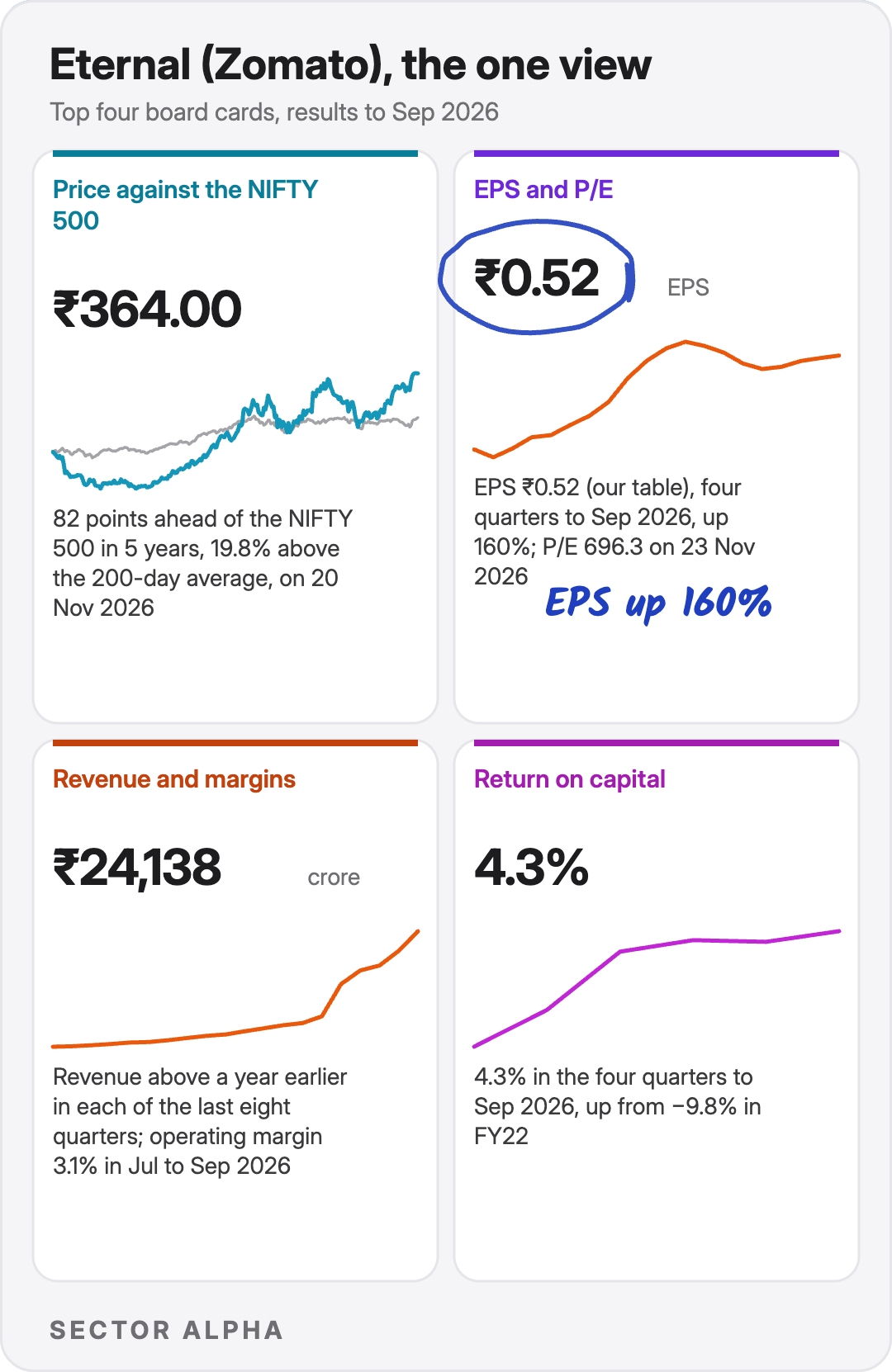
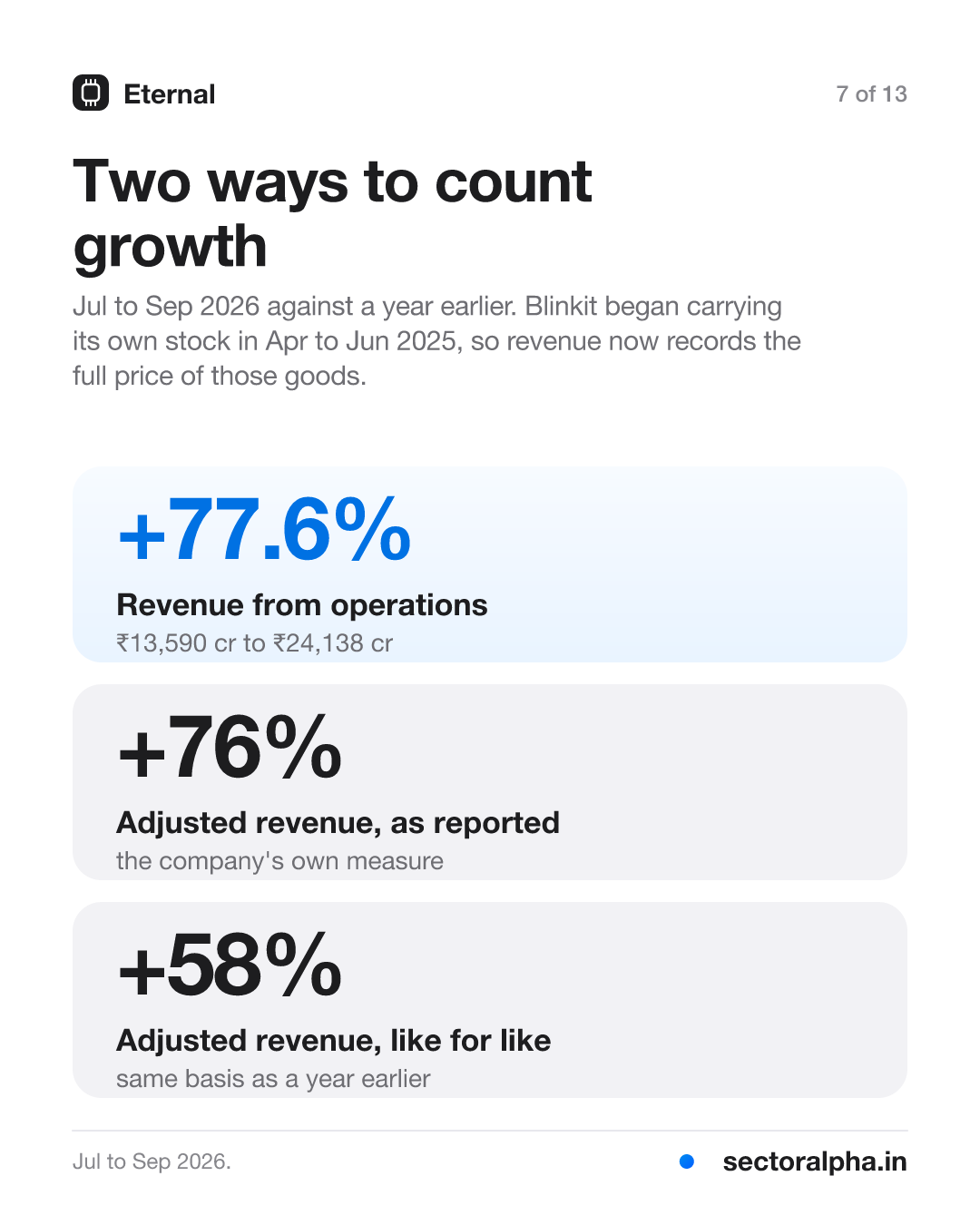
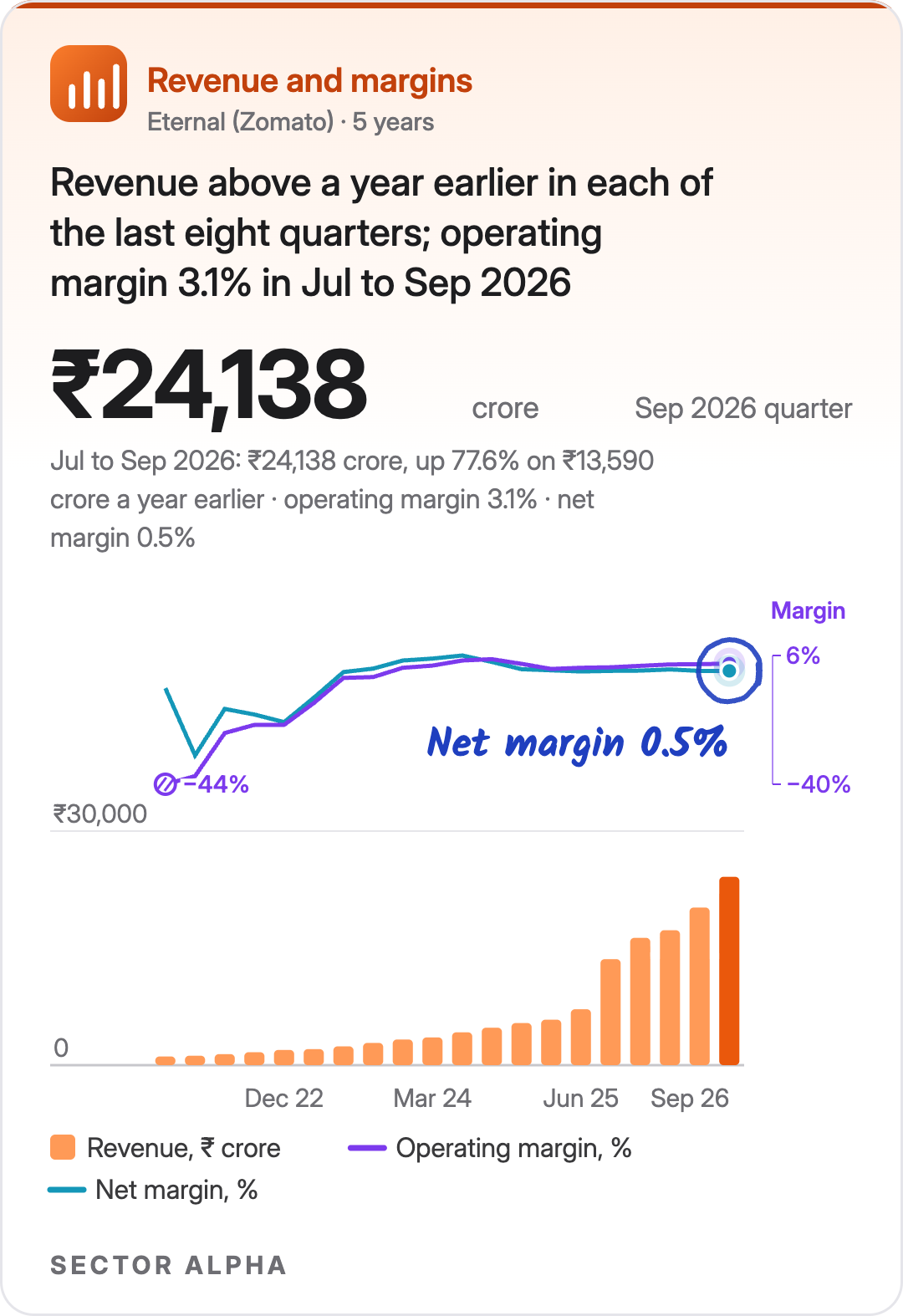
Its sales rose 77.6% in Jul to Sep 2026 against a year earlier. Part of that is accounting: Blinkit began carrying its own stock, so since then revenue records the full price of those goods, not just a fee.
What I found more telling: Blinkit earned ₹184 crore on Eternal's adjusted operating-profit measure, against a ₹156 crore loss a year earlier.
The catch: after depreciation and interest, the business itself came up ₹28 crore short. Other income is what put the profit in the black.
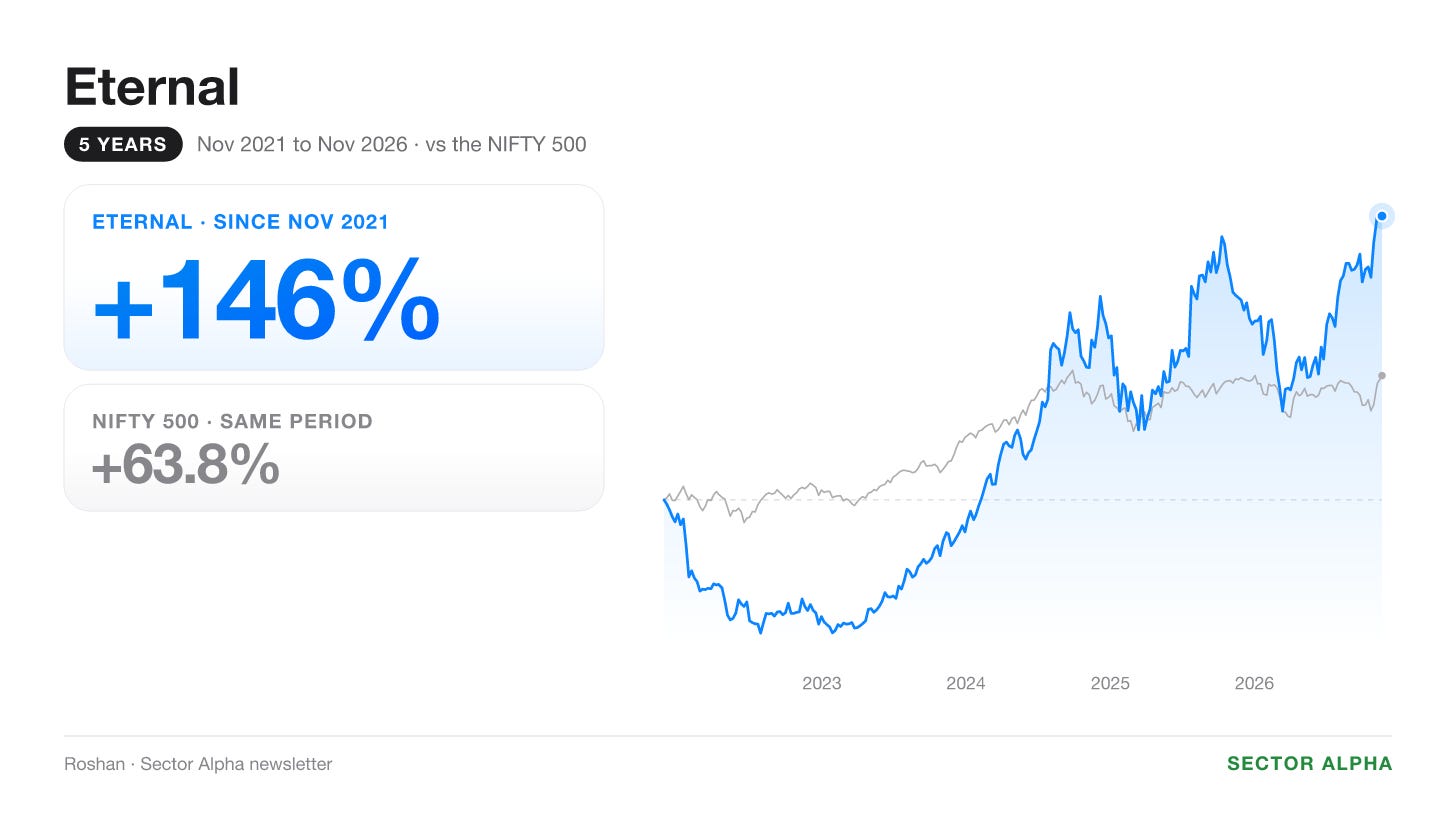
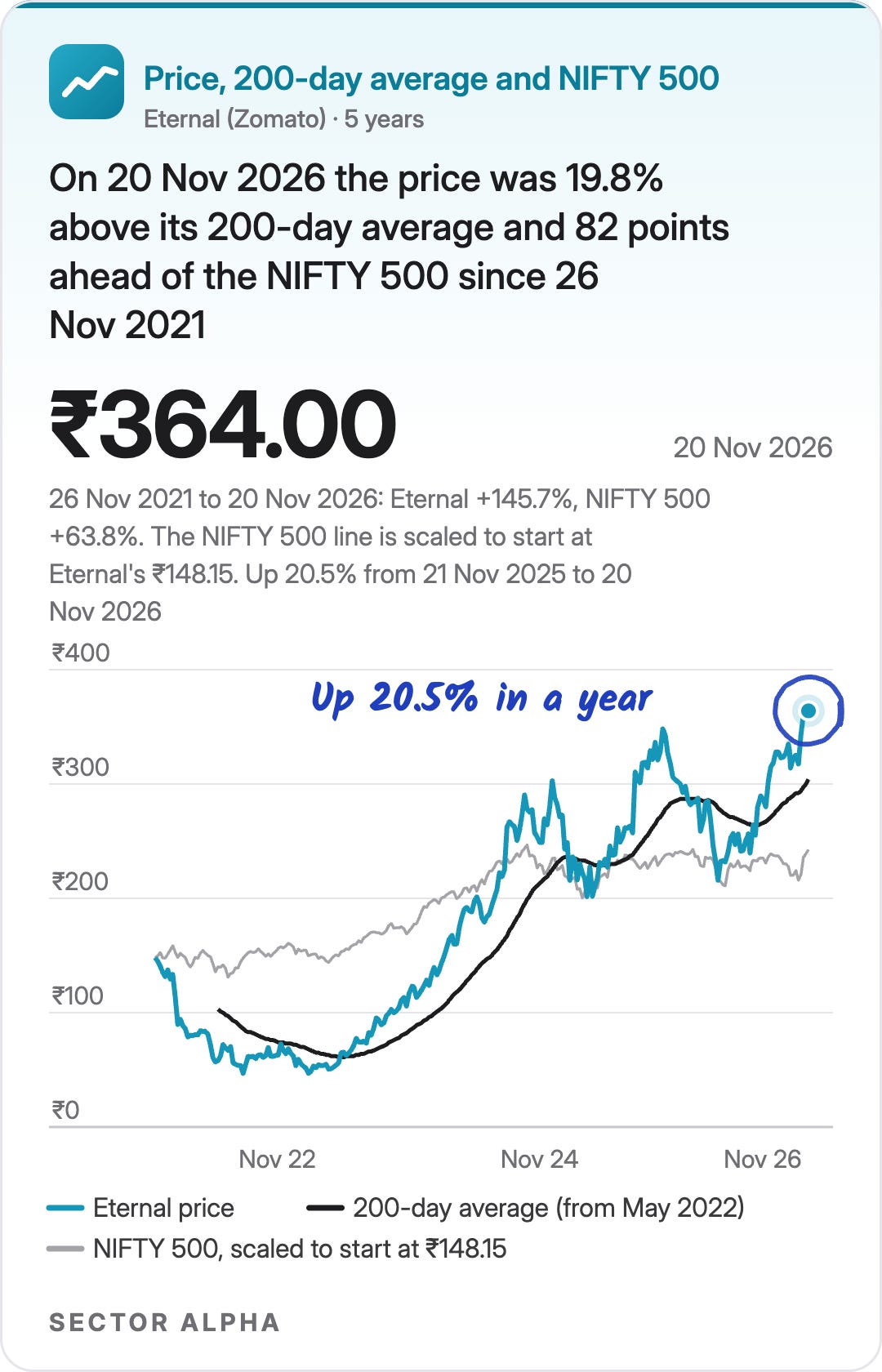
From 21 Nov 2025 to 20 Nov 2026, Eternal's share price rose 20.5% and the NIFTY 500 rose 1.3%.
Earnings and P/E
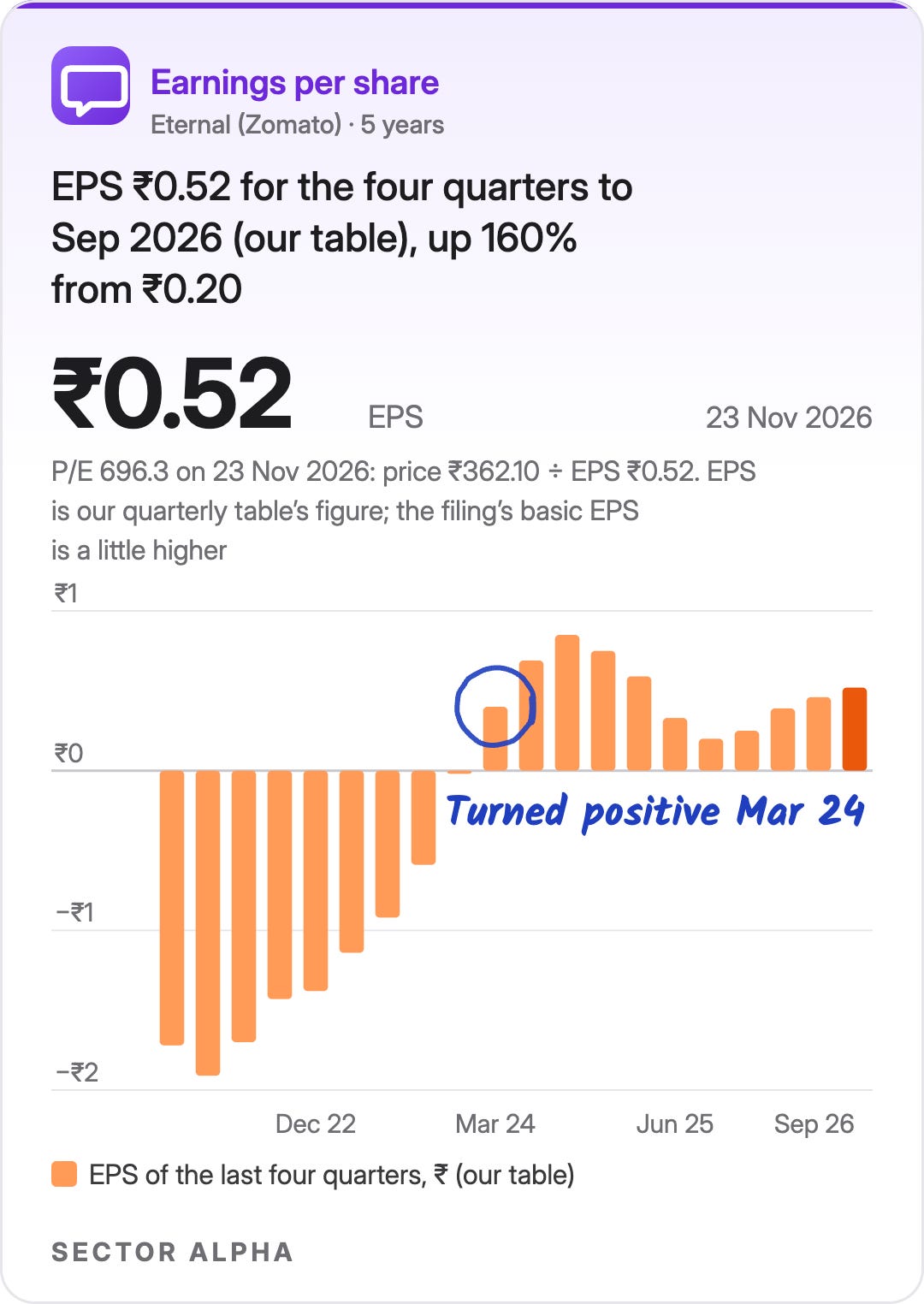
Earnings per share, four quarters to Sep 2026: ₹0.52, against ₹0.20 a year earlier. Up 160%.
Profit per share here is the figure in my quarterly table, as on Eternal's company page. The filing's basic figure for Jul to Sep 2026 is ₹0.14, against ₹0.13 in my table.
Share price, 21 Nov 2025 to 20 Nov 2026: up 20.5%.
Earnings ran far ahead of the price, but from a tiny base. So P/E, the price divided by a year of earnings per share, went from about 1,510 on 21 Nov 2025 to 696.3 on 23 Nov 2026.
How Eternal compares
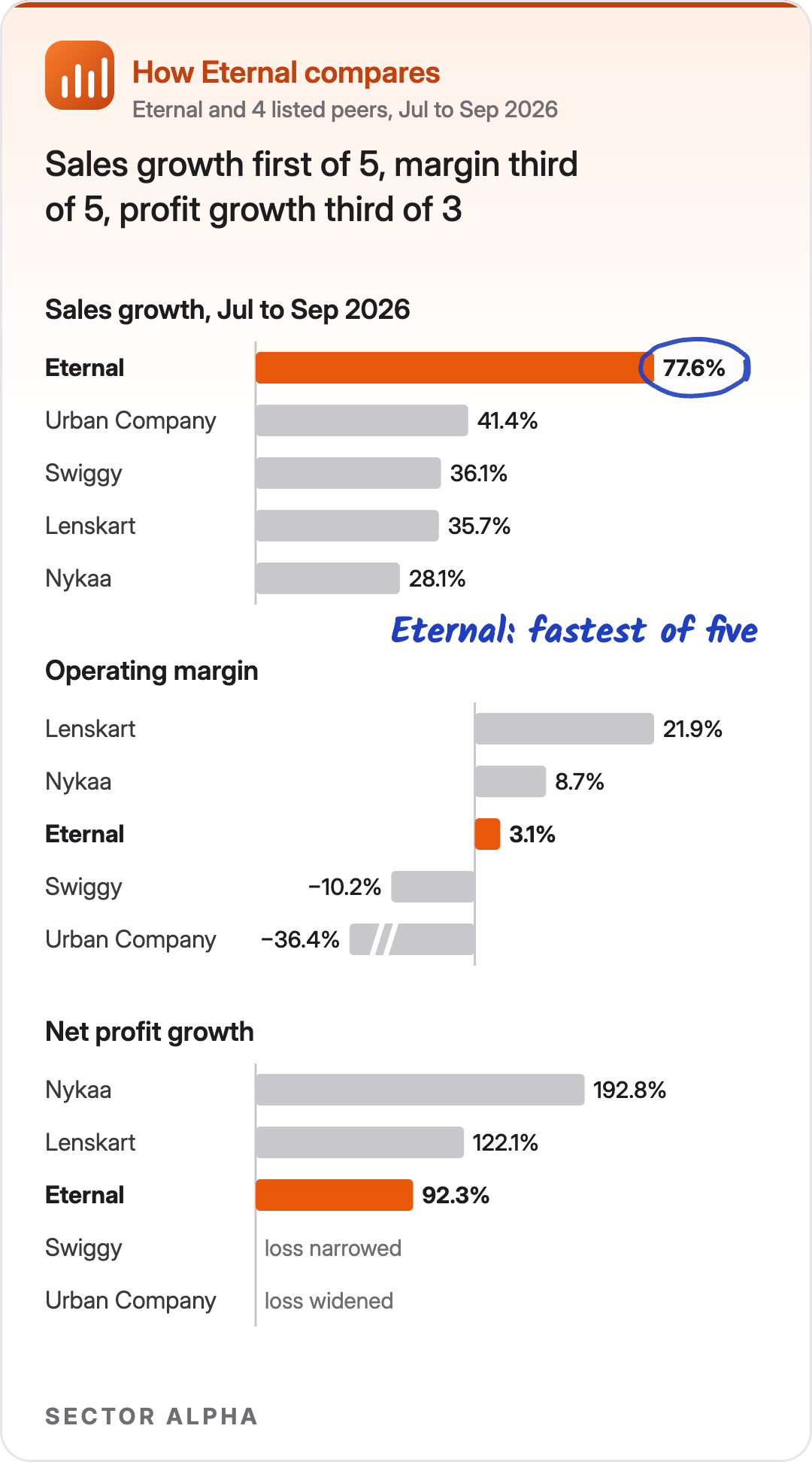
I compare Eternal with Swiggy, its direct rival, and three other consumer apps: Nykaa, Lenskart and Urban Company.
Sales growth in Jul to Sep 2026 ran from Nykaa's 28.1% to Eternal's 77.6%, helped at Eternal by the Blinkit accounting change.
Operating margin, the share of sales left after running costs: Lenskart 21.9%, Nykaa 8.7%, Eternal 3.1%. Swiggy and Urban Company lost money.
Profit for shareholders grew 192.8% at Nykaa, 122.1% at Lenskart and 92.3% at Eternal. Swiggy's loss narrowed and Urban Company's widened.
The deep dive
What is happening
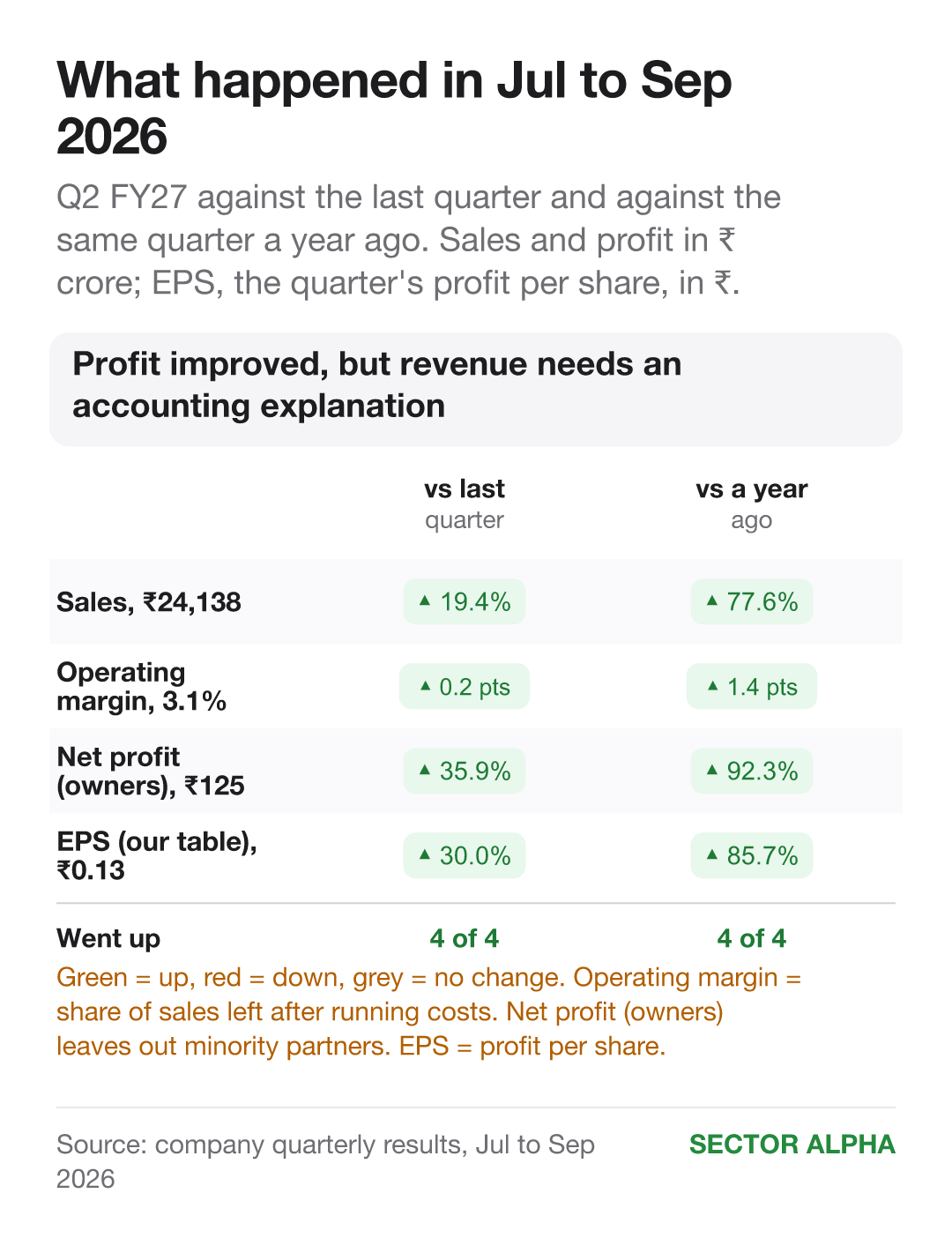
Sales rose against Apr to Jun 2026 and against a year earlier. Net profit rose to ₹125 crore from ₹92 crore in Apr to Jun 2026. The shareholders' letter of 21 Oct 2026 explains why:
Blinkit carries its own stock. It began the switch in Apr to Jun 2025. Since then revenue records the full price of those goods, not just a fee.
Blinkit turned the corner. It made ₹184 crore on the company's adjusted measure, against a ₹156 crore loss a year earlier. Its margin improved for the sixth quarter running.
Zomato kept earning. Food delivery made ₹627 crore on the same measure. Its net order value, the company's measure of the value of customer orders, grew 21.5% on a year.
More tax. Tax took 61% of profit before tax. From Apr to Jun 2026, Eternal began recording tax on business income because it expected to use up the parent company's past tax losses by Mar 2027.
What it makes
Zomato delivers restaurant food. Blinkit delivers groceries and other goods from small local warehouses called dark stores. District sells dining, movie and event bookings, and Hyperpure supplies restaurants.
Blinkit is now the biggest part by far: ₹19,152 crore of the ₹24,138 crore revenue in Jul to Sep 2026.
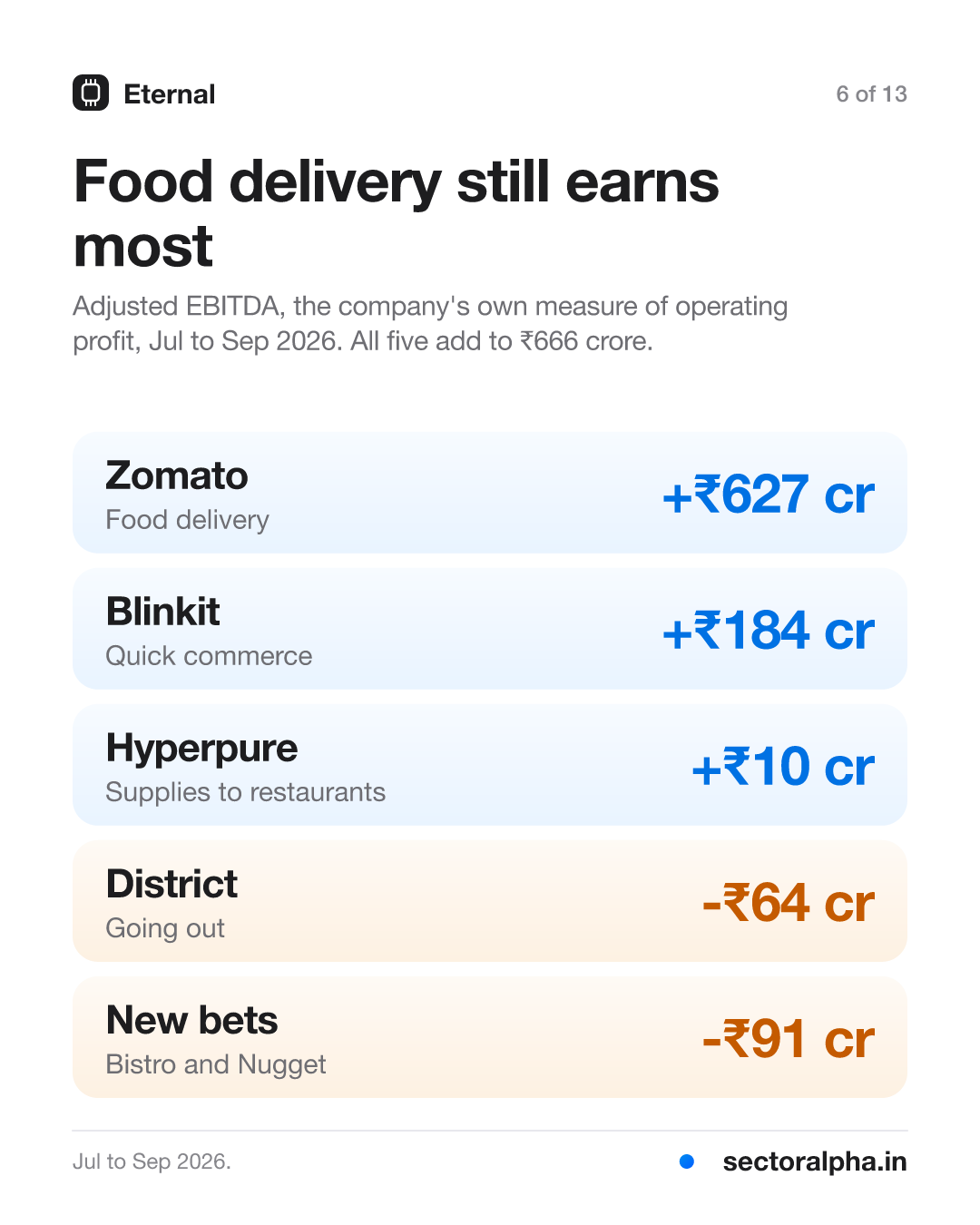
On Eternal's adjusted measure, Zomato earned ₹627 crore, Blinkit ₹184 crore and Hyperpure ₹10 crore. District lost ₹64 crore and the other businesses lost ₹91 crore.
Context: on 21 Oct 2026 the finance head said Zomato is spending more to win new customers and to get existing ones to order more often. He expects food delivery margins to stay about flat for one to two years.
Each quarter vs a year earlier
The company's adjusted revenue grew 76% as reported. On the same basis as a year earlier, it grew 58%.
Sales: above a year earlier in all eight of the last eight quarters. Since Apr to Jun 2025 that also carries the switch to owning stock.
Margin: above a year earlier in four of the last eight. By my read, the margin looks small because revenue since Apr to Jun 2025 records the full price of the goods Blinkit sells.
Profit: above a year earlier in four of the last eight. From Apr to Jun 2026 a bigger tax bill has held it back.
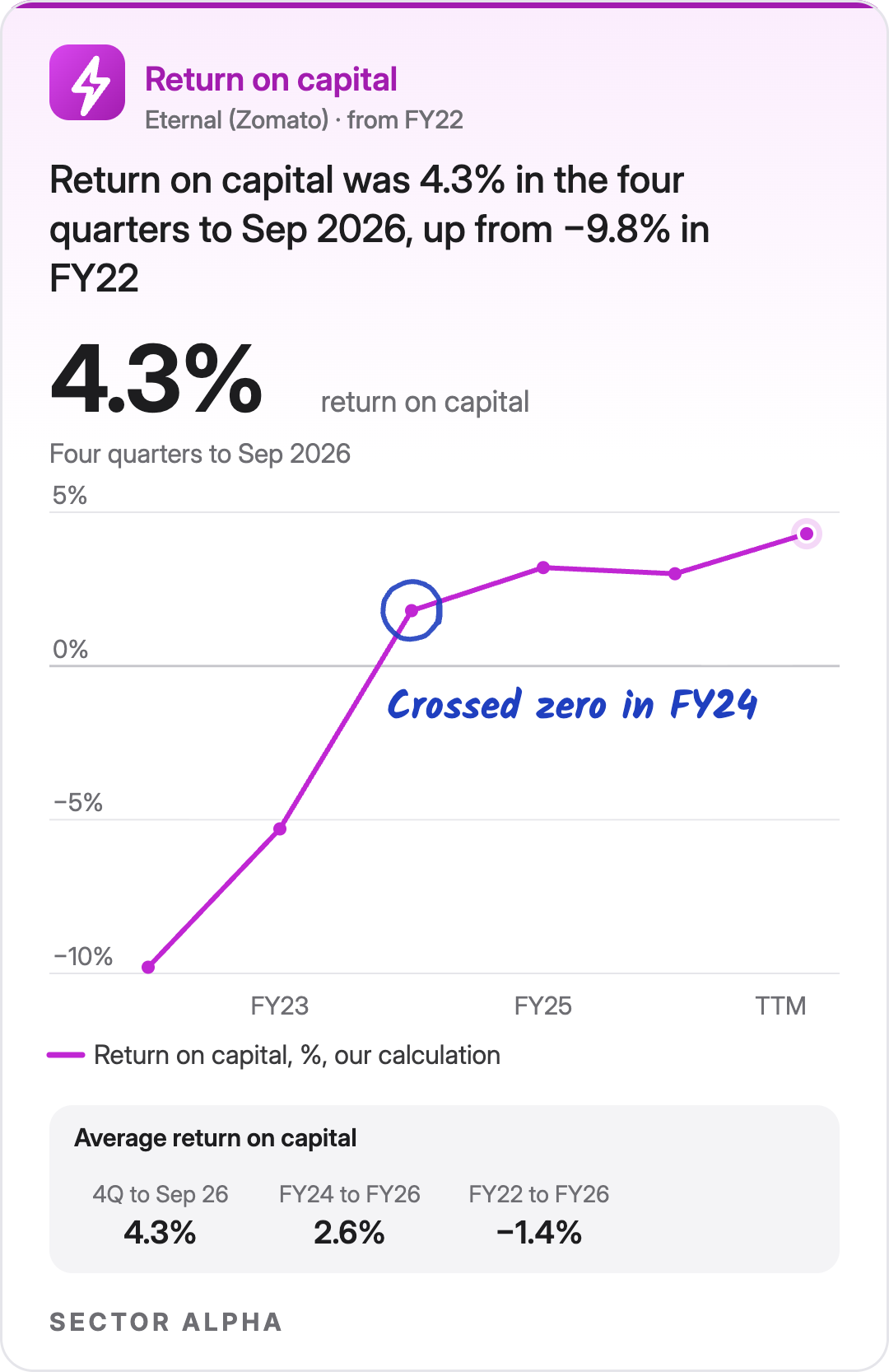
Returns: by my calculation, the return on money used by the business crossed zero in FY24 and was 4.3% over the four quarters to Sep 2026.
Cash and debt
Here is what still worries me. In Jul to Sep 2026, operating profit before depreciation, interest and other income was ₹752 crore. Depreciation and amortisation, the cost of using physical and intangible assets over time, came to ₹625 crore. Interest took ₹155 crore.
So the business was ₹28 crore short of covering interest. Other income of ₹351 crore brought profit before tax to ₹323 crore.
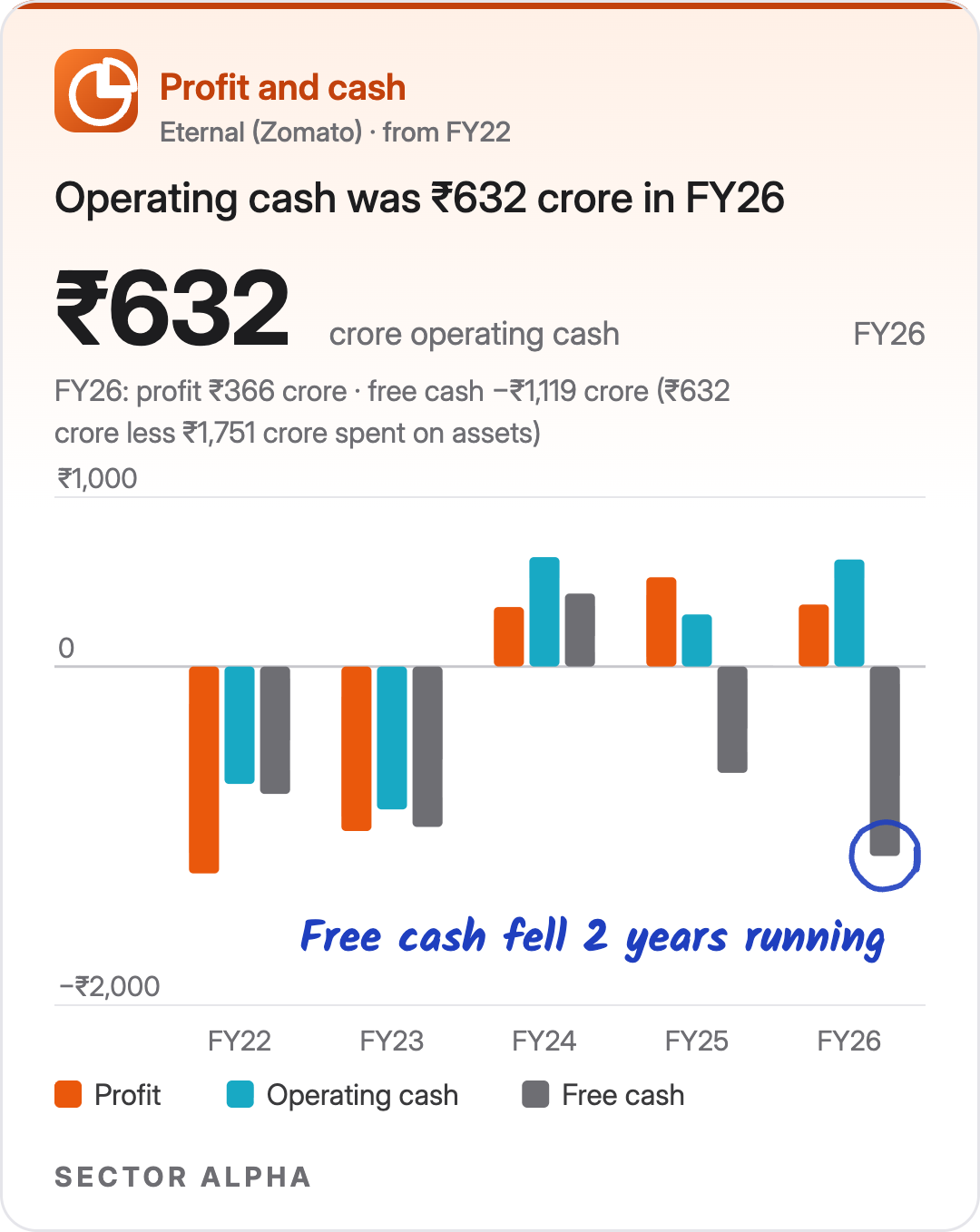
Cash from operations was ₹632 crore in FY26.
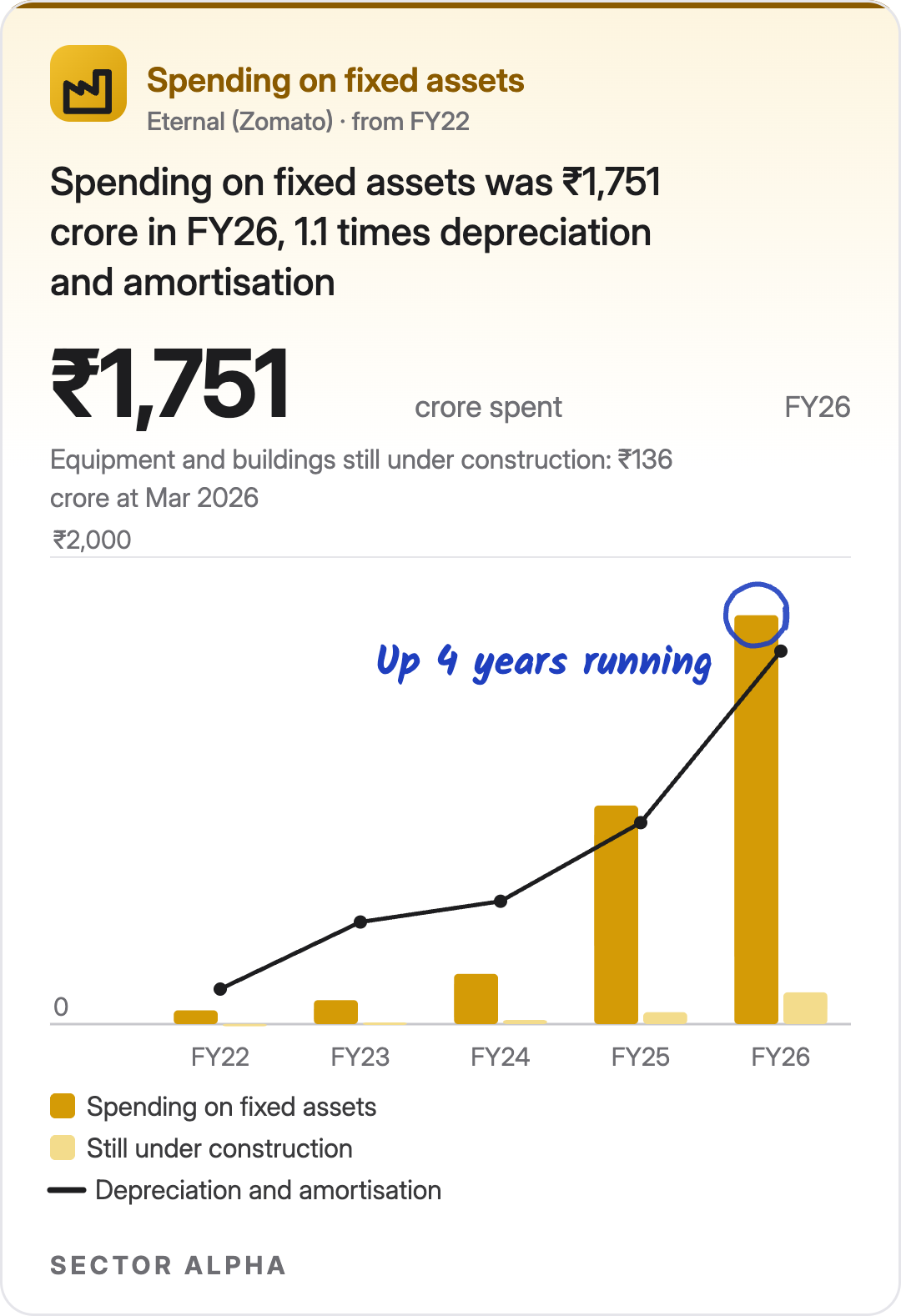
Spending on fixed assets went from ₹59 crore in FY22 to ₹1,751 crore in FY26.
Cash fell by ₹1,813 crore in Jul to Sep 2026 to ₹16,475 crore. The finance head gave two reasons: Blinkit stocked up before the festive season, and food delivery owed restaurants less at quarter end.
Eternal has no bank loans. The ₹5,757 crore shown as debt on its 30 Sep 2026 balance sheet is lease liabilities. That is rent it has signed up to pay on the property it leases.
Most of its interest is on those leases: ₹281 crore of the ₹306 crore in Apr to Sep 2026.
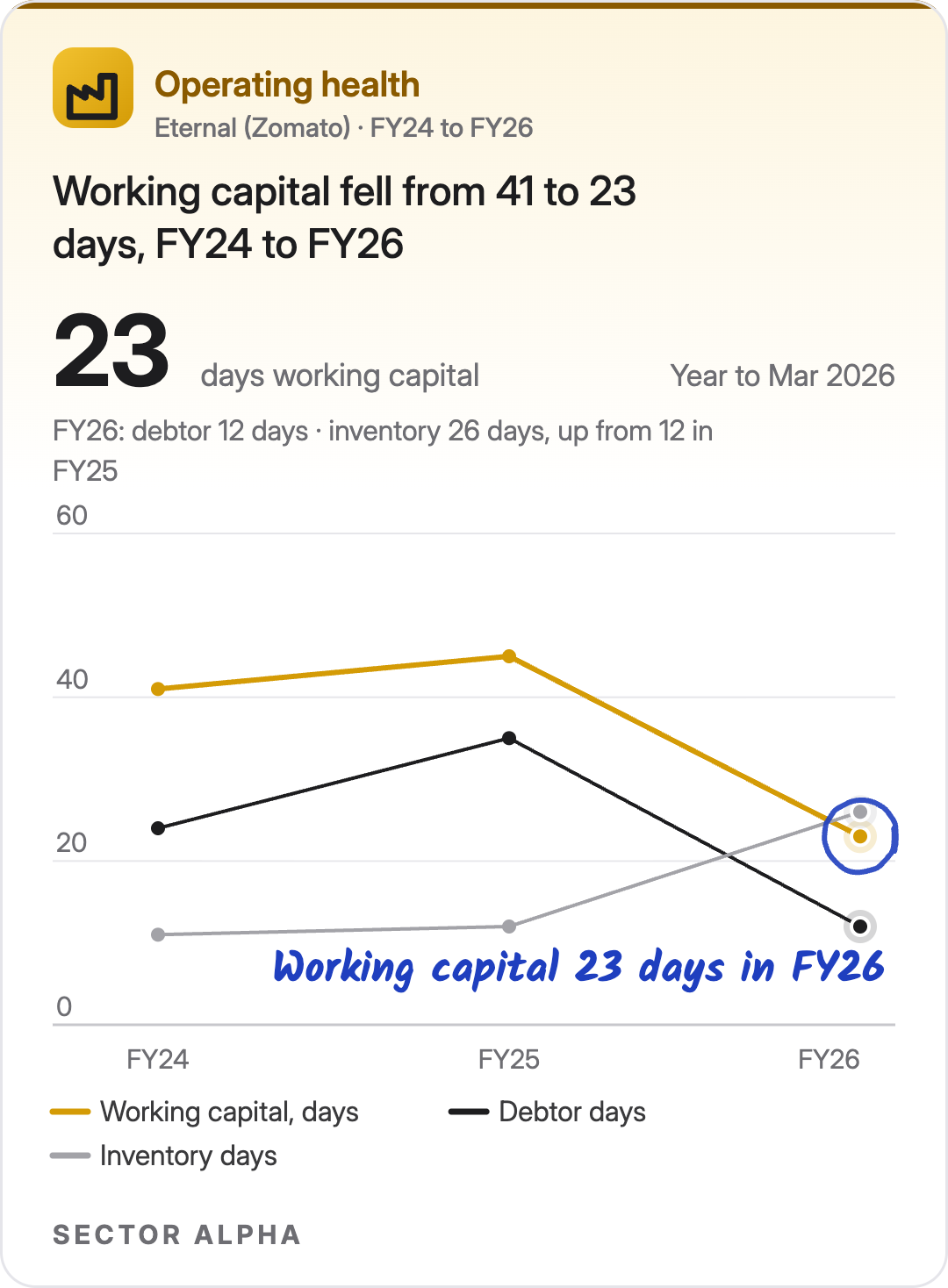
Working capital fell from 41 days in FY24 to 23 days in FY26. Inventory rose from 12 days in Mar 2025 to 26 days in Mar 2026.
Who owns Eternal
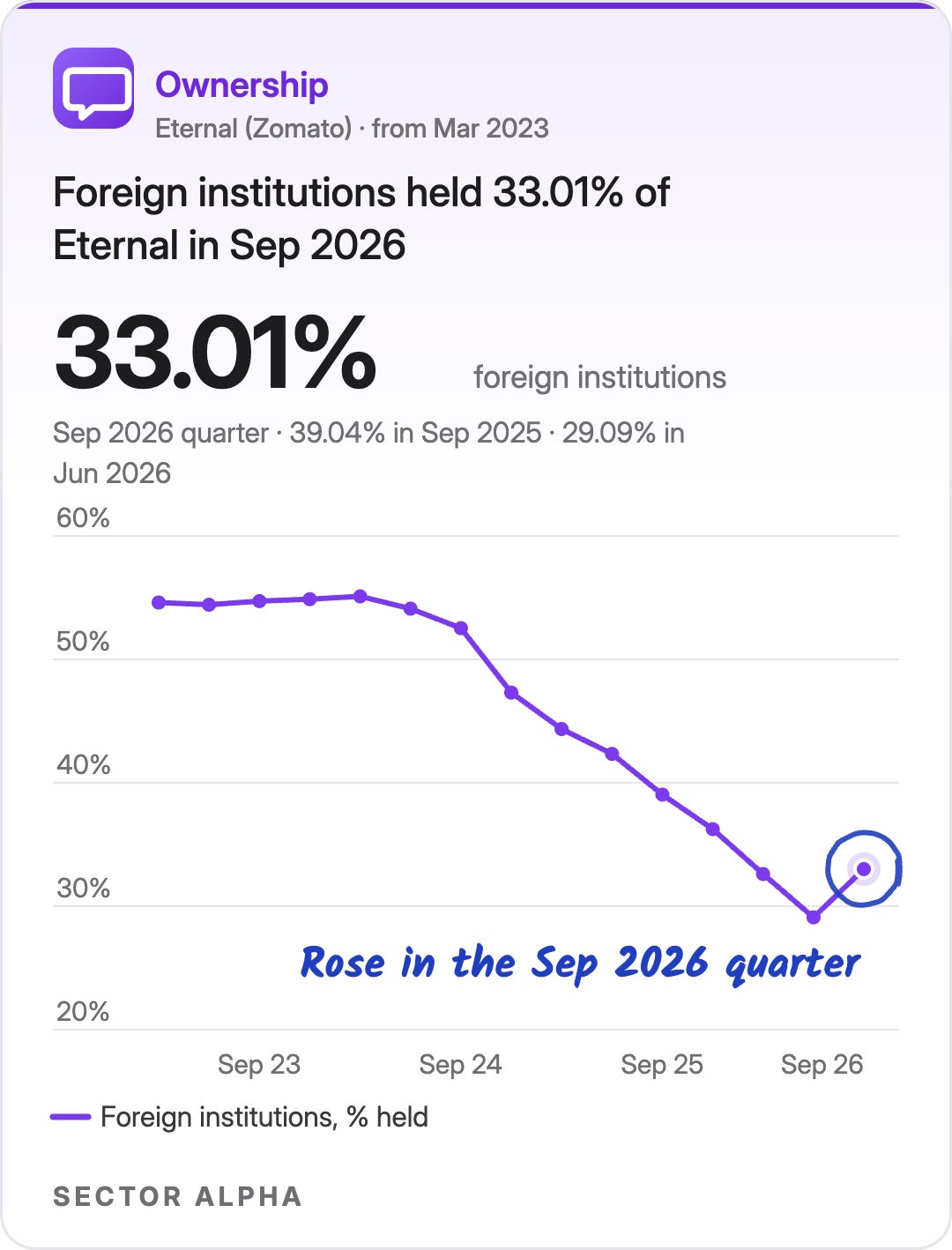
Foreign institutions held 39.04% in Sep 2025, 29.09% in Jun 2026 and 33.01% in Sep 2026.
Domestic institutions cut theirs to 36.22% in Sep 2026 from 39.21% in Jun 2026.
The number of shareholders fell from 22,68,441 in Sep 2025 to 21,26,951 in Sep 2026.
What management said, what happened
Blinkit margin. On the Apr to Jun 2026 results call, the finance head agreed that, as things stood then, Blinkit margins should keep improving. Its margin then rose for the sixth quarter in a row, to 0.9% of net order value.
Goal raised. Blinkit had 2,751 stores on 30 Sep 2026. On 21 Oct 2026 management raised its Mar 2027 goal from 3,000 to more than 3,500, with about 5,000 by Mar 2028.
Too early. Blinkit's net order value was guided to grow an average of 60% a year over three years. Two quarters in, management says it is ahead but will not raise the goal yet.
Why is this happening
Cash and both businesses fund the stores. Eternal said its cash reserves and profits from Zomato and Blinkit helped fund new stores.
Smaller cities pay back. Goyal said stores already open in smaller cities had earned back their cost quickly. He expected most new stores to open in those cities.
Old cities carry the margin. Blinkit's mature cities already earn above 5% of net order value on the company's adjusted measure. Management expects them to more than offset the drag from new stores.
Directionally, we want to maintain margins broadly and reinvest in growth as much as it makes sense to continue to drive the growth upwards.
Akshant Goyal, Chief Financial Officer, Eternal Limited, 21 Oct 2026
What he means: Goyal expects food delivery to keep roughly the same share of order value as profit while Zomato spends to attract customers.
What we have seen so far is that the economics are pretty robust. Paybacks are extremely good in these markets.
Akshant Goyal, Chief Financial Officer, Eternal Limited, 21 Oct 2026
What he means: stores in smaller cities earn back their cost quickly, so Blinkit will open more of them there.
What to track
Store count: does Blinkit pass 3,500 stores by Mar 2027?
Blinkit growth: will Blinkit's net order value grow faster in Oct to Dec 2026 than the 79.3% recorded in Jul to Sep?
Blinkit margin: does it keep rising while new stores open faster?
Food margin: does it stay near 5.5% of net order value while Zomato spends on growth?
Profit without other income: does operating profit grow enough to cover depreciation and interest on its own?
Cash: does the cash balance recover after the festive stock build?
All of Eternal's numbers, every quarter, are on my page: sectoralpha.in/stocks/eternal-ltd
— Roshan, Sector Alpha