


Not SEBI registered. Not investment advice. For your own research only.

HDFC Bank takes deposits and lends them out to people and businesses. It holds about 11% to 12% of India’s banking market, management said.
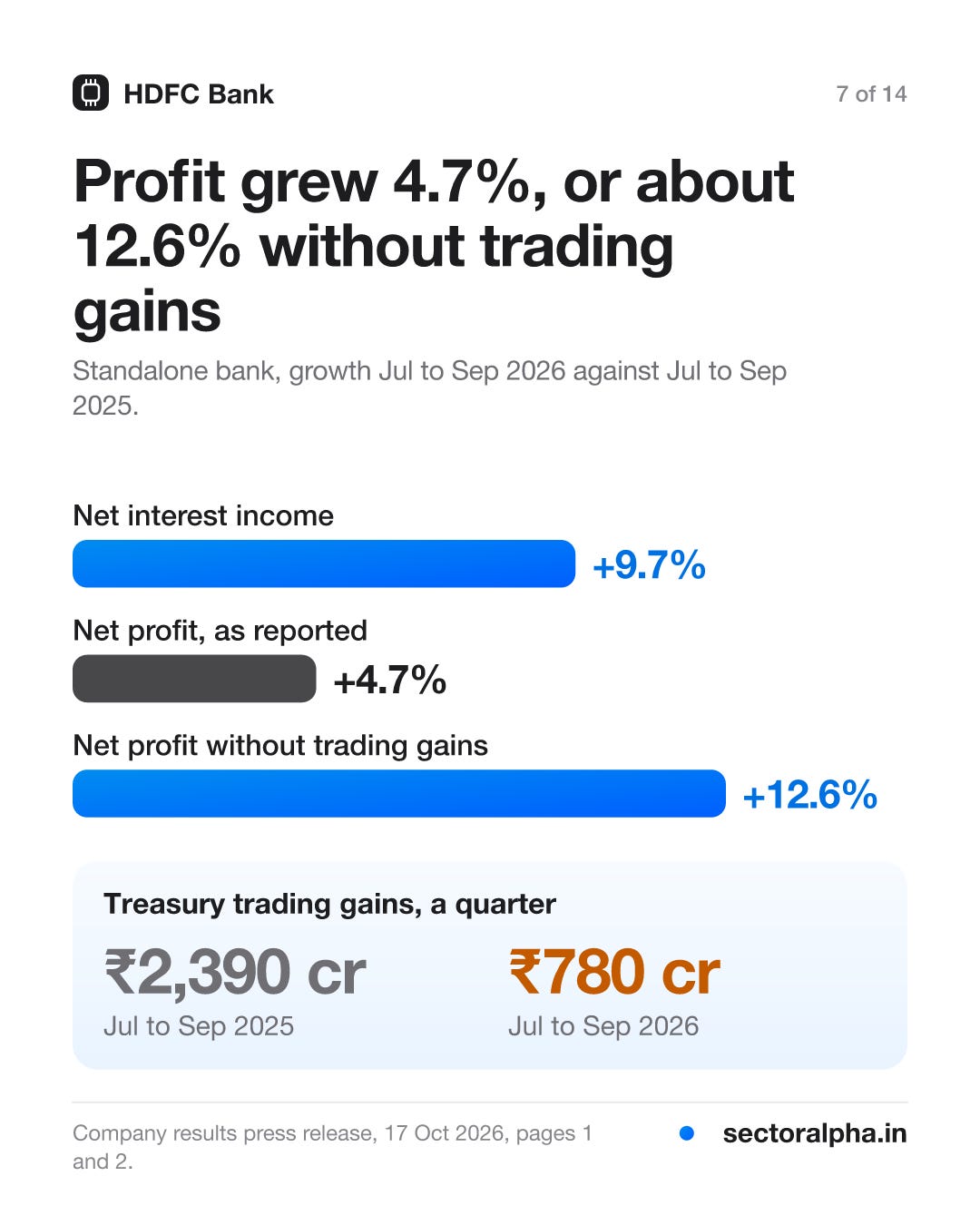
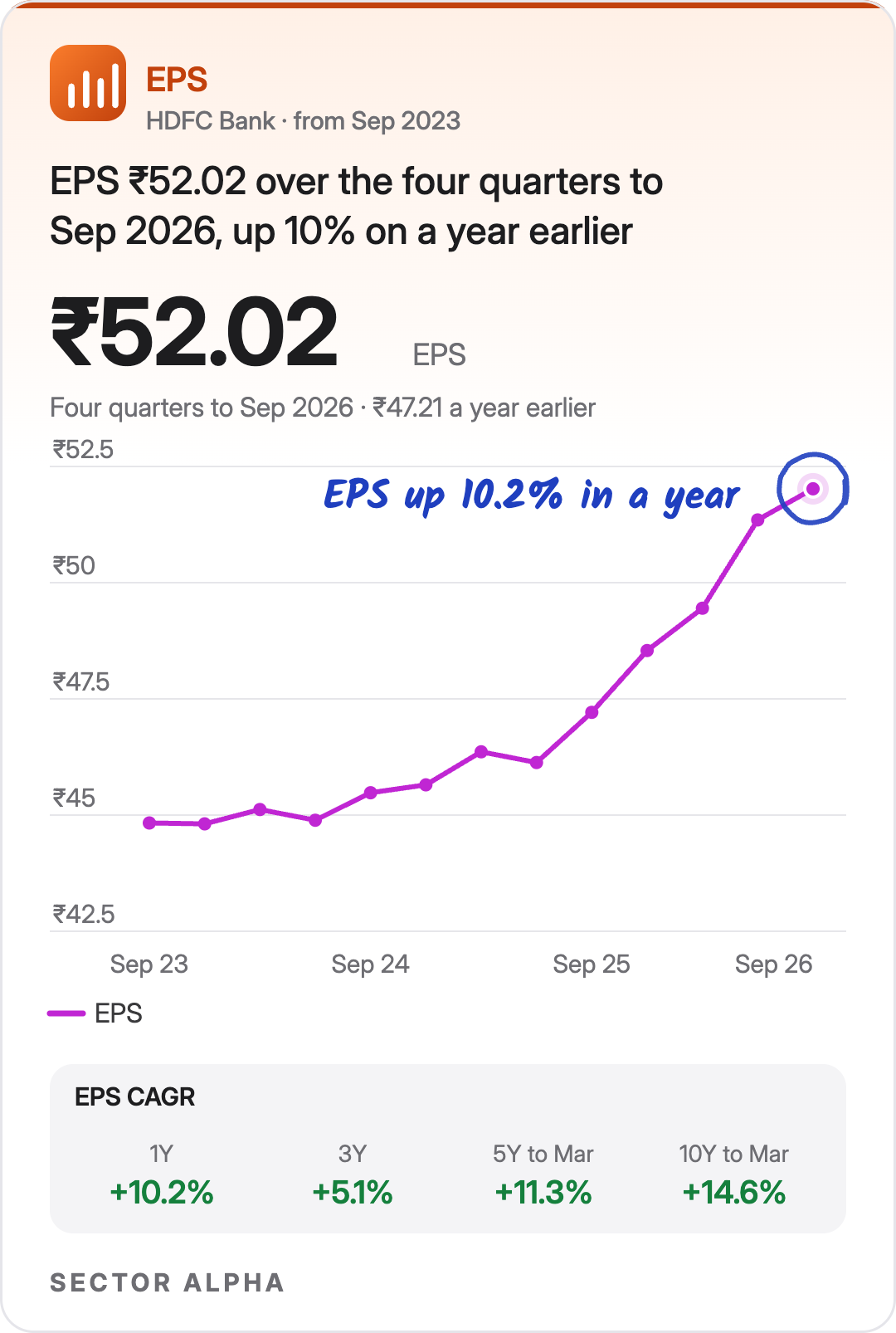
The bank alone grew profit only 4.7% in Jul to Sep 2026, while its lending business grew far faster.
The reason: it made much less money from trading bonds than a year earlier, and the gap between what it earns on loans and pays on deposits was at a low point.
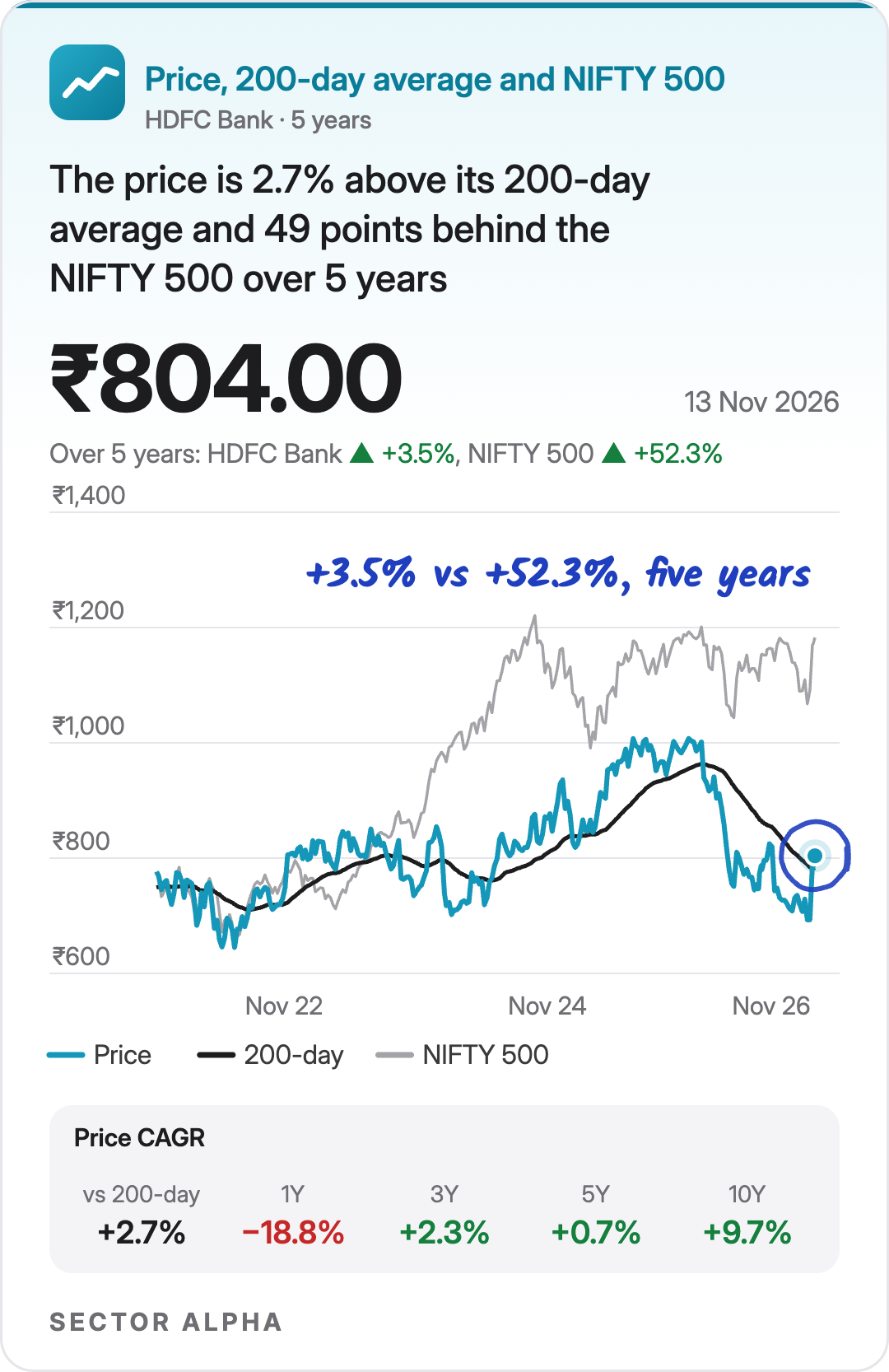
HDFC Bank’s share price fell 18.8% from 14 Nov 2025 to 13 Nov 2026. The NIFTY 500 fell 0.4% over the same dates.
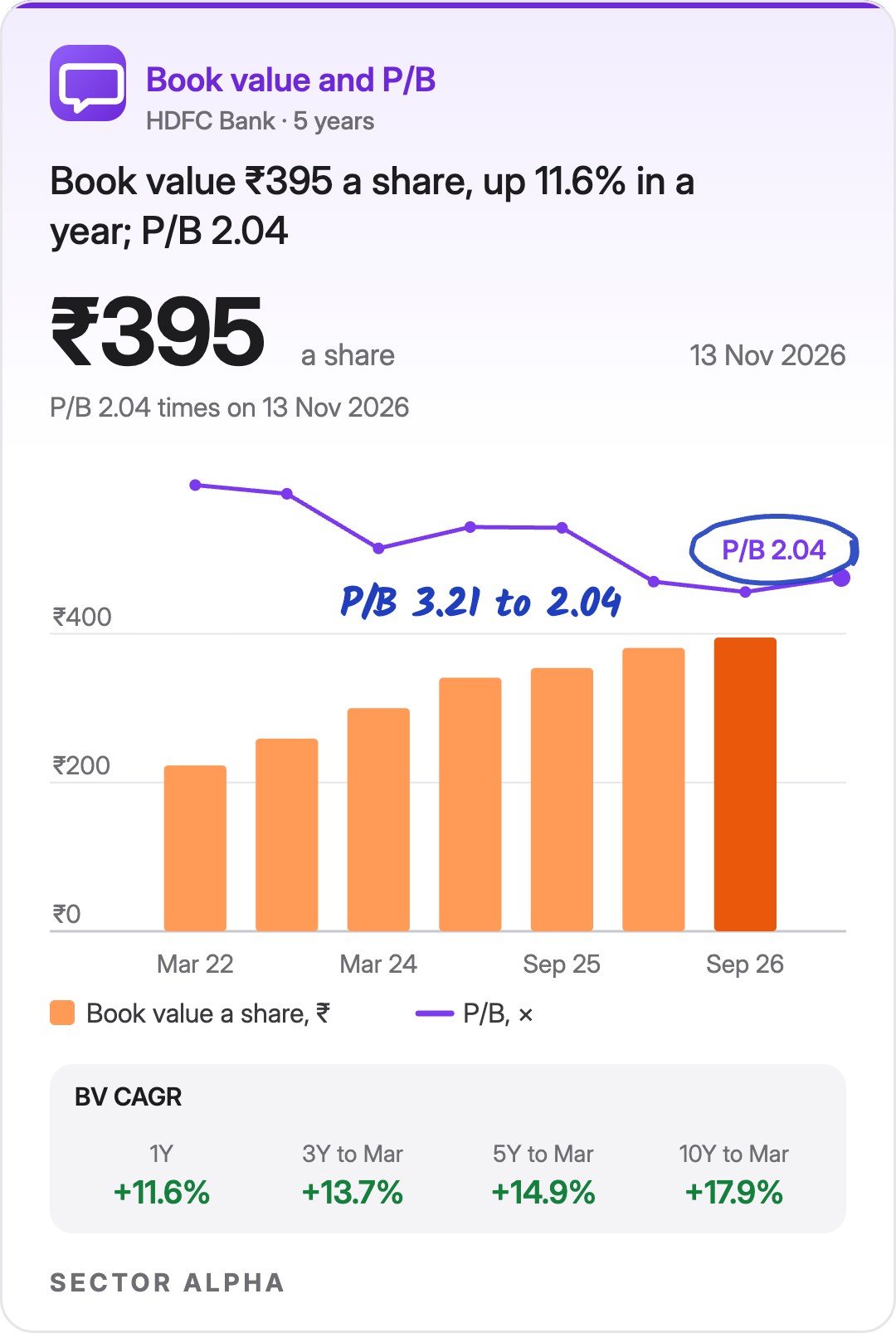
Book value and P/B
Book value per share, what the bank owns minus what it owes, for each share: up 11.6% in the year to Sep 2026.
Share price, about the same year: down 18.8%.
Book value grew while the price fell, so P/B, the price divided by book value per share, fell from about 2.8 on 14 Nov 2025 to 2.04 on 13 Nov 2026.
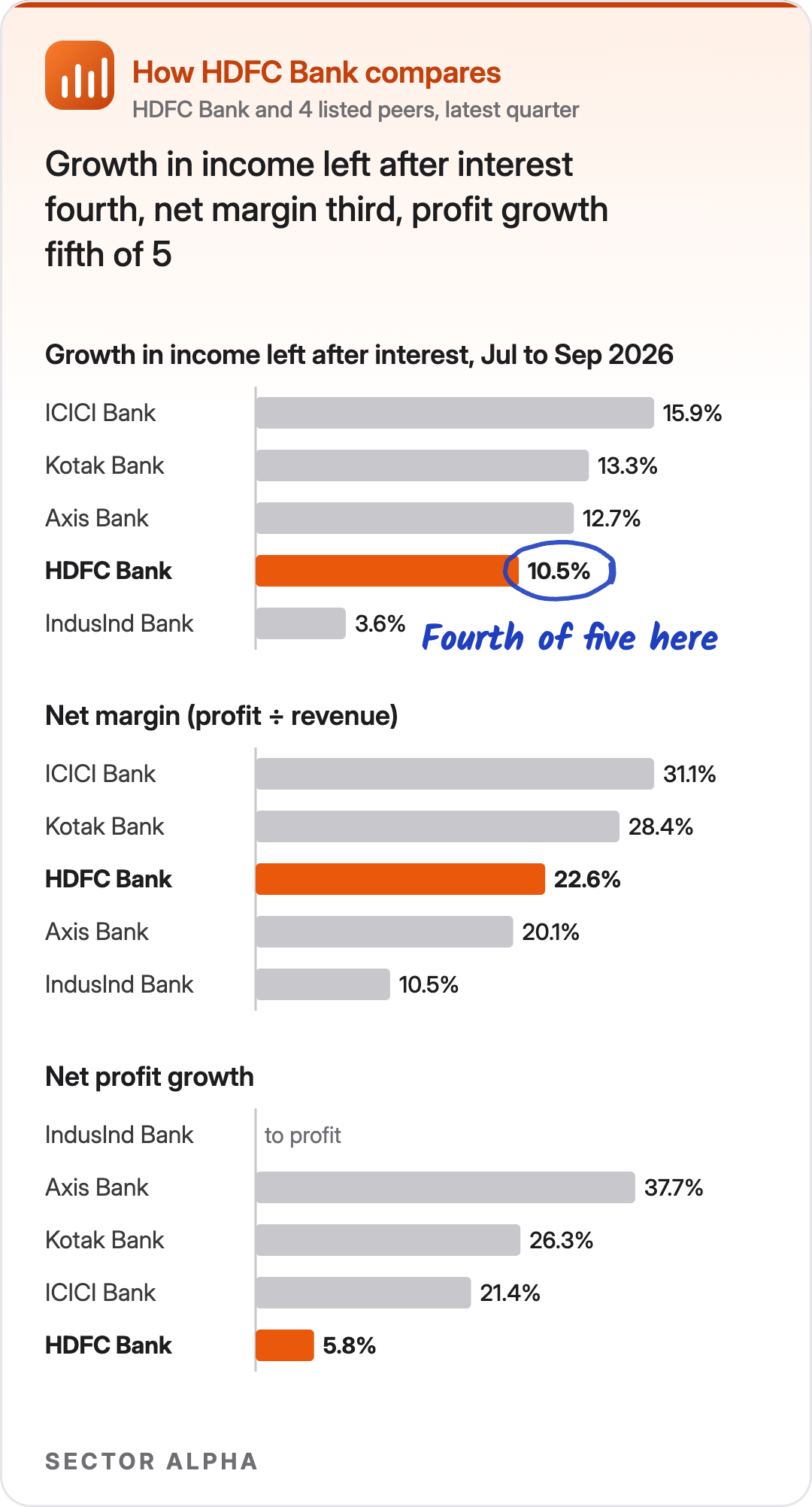
How HDFC Bank compares
I compare HDFC Bank with ICICI Bank, Axis Bank, Kotak Bank and IndusInd Bank, each with its subsidiaries, for Jul to Sep 2026.
Fourth of five in growth of income left after paying interest.
Third of five in net margin, the share of income kept as profit.
Slowest profit growth of the four banks that made a profit in both years. IndusInd Bank swung from a loss to a profit.
Why it trails: the drop in bond trading gains (below), and a thin lending margin. Management also said on the 17 Oct 2026 call that its loans to large companies grew a couple of points slower than at rivals, and that it keeps the returns on those loans in mind.
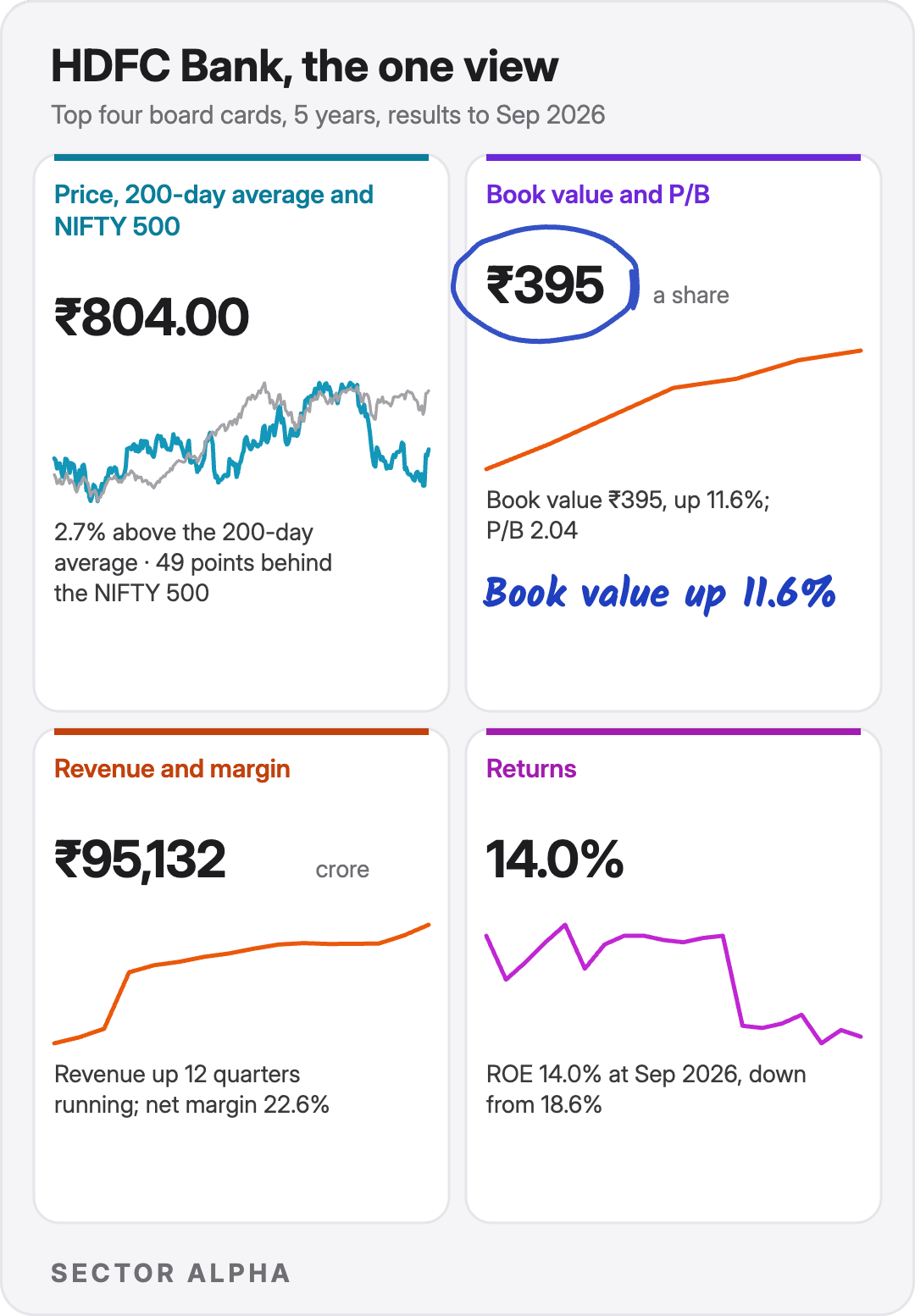
The deep dive
What is happening
Interest earned, income left after interest, and profit all rose against both Apr to Jun 2026 and a year earlier. Against a year earlier, profit rose the slowest. Management’s reasons on the 17 Oct 2026 call:
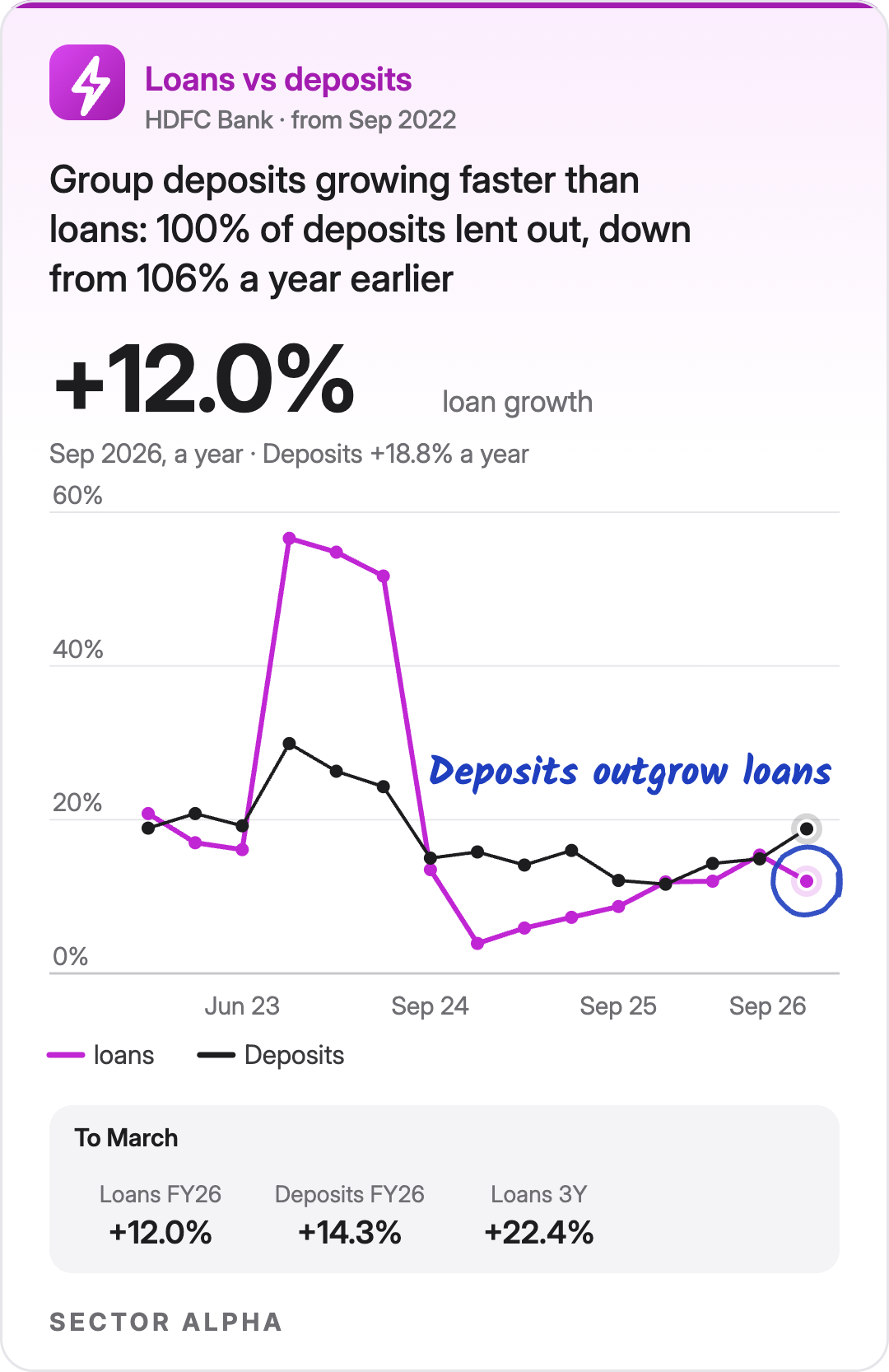
More lending. Deposits grew by about ₹1,57,000 crore in the quarter and loans by about ₹1,58,000 crore, so new money was lent out almost at once.
A thin margin. When interest rates were being cut, the bank’s loan rates came down faster than its deposit costs. That squeezed the gap it earns.
Smaller bond gains. Profit from trading bonds fell sharply against a year earlier.

What it makes
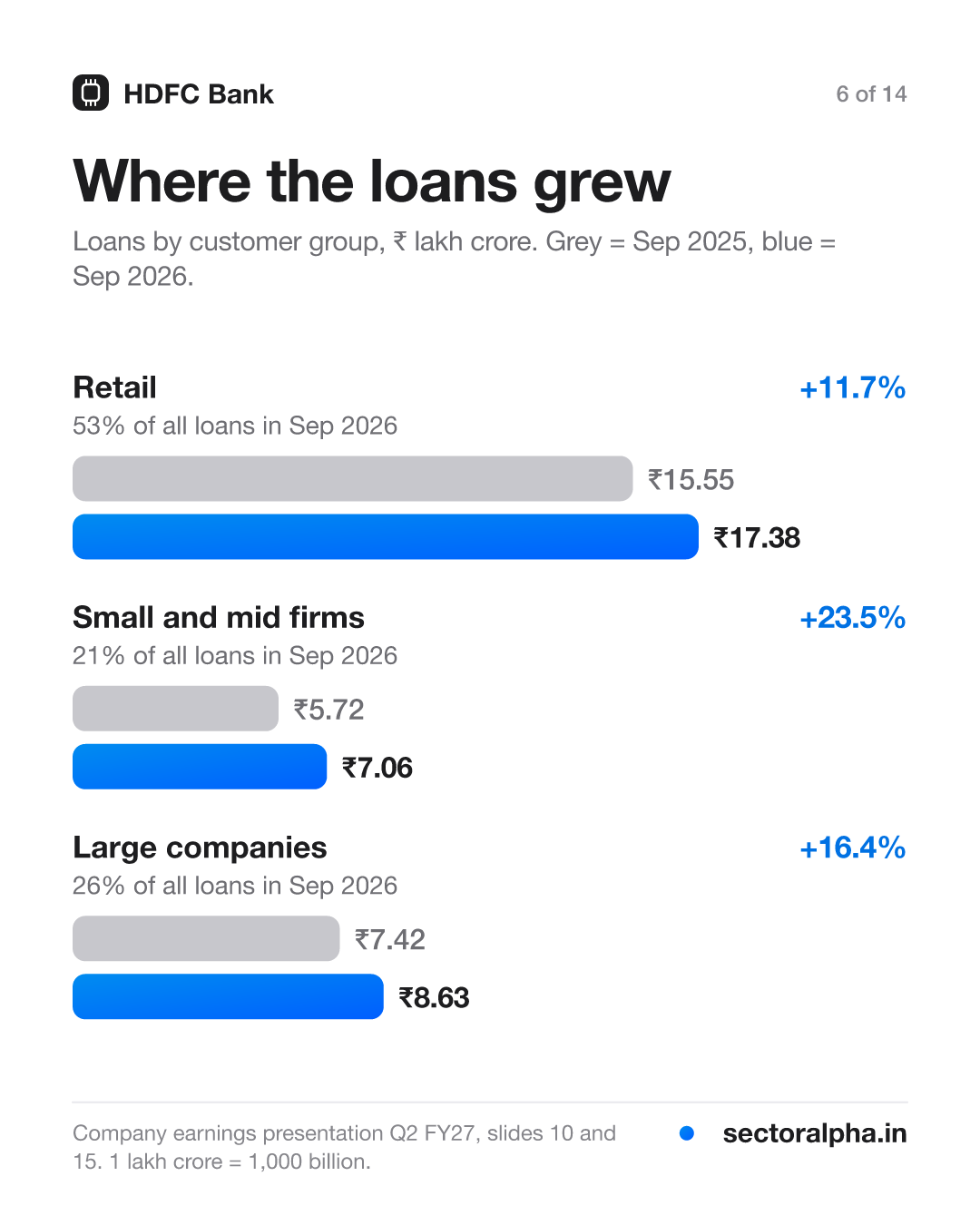
The bank lends to households, to small and mid-sized firms, and to large companies. It also owns stakes in insurance, fund management and other finance businesses.
Why loans to small and mid-sized firms grew fastest: a government credit guarantee scheme, ECLGS 5.0, made these loans safer to give. HDFC Bank paid out ₹41,000 crore under it by Aug 2026, the most of any bank, management said.
Why retail lending picked up: since May 2026 the bank has pushed digital, same-day processing. Management said products reach customers 10% to 15% faster since then, so each staff member visits more customers a day. Retail loans paid out crossed ₹90,000 crore in Jul to Sep 2026, up from ₹76,000 crore in Apr to Jun 2026.
Why loans to large companies grew slower than at rivals: management said it keeps the returns on these loans in mind.
Why profit grew only 4.7%
Leave out bond trading and the bank’s profit grew about 12.6%. By my read, the lending business itself held up.
The drag was one line: gains from trading bonds fell to ₹780 crore in Jul to Sep 2026, from ₹2,390 crore a year earlier. Management did not say on the call why these gains fell.
By my read, interest income from lending grew slower than loans because the margin was squeezed.
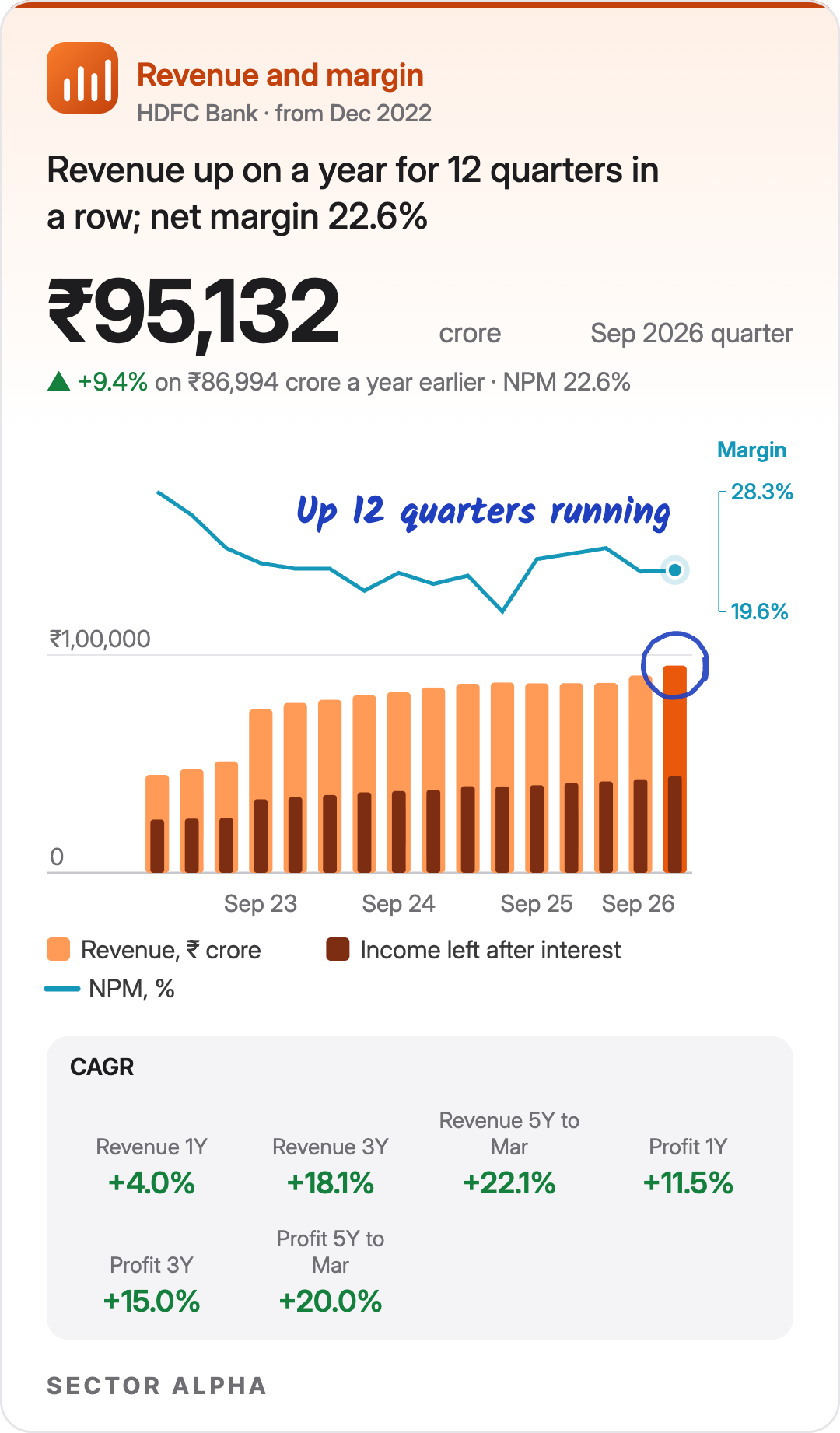
Each quarter vs a year earlier
Interest earned and income after interest: up on a year in each of the last eight quarters. The lever is a loan book that keeps growing.
Profit: up on a year in seven of the last eight quarters.
Margin: management said Jul to Sep 2026 was the low point. About 70% of its loans move with interest rates, and the RBI raised rates by 0.25 percentage points in Oct 2026, so loan rates go up by Dec 2026.
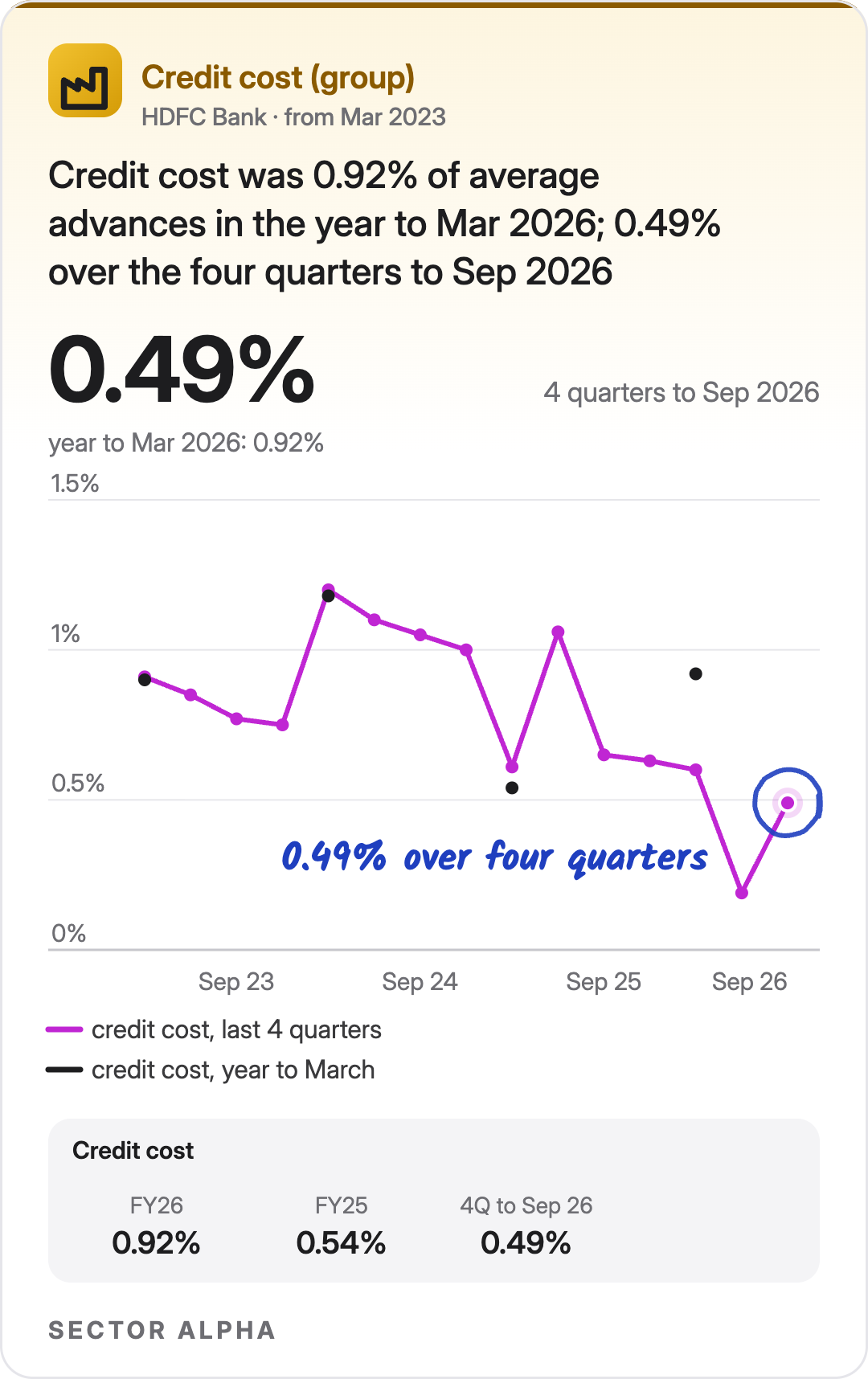
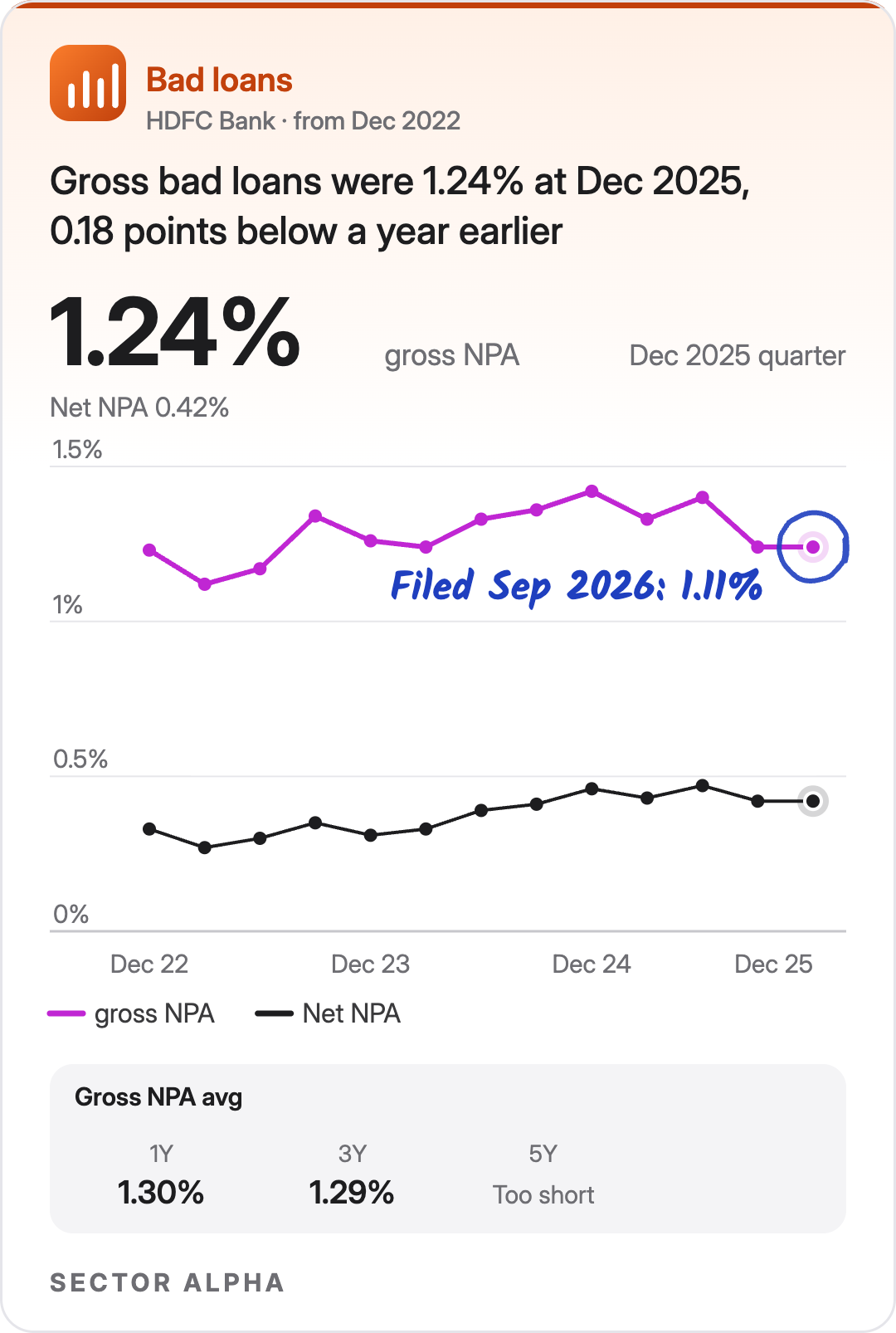
Bad loans and credit cost: low. Management said fewer loans are turning bad across most products, not because the mix of loans changed, and the credit climate has been calm for a long time.
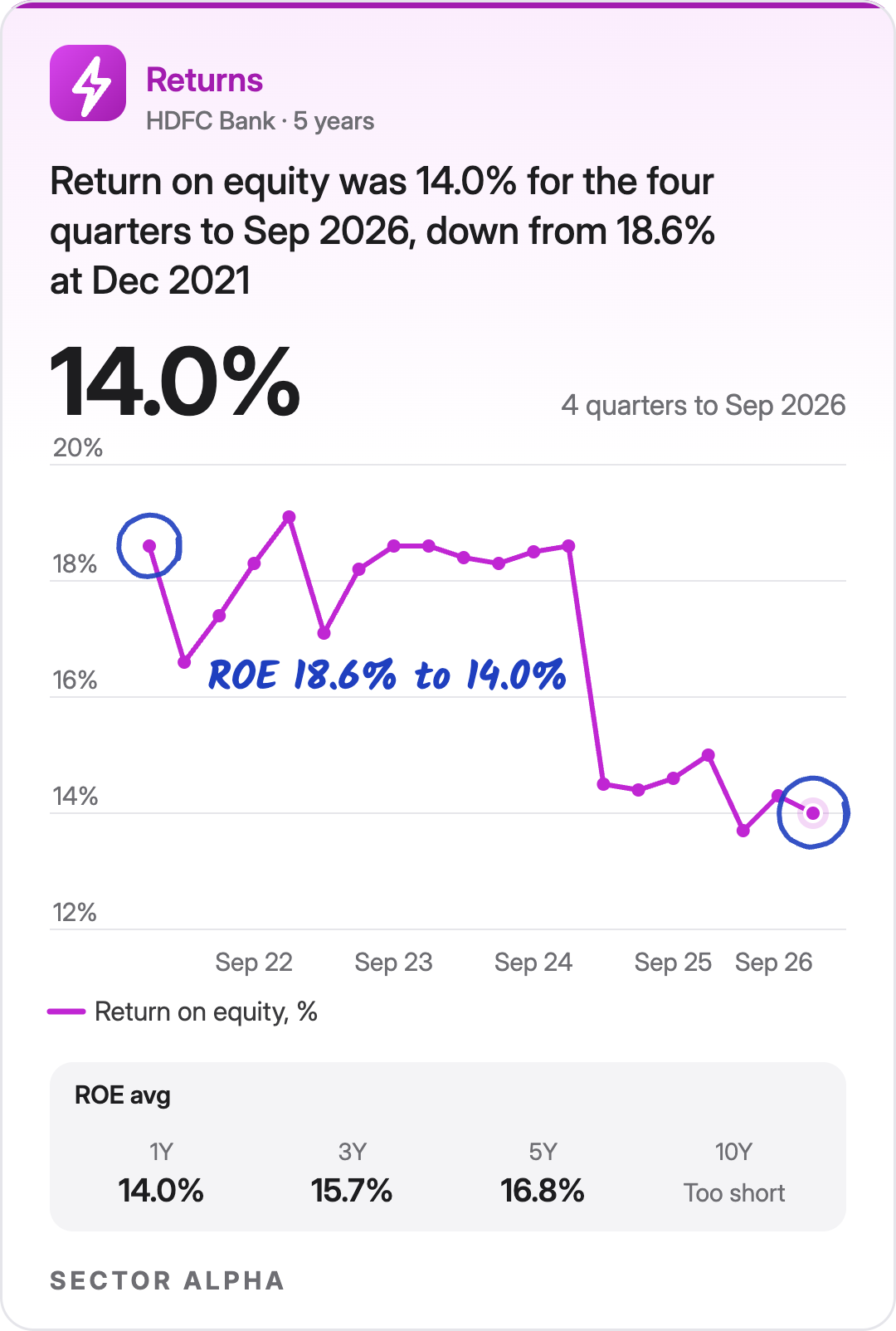
Return on assets: about 1.8%, the range it has held for a long time, the CEO said.
Cash and debt
For a bank, cash flow swings with deposits taken and loans given, so it tells me little about profit.
Why the bank still carries large borrowings: the merger with HDFC Ltd brought that company’s borrowings with it. Nearly ₹2.6 lakh crore of them came due over the last three years, and the bank replaced them with fixed deposits, which cost more than savings accounts.
Capital is ample: 18.9% of risky loans on 30 Sep 2026, against an 11.9% minimum.
One limit: the bank keeps easy-to-sell assets at about 113% of the money that could leave within 30 days. Management wants 110% to 120%, and said this level must hold for loans to keep growing.
Who owns HDFC Bank
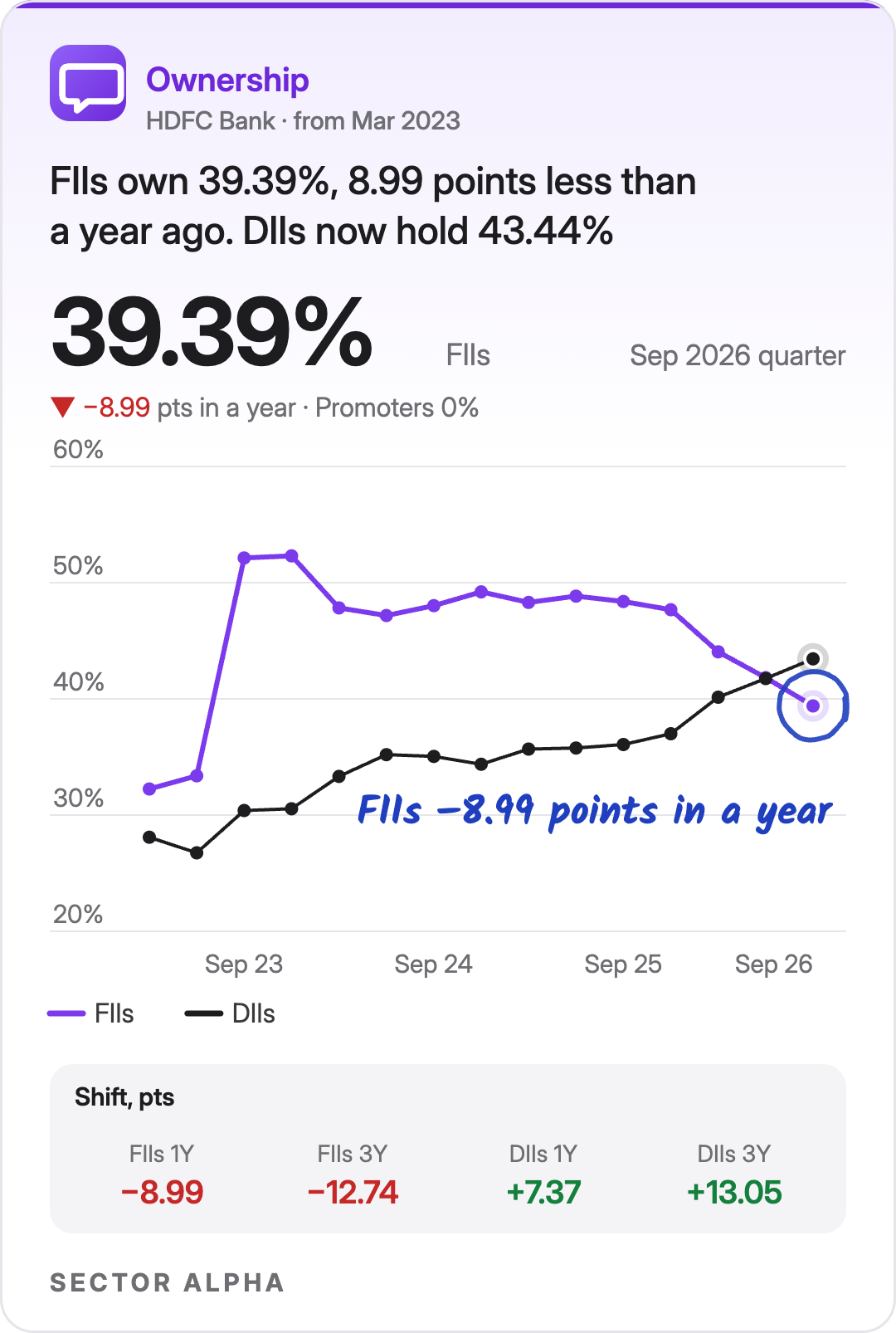
Indian funds bought more of the bank in the year to Sep 2026, and foreign funds sold. There is no promoter, no founding family or parent that controls it.
The call did not cover why foreign funds sold.
Why is this happening
Deposits grew fast, but the costly kind. About 4 points of the 18.8% deposit growth came from a special RBI window for foreign-currency deposits from Indians abroad. Most new money was fixed deposits, so the bank’s funding cost stayed flat at about 4.4% instead of falling.
Savings and current accounts grew slower. These are the cheapest deposits. Management blamed some large one-off withdrawals, and households moving savings away from bank accounts. Retail savings and current accounts did speed up, to about 11.2% growth from 9% a year earlier.
Bad loans stay low. Management said its lending choices keep bad loans down. Farm loans are the one to watch after a weak monsoon, though bad farm loans held steady from Jun to Sep 2026.
New leaders. Sashidhar Jagdishan is leaving as CEO; Anup Bagchi takes over. Deputy MD Kaizad Bharucha asked to retire early by end Dec 2026.
Insurance commissions. Draft rules would cut what banks earn for selling insurance. The CFO called the hit “pretty high” if the draft stays as it is.
From a trajectory point of view, I think that it is at the bottom.
Srinivasan Vaidyanathan, Chief Financial Officer, 17 Oct 2026
What he means: the gap between loan rates and deposit costs stops shrinking from Oct 2026, as loans reprice after the rate rise. A full quarter of the costly foreign-currency deposits works against that.
What to track
Margin: does it rise from 3.32% in Oct to Dec 2026, as management expects?
Funding cost: does it fall below about 4.4%?
Cheap deposits: do savings and current accounts keep speeding up?
Room to lend: do easy-to-sell assets stay in the 110% to 120% band without slowing loans?
Bad loans: do they stay near 1.11%, and do farm loans hold after the weak monsoon?
New CEO: what does Anup Bagchi say on growth, margins, loan quality and productivity?
Insurance rules: how much commission income is left once the final rules land?
All of HDFC Bank’s numbers, every quarter, are on my page: sectoralpha.in/stocks/hdfc-bank-ltd
— Roshan, Sector Alpha