


Not SEBI registered. Not investment advice. For your own research only.
Multi Commodity Exchange of India, MCX for short, runs India’s largest commodity exchange. People trade contracts on gold, silver, crude oil and gas there, and MCX takes a small fee on every trade.
In Jul to Sep 2026 its revenue more than doubled against a year earlier.
The fee did not go up. The trading did.
The catch: one cost took a break. MCX made no payment into its settlement guarantee fund in Jul to Sep 2026. On 4 Nov, the CEO said payments might resume after a few quarters.
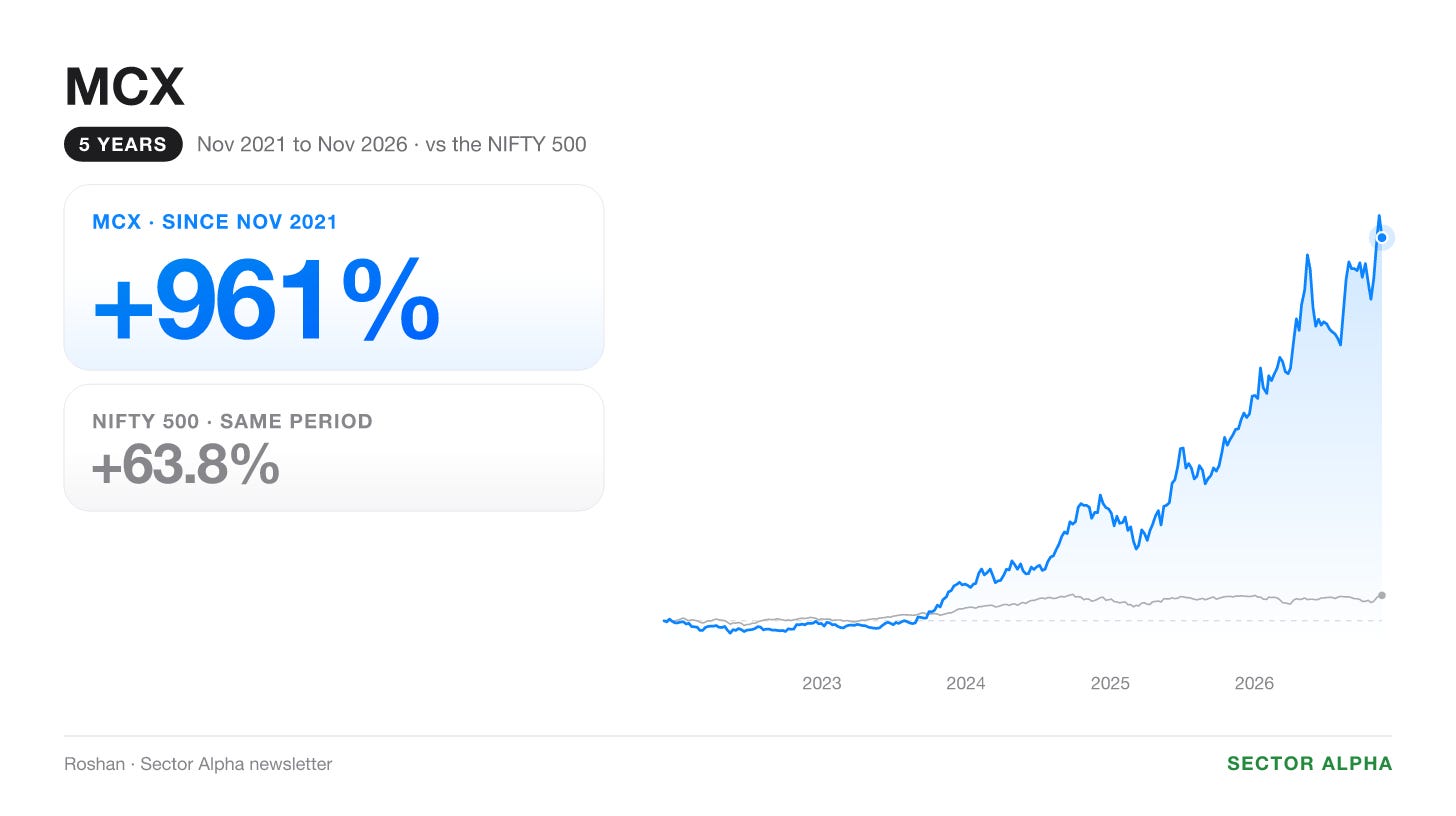
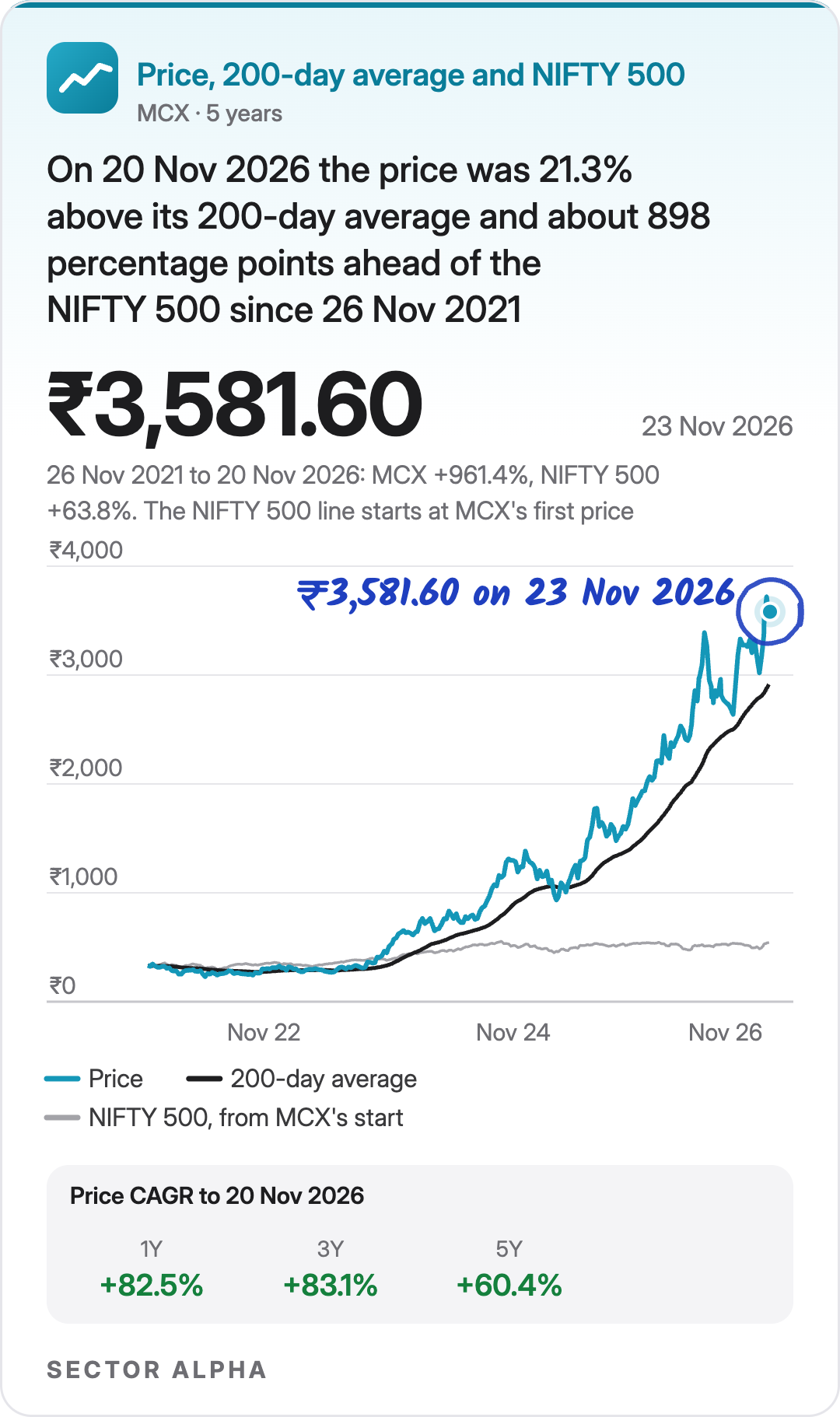
MCX’s share price rose 82.5% from 21 Nov 2025 to 20 Nov 2026. The NIFTY 500, a broad Indian stock market index, gained 1.3% over the same dates. Over five years, 26 Nov 2021 to 20 Nov 2026, MCX rose 961.4% and the NIFTY 500 63.8%.
Earnings and P/E
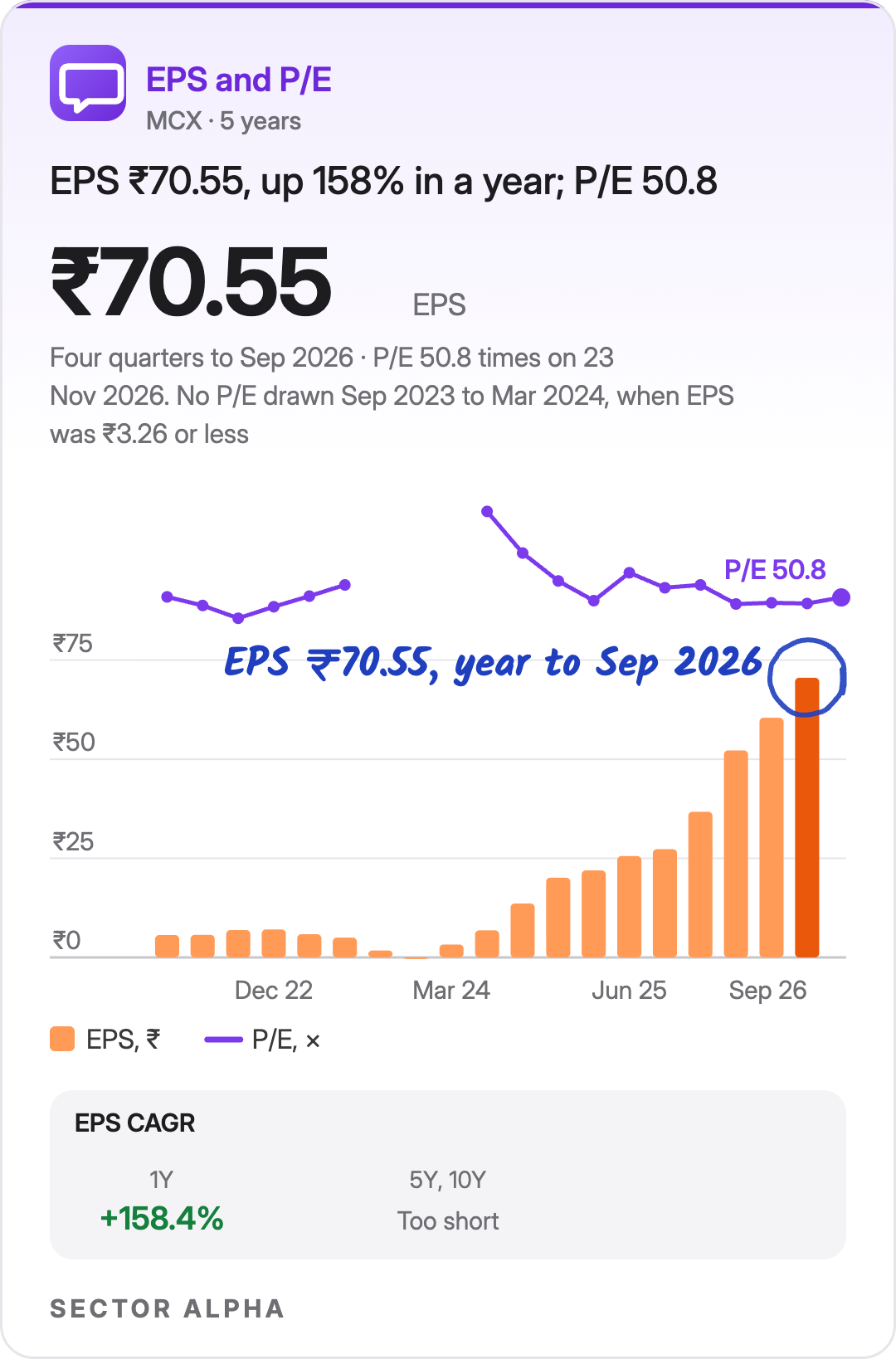
Earnings per share, added up over four quarters: ₹27.3 to Sep 2025, ₹70.55 to Sep 2026. Up 158.4%.
Earnings ran well ahead of the price. So P/E, the price divided by a year’s earnings per share, fell from about 71 on 21 Nov 2025 to 50.8 on 23 Nov 2026.
How MCX compares
I put MCX next to four listed companies that also earn fees from services that keep Indian markets running. BSE Ltd runs a stock exchange. CDSL holds shares electronically for people. CAMS and KFin Tech keep records for mutual funds.
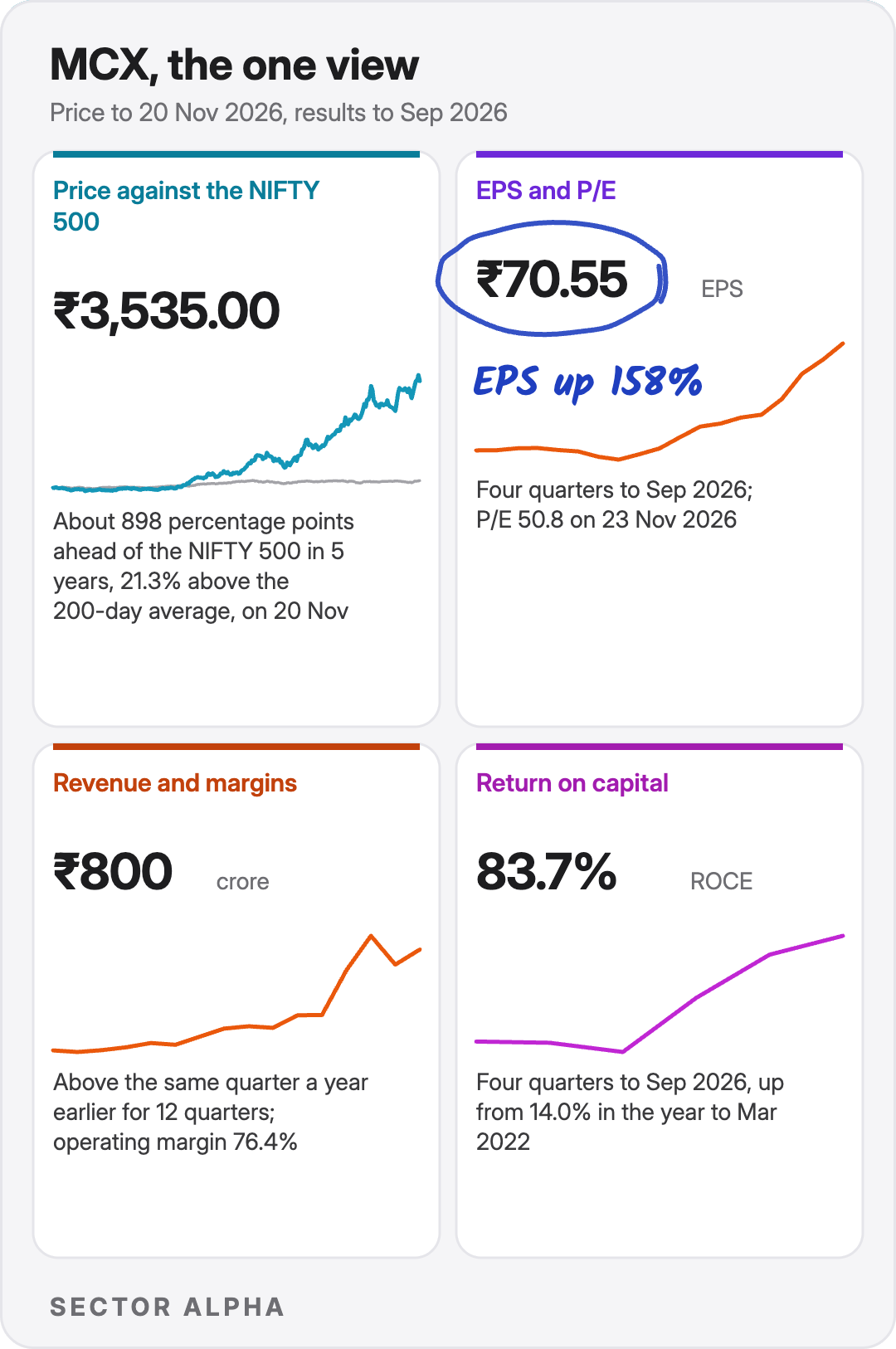
Sales growth in Jul to Sep 2026 against a year earlier: 113.9%, ahead of all four others. BSE Ltd’s sales grew 34.2%.
Operating margin, the share of sales left after running costs, in Jul to Sep 2026: 76.4%, above all four others.
Profit growth in Jul to Sep 2026 against a year earlier: 130.2%, ahead of all four others.
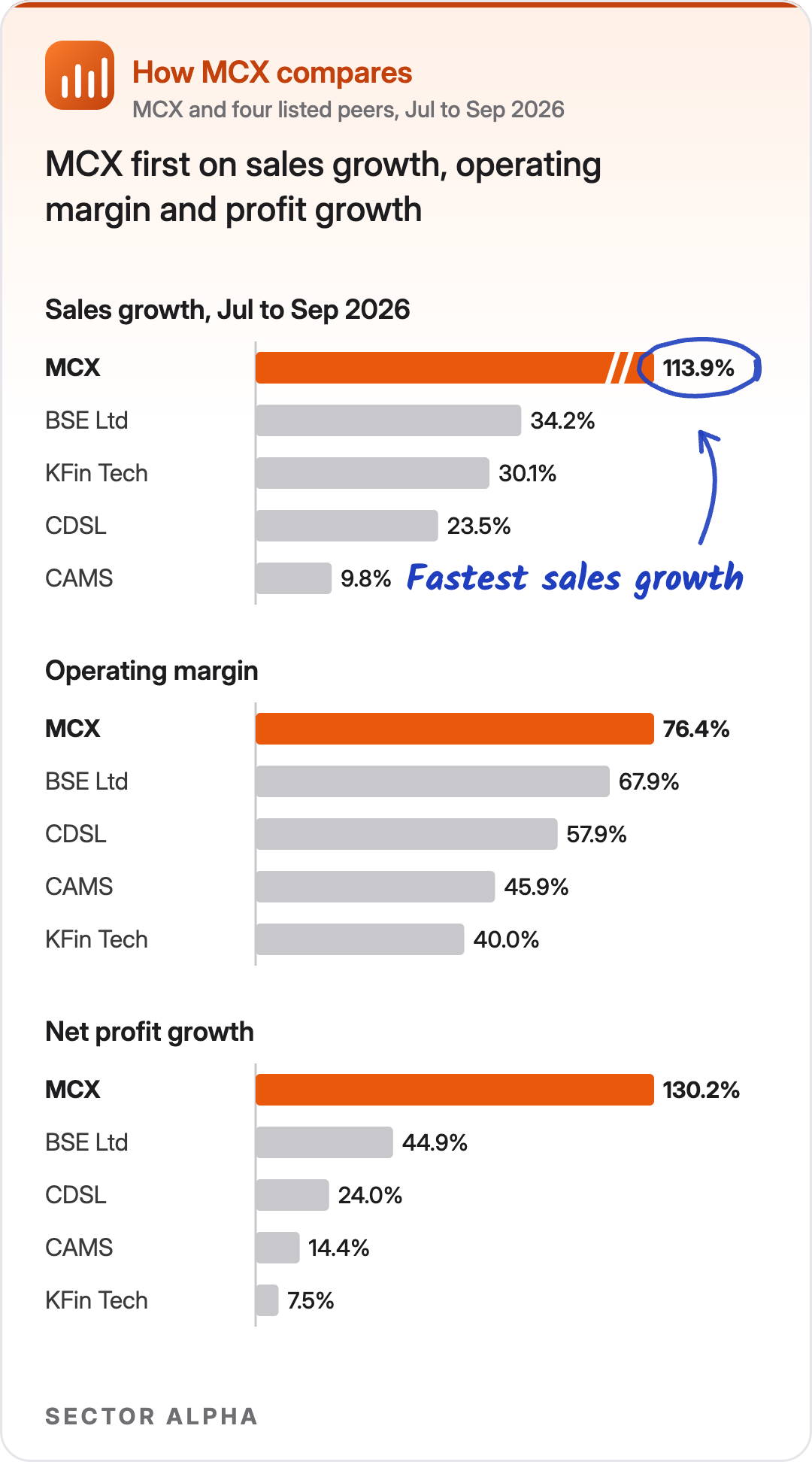
My page works from sales rounded to the crore, so MCX’s growth shows as 113.9%. On the exact filed figures it is 113.7%.
The deep dive
What is happening
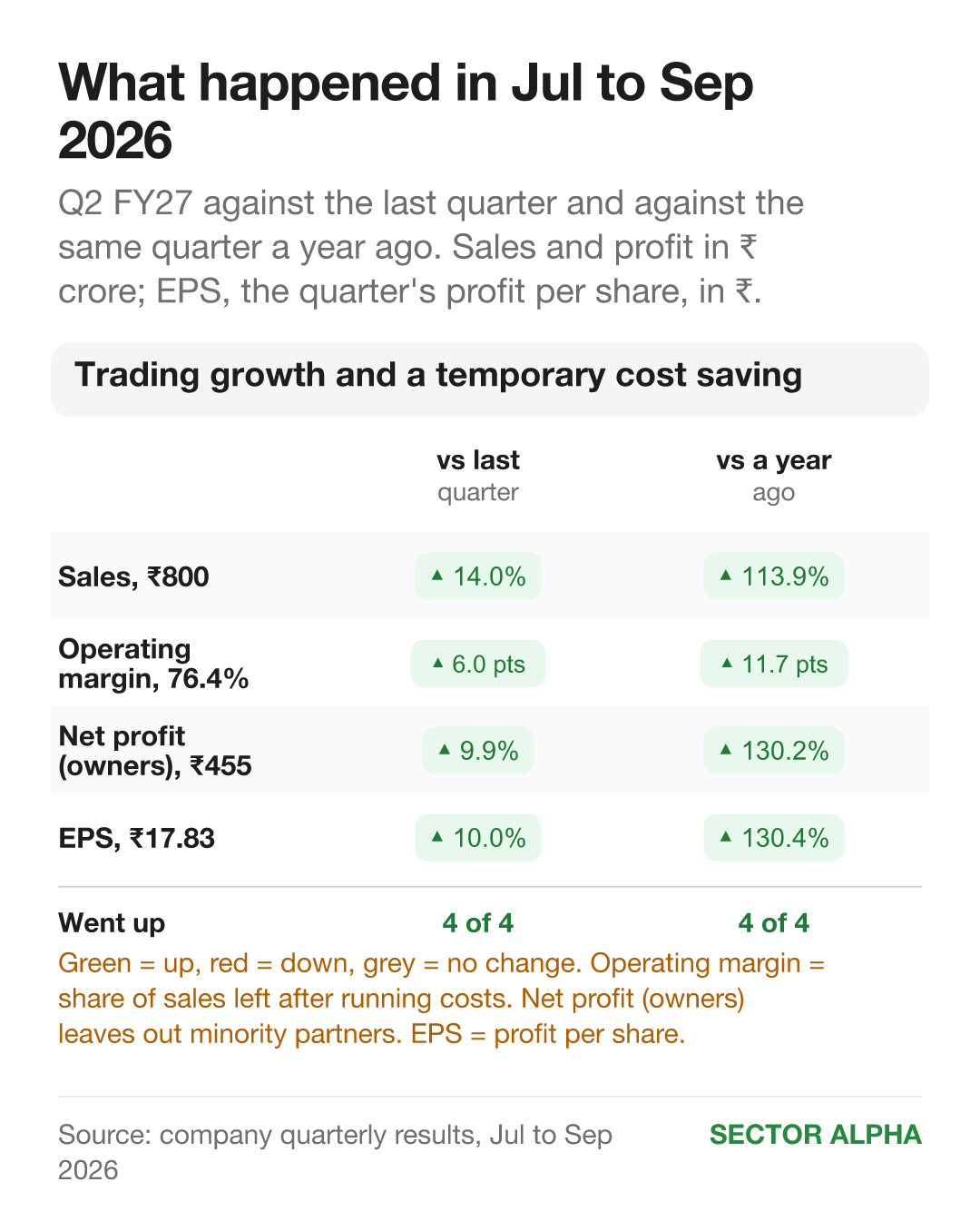
Against Apr to Jun 2026, sales rose 14.0% to ₹800 crore and profit that belongs to the owners rose 9.9% to ₹454.57 crore. The results and the earnings call give these reasons:
More trading, same fee. Average daily turnover in futures and options rose 20.4% against Apr to Jun 2026. The CEO linked larger price swings to heavier trading and said no fee increase was behind it.
A paused payment. Regulatory fees and fund contributions fell to ₹24.84 crore from ₹54.19 crore. The finance head said the Jul to Sep 2026 amount went to other funds and regulatory payments. He said a SEBI rule change in August 2026 cut what the settlement guarantee fund must hold. The fund covers trades if a clearing member, a firm that settles trades on the exchange, defaults.
Costs that stay. IT costs rose 23.2% against Apr to Jun 2026, to ₹34.63 crore. The CEO said they pay for added trading capacity and are not one-time.
A bigger tax bill. Tax rose 68.4% to ₹184.67 crore. It included a catch-up at the clearing arm, the subsidiary that settles trades, so profit grew slower than sales. The finance head expects a rate closer to 25% from here.
What it makes
MCX sells a place to trade. Traders pay a fee for futures, a deal to trade on a later date at a price agreed up front, and for options, the right but not the duty to make that deal.
MCX handled over 98% of the value of India’s commodity futures traded in Apr to Sep 2026. Gold and silver were 66% of its futures turnover in Apr to Sep 2026.
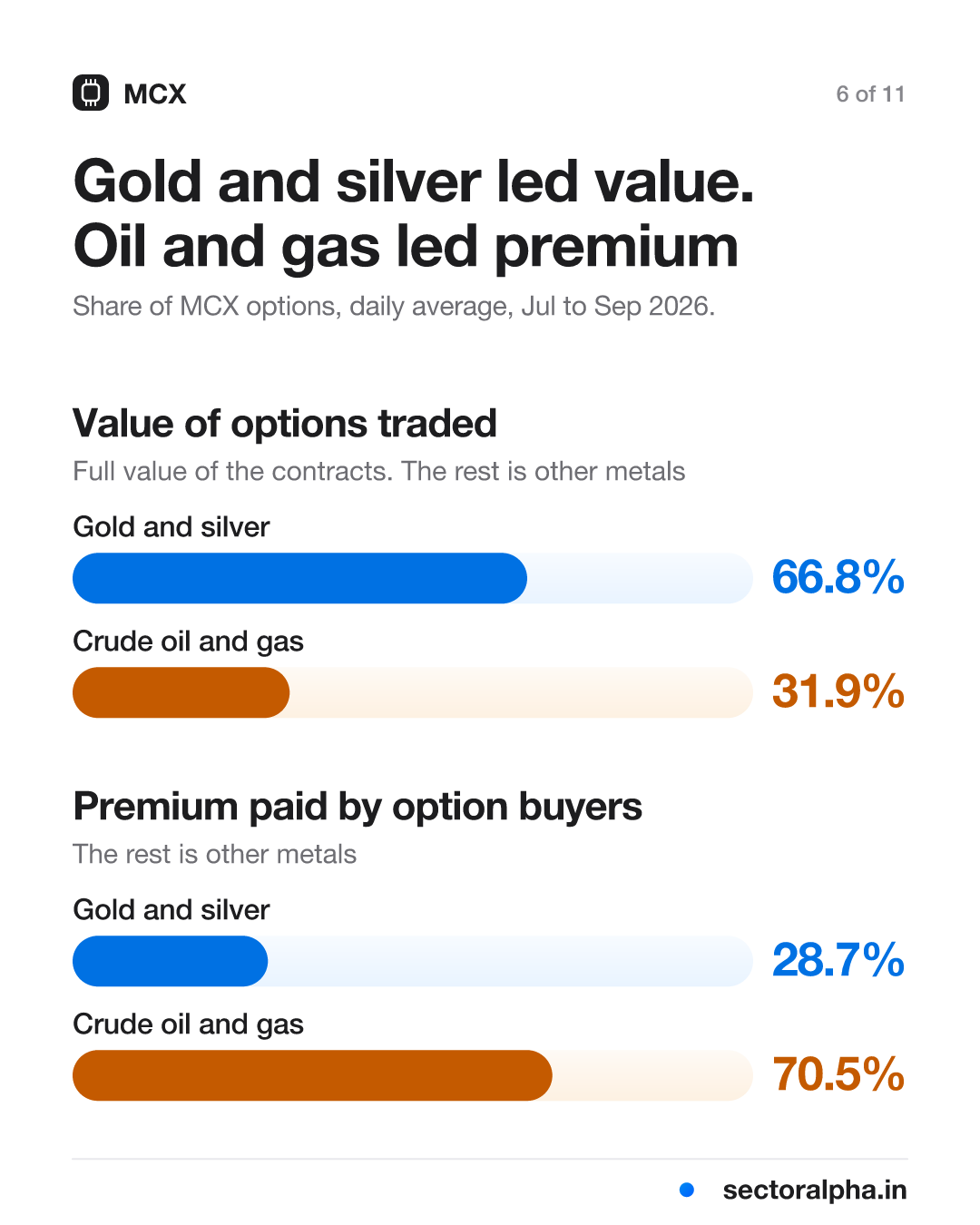
Options are where the growth is. The premium, what option buyers pay for the contract, averaged ₹10,291 crore a day in Jul to Sep 2026, up 151% from ₹4,096 crore a year earlier.
What surprised me: gold and silver were 66.8% of options contract value and crude oil and gas 31.9%. Their shares of premiums were 28.7% and 70.5%. Other metals made up the balance in each case.
I found the newer contracts still small. Silver 100-gram futures started trading on 1 Jun 2026. On the 4 Nov 2026 call, the CEO said they were trading more than ₹100 crore a day. Electricity futures averaged about ₹77 crore a day in Jul to Sep 2026. On the same call, the business head put MCX’s share of electricity futures at about 75%.
Each quarter vs a year earlier
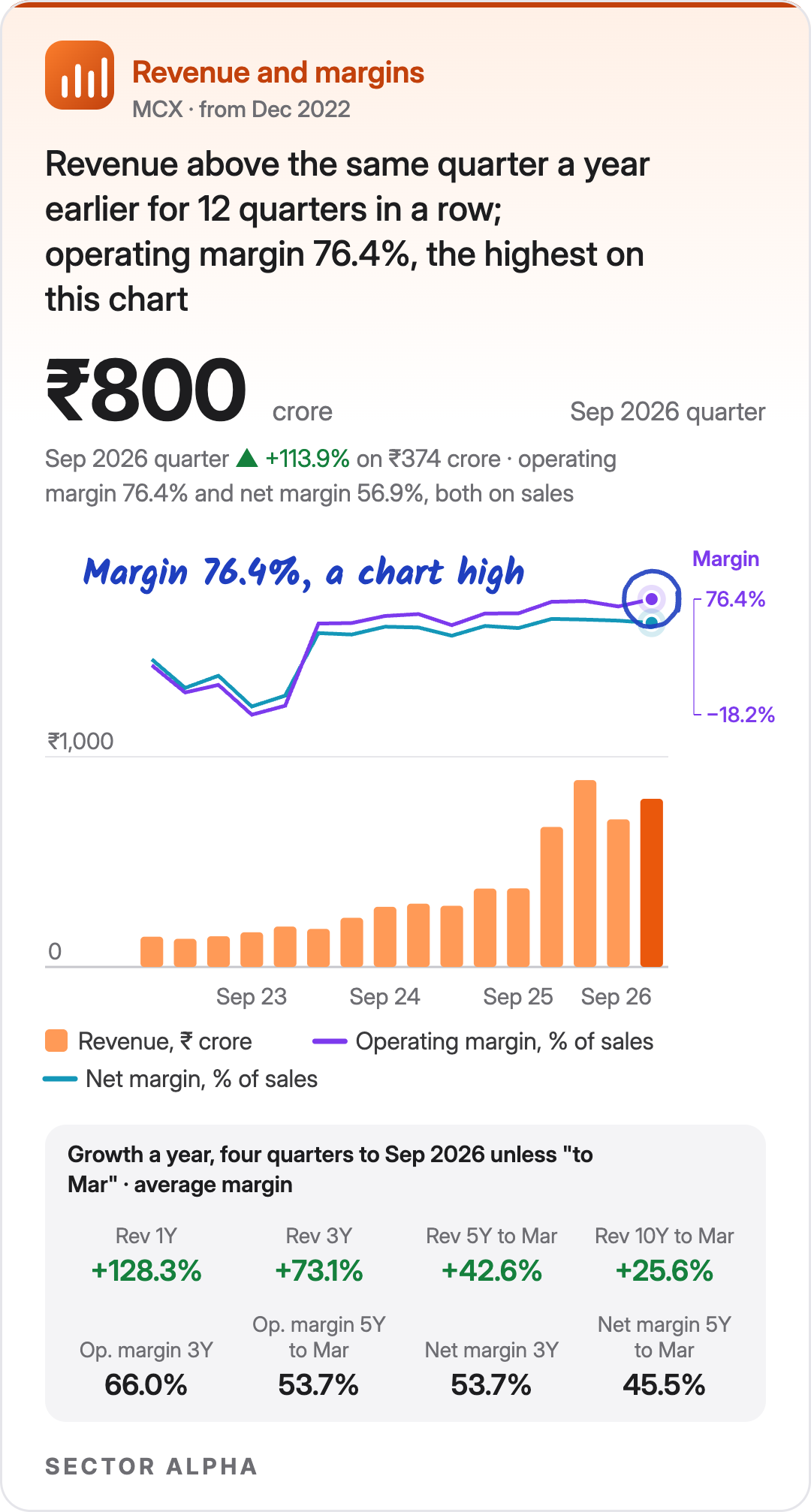
Sales: beat the same quarter a year earlier for all 12 quarters from Dec 2023 to Sep 2026. The step up came in Oct to Dec 2025, when average daily options turnover more than tripled against a year earlier.
Margin: above a year earlier in seven of the last eight quarters. I think most of an exchange’s costs stay put while trading swells, so each extra rupee of fees keeps more profit. In Jul to Sep 2026, staff cost grew 25.4% and IT cost 50.2% on a year, both well below sales growth of 113.7%.
Profit: above a year earlier in eight of the last eight quarters.
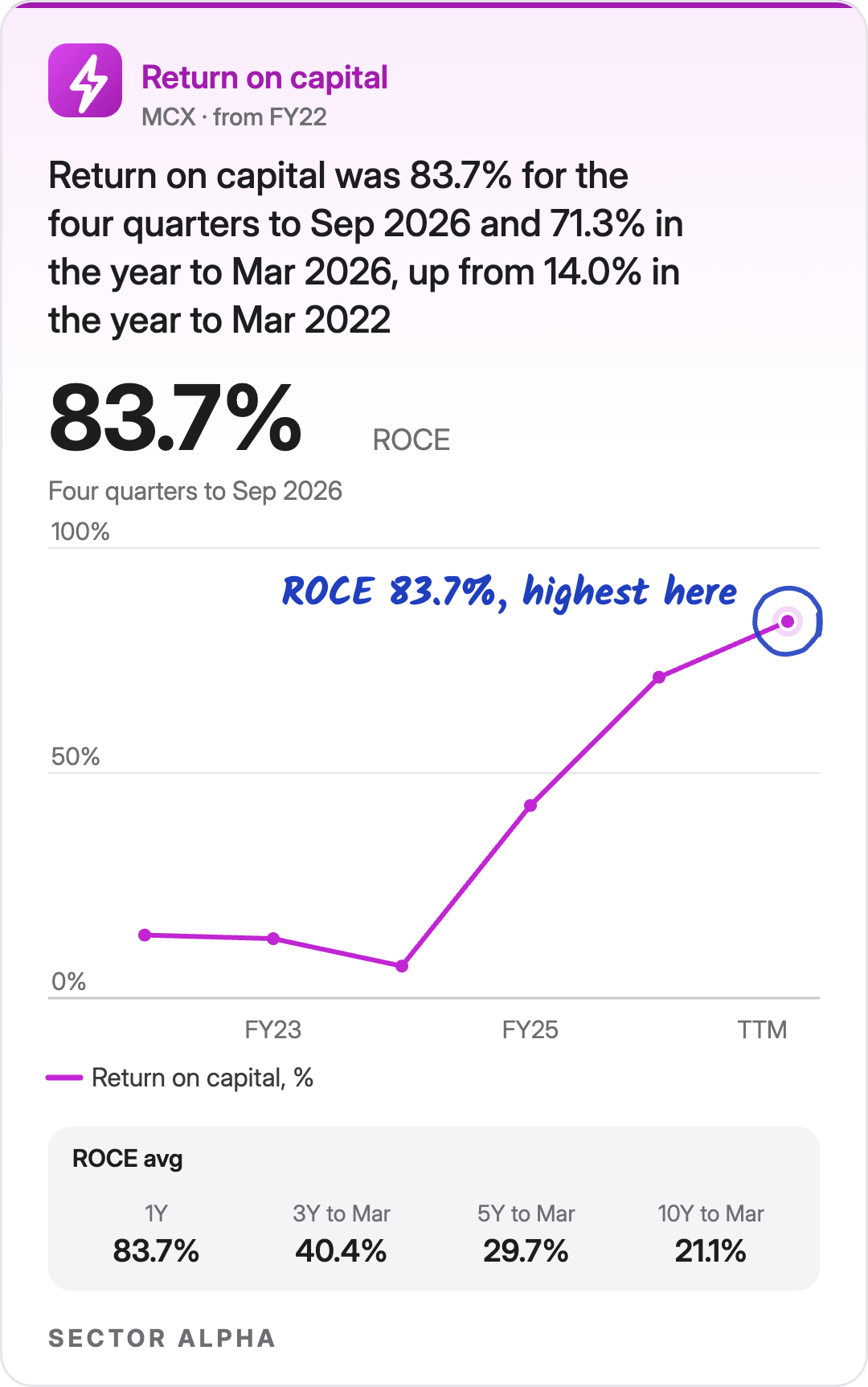
Return on capital, by my math: 71.3% in the year to Mar 2026 and 83.7% for the four quarters to Sep 2026. I divide profit before interest and tax by the average money put in by shareholders and lenders over the period, the same way my page does.
Cash and debt
Cash from operations was ₹3,035 crore in the year to Mar 2026, against a profit of ₹1,332 crore.
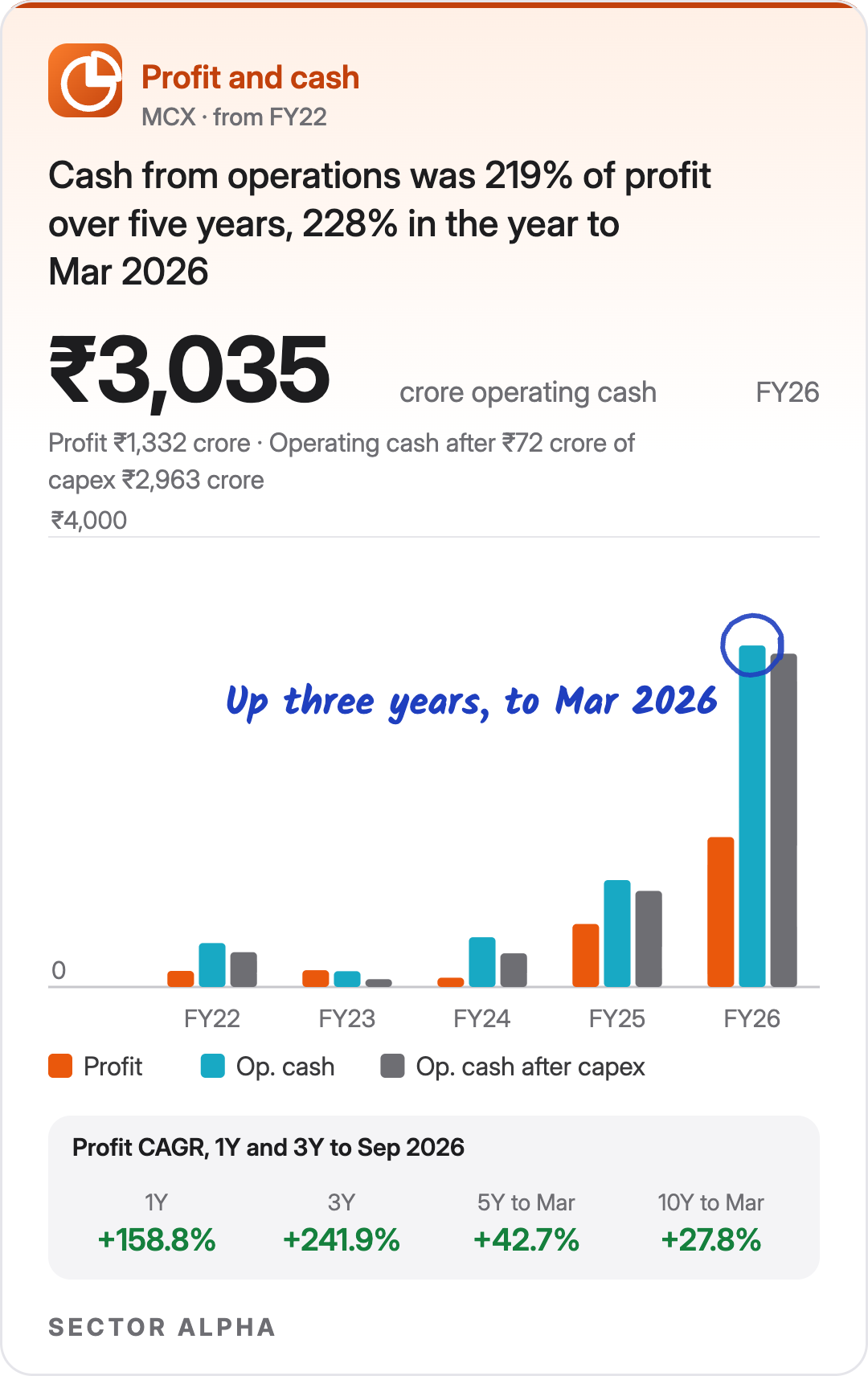
The half year since looks different. In Apr to Sep 2026, operating cash was ₹305.97 crore, against ₹1,016.09 crore a year earlier. Other short-term financial liabilities, a line of the filed cash flow statement, fell by ₹547.78 crore in Apr to Sep 2026, after rising by ₹436.88 crore a year earlier.
Spending on equipment and software was ₹72 crore in the year to Mar 2026. In Apr to Sep 2026 it was ₹112.96 crore, against ₹39.46 crore a year earlier.
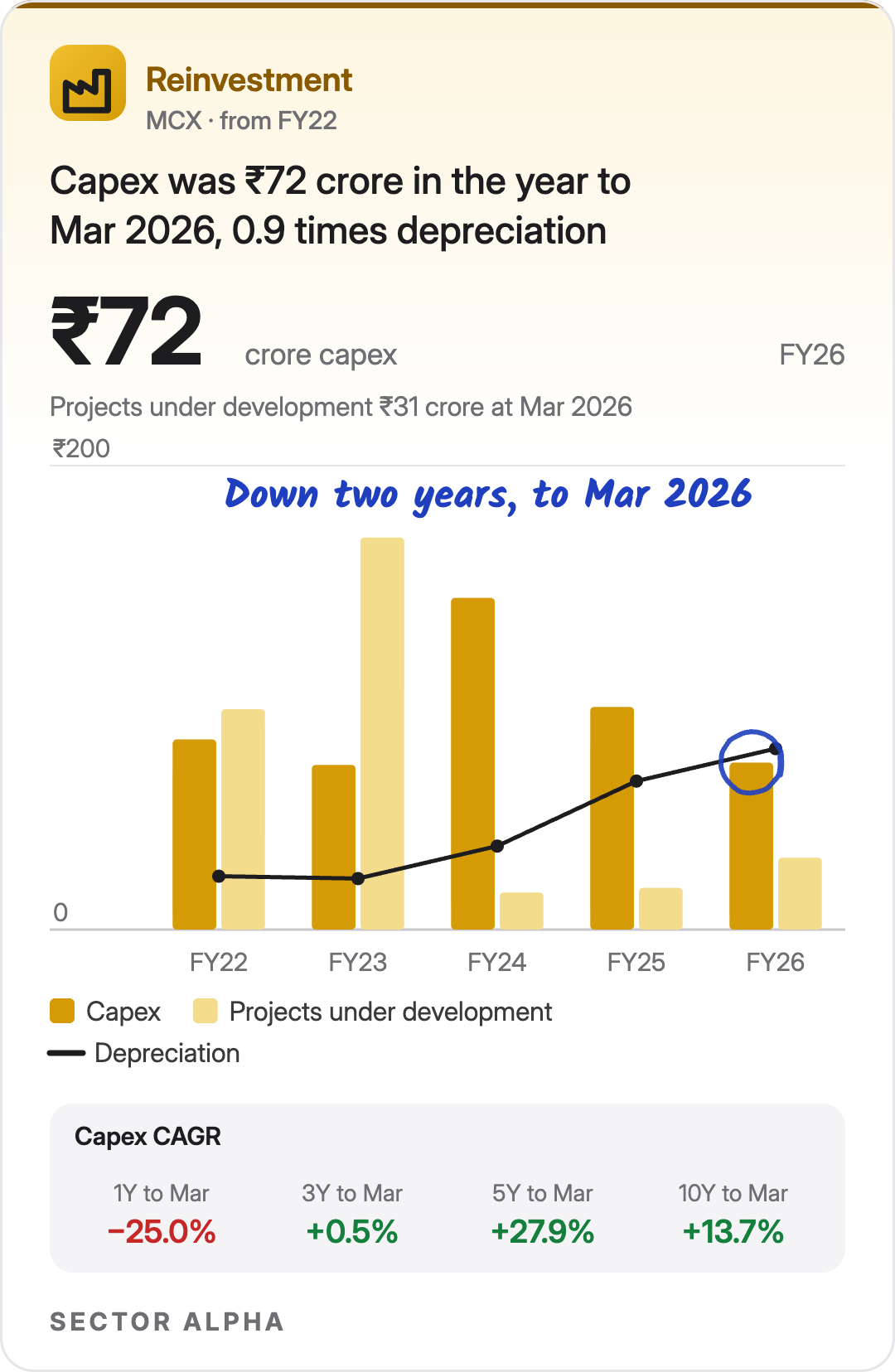
MCX has no bank borrowings. Its only debt-like item is ₹9.08 crore of lease liabilities on 30 Sep 2026, against ₹3,511.96 crore of the owners’ money.
Who owns MCX
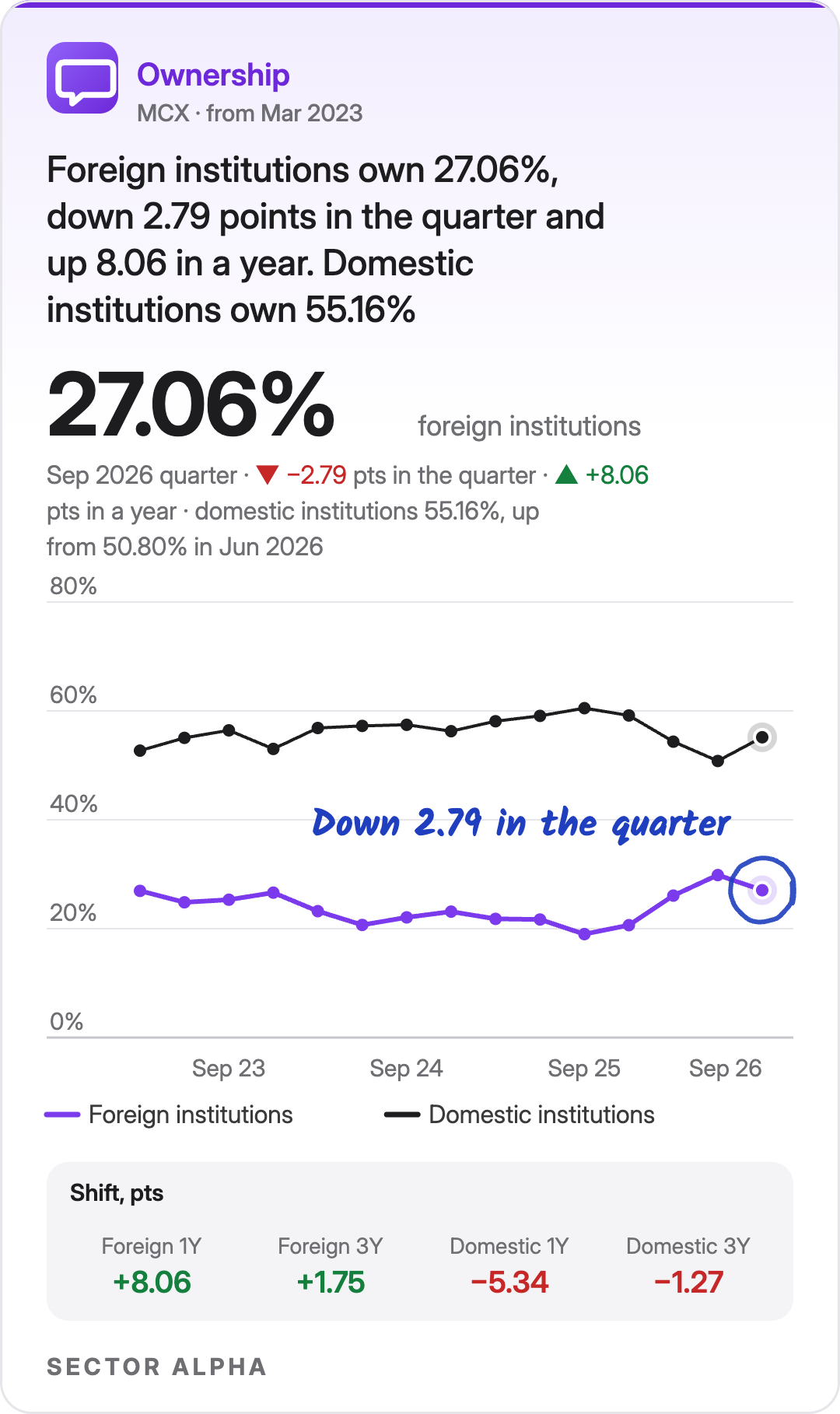
MCX has no promoter. On 30 Sep 2026, mutual funds held 33.95%, foreign portfolio investors 27.06% and banks 15.00%, per its 4 Nov 2026 presentation.
Domestic institutions held 55.16% in Sep 2026, up from 50.80% in Jun 2026. Foreign institutions held 27.06% in Sep 2026, against 29.85% in Jun 2026 and 19.00% in Sep 2025.
Shareholders went from 2,56,715 in Sep 2025 to 4,21,389 in Sep 2026.
What management said, what happened
I checked what management said on the August call against the November results and call.
Effect unclear. The CEO did not expect a new RBI rule on bank guarantees to hurt trading much. Average daily futures and options turnover rose 20.4% against Apr to Jun 2026. She said the mix of large trading firms and retail traders held steady, but that it was hard to say if broader growth hid the rule’s effect.
Staff cost fell slightly. The finance head said a one-time item in staff cost would not repeat. Staff cost was ₹56.16 crore in Jul to Sep 2026, against ₹57.45 crore in Apr to Jun 2026.
On track. On the 5 Aug 2026 call, the CEO said she expected more clients to trade in FY27 than in FY26. FY26 had 20.9 lakh clients who traded. In Apr to Sep 2026, the first six months, there were 19.8 lakh.
Launch status unconfirmed. On the 5 Aug 2026 call, the CEO said planned index contracts would reach the market within a few months. Index trading was nil in Jul to Sep 2026. On the 4 Nov 2026 call, she said MCX is pacing its pipeline of launches.
Why is this happening
Jumpy markets. The CEO linked larger price swings to heavier trading.
Options clients more than doubled. 13.03 lakh clients traded options in Jul to Sep 2026, up from 6.40 lakh a year earlier.
More people trading. 14.98 lakh clients traded futures or options in Jul to Sep 2026, up 89.8% from a year earlier.
Fixed costs, bigger volumes. Costs rose far slower than revenue, so the margin widened.
...we are in times of greater uncertainty, and that does lead to increased extent of volatility and hence, volume is related to that.
Praveena Rai, Managing Director and Chief Executive Officer, MCX, on the November results call
So whatever SGF contribution we have made so far is sufficient
Chandresh Shah, Chief Financial Officer, MCX, on the November results call
SGF is the settlement guarantee fund.
What to track
Calmer markets: does trading hold up if gold, silver and oil prices settle down?
Options premium: does what option buyers pay keep growing in Oct to Dec 2026?
Safety-fund payments: when payments into the settlement guarantee fund restart, how much margin do they take back?
Tax: does the rate settle near 25%, as the finance head expects?
Clients who traded: does FY27 beat FY26’s 20.9 lakh?
Foreign funds: on 4 Nov 2026, about 250 foreign funds were registered. They could trade only energy contracts settled in cash. Does permission for gold, silver and metals arrive?
Index products: do the planned index contracts reach the market?
MCX’s quarterly figures are on my page: sectoralpha.in/stocks/multi-commodity-exchange-of-india-ltd
— Roshan, Sector Alpha