


Not SEBI registered. Not investment advice. For your own research only.
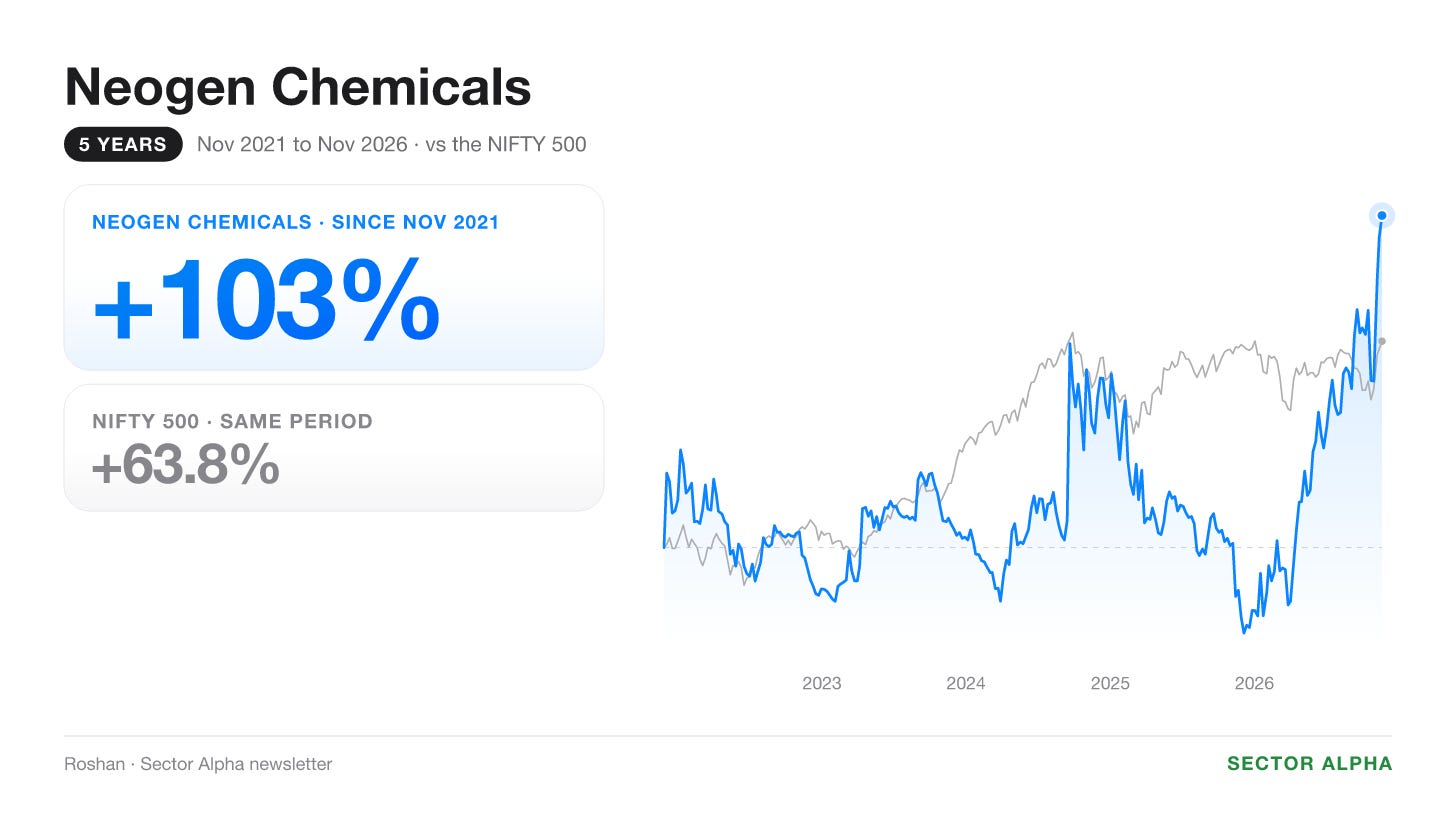
Neogen Chemicals makes specialty chemicals based on bromine and lithium. A newer arm makes chemicals that go inside lithium-ion batteries.
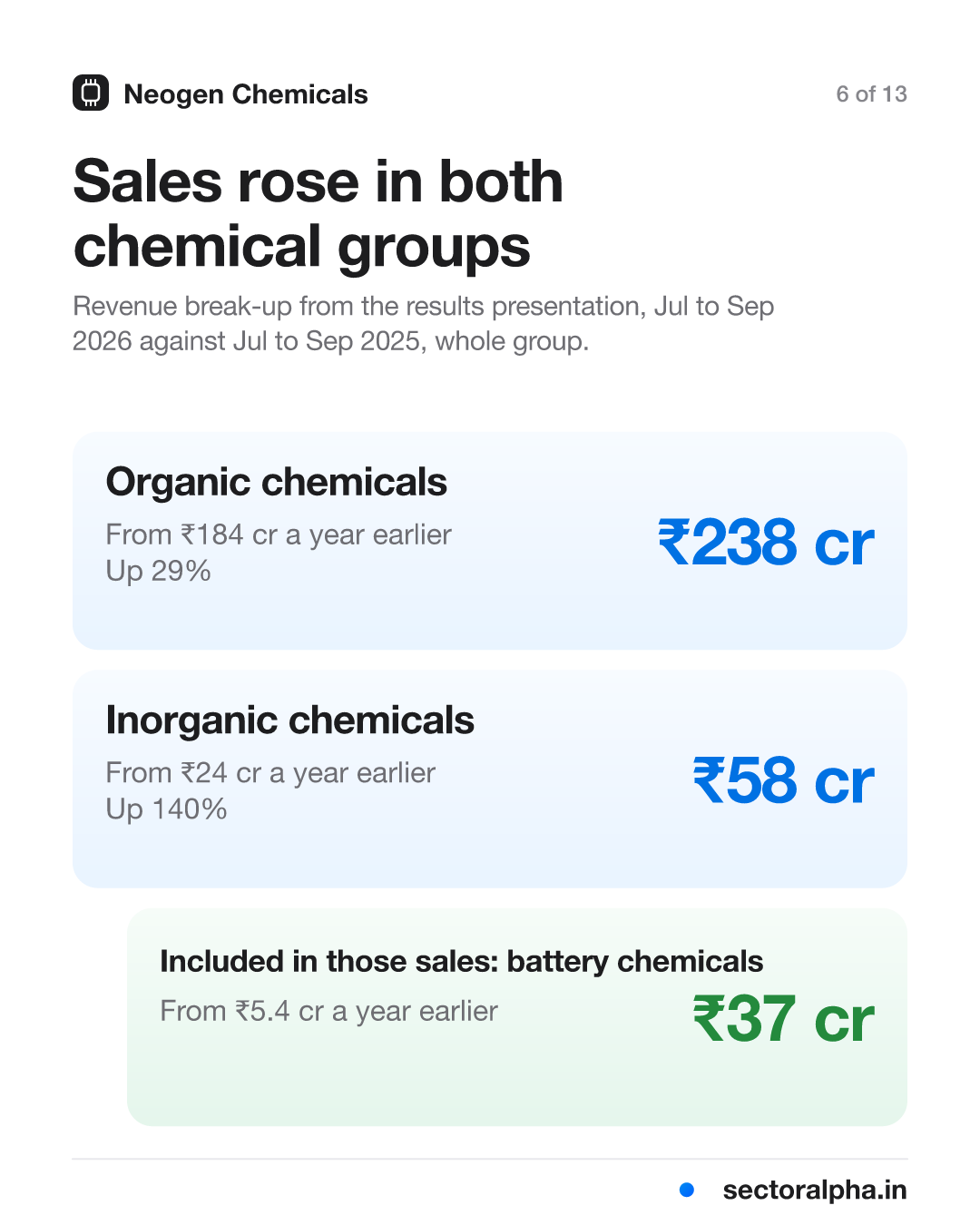
That battery arm sold ₹37 crore in Jul to Sep 2026. In the whole of FY26 it sold ₹36 crore.
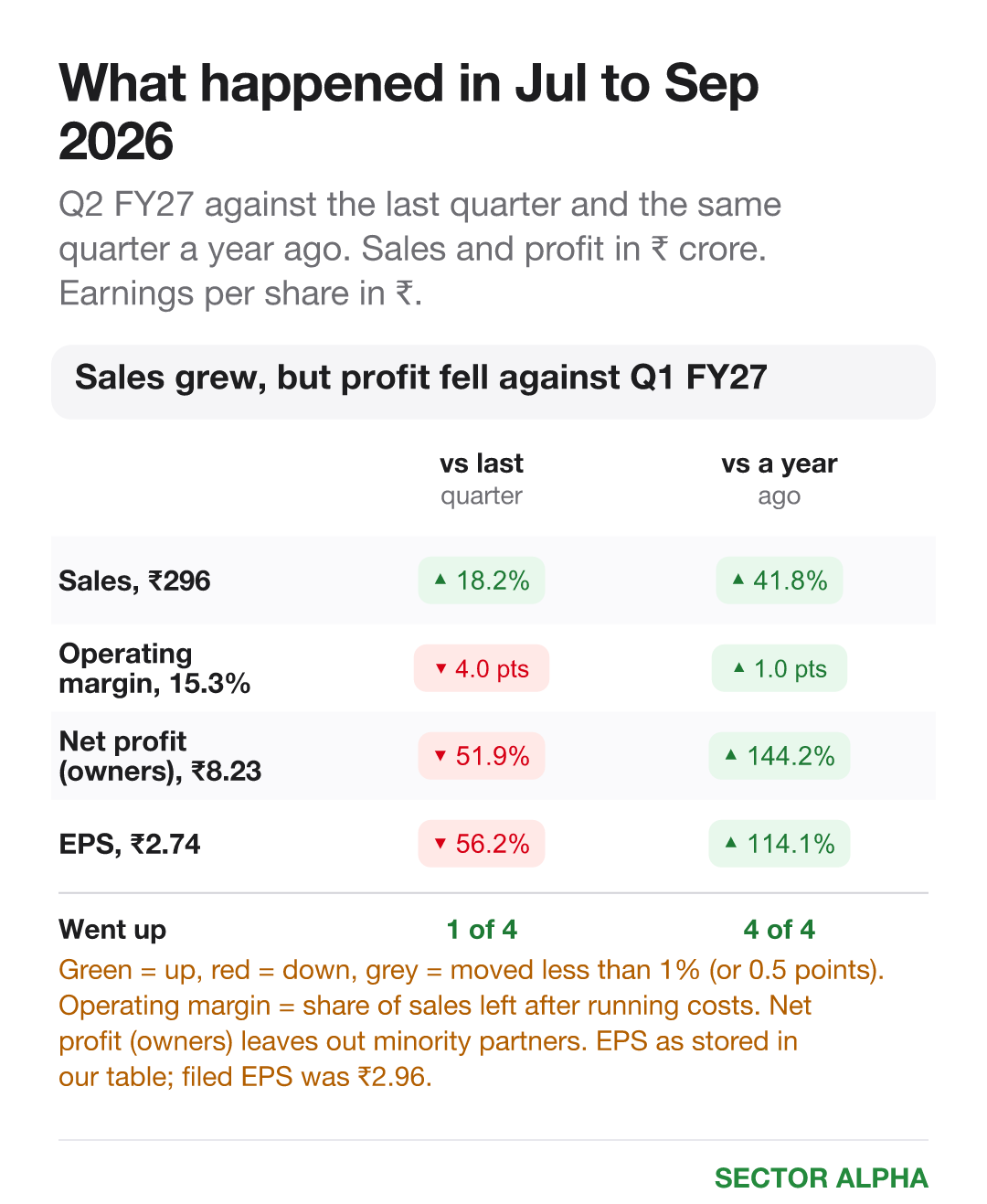
The catch: group profit fell 51.9% from Apr to Jun 2026. Neogen is paying interest and start-up costs on plants that are not running fully yet.
Profit for the four quarters to Dec 2025 was down about 60% on a year. So profit is the line I read first.
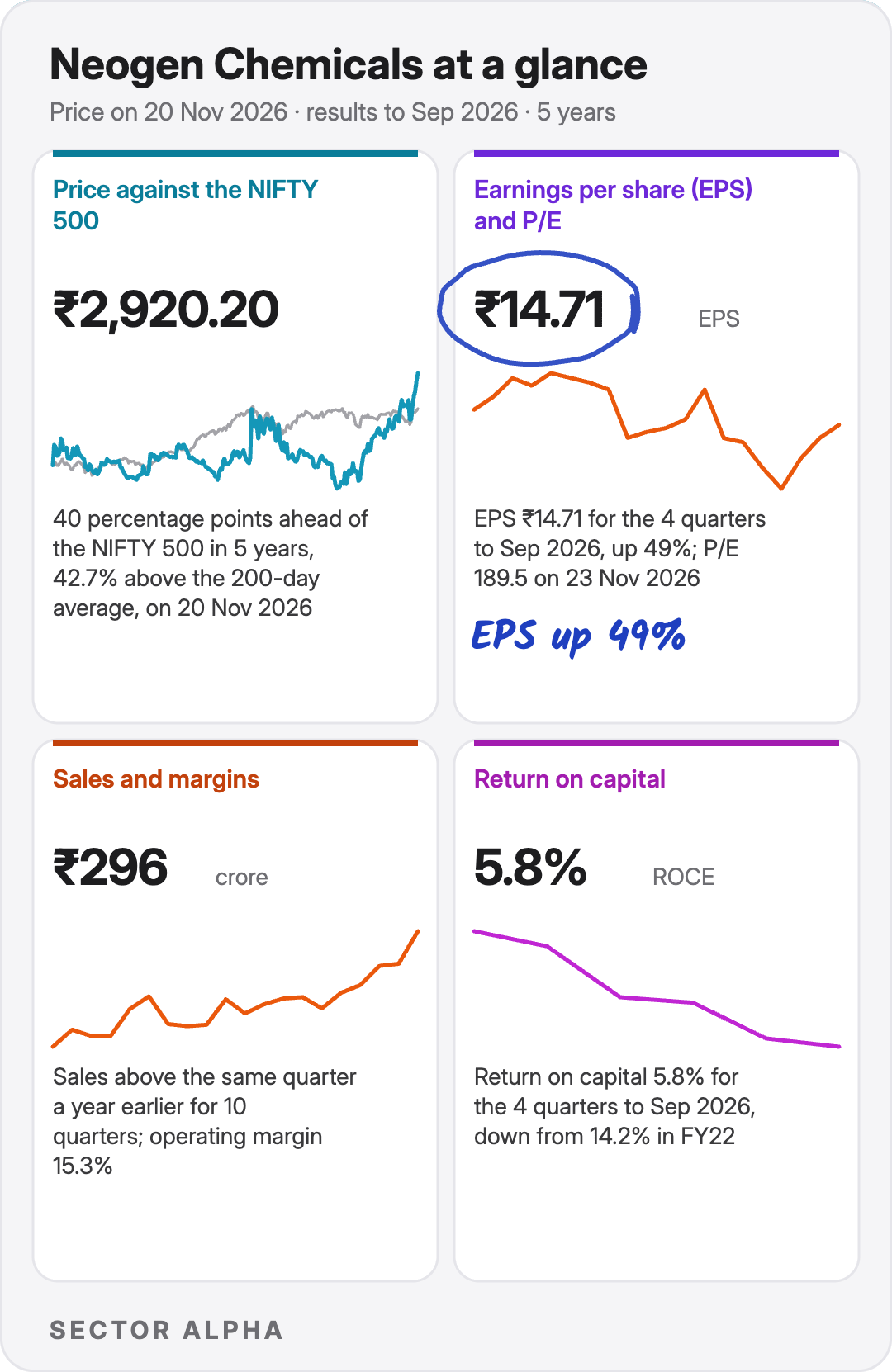
Neogen's share price rose 134.7% from 21 Nov 2025 to 20 Nov 2026. The NIFTY 500 index rose 1.3% over the same dates.
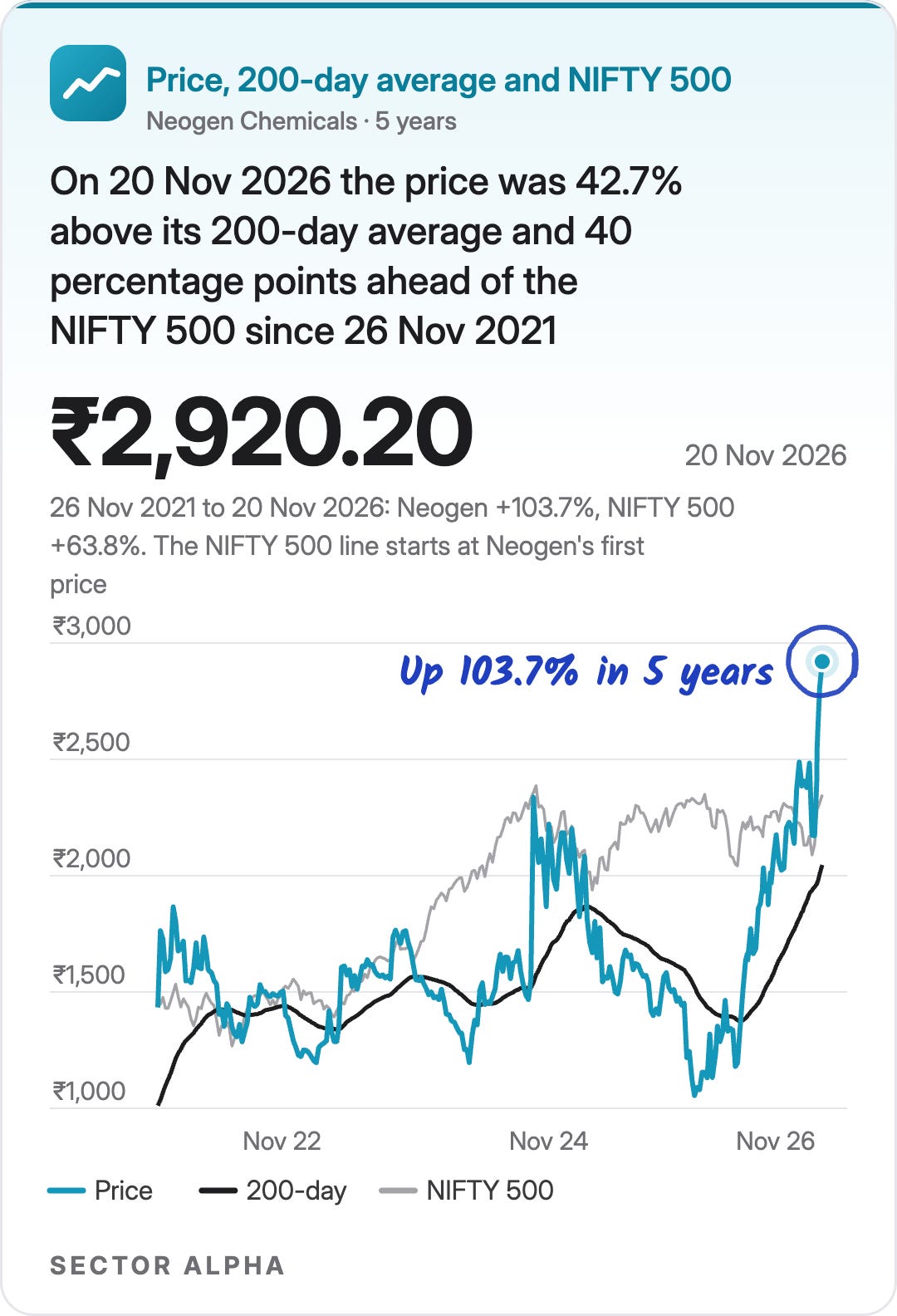
Earnings and P/E
Earnings per share, last four quarters to Sep 2026: up 49% on a year.
Part of that rise is a low starting point. Jan to Mar 2025 carried a one-time fire loss of ₹14.08 crore, counted after recording the insurance claim.
My earnings per share adds the four quarterly figures stored in my table. Some differ from the filed ones.
Apr to Jun 2026: ₹6.25 in my table, ₹6.29 filed.
Jul to Sep 2026: ₹2.74 in my table, ₹2.96 filed.
The price moved much faster than earnings. So P/E, the price divided by a year of earnings per share, went from about 126 on 21 Nov 2025 to 189.5 on 23 Nov 2026.
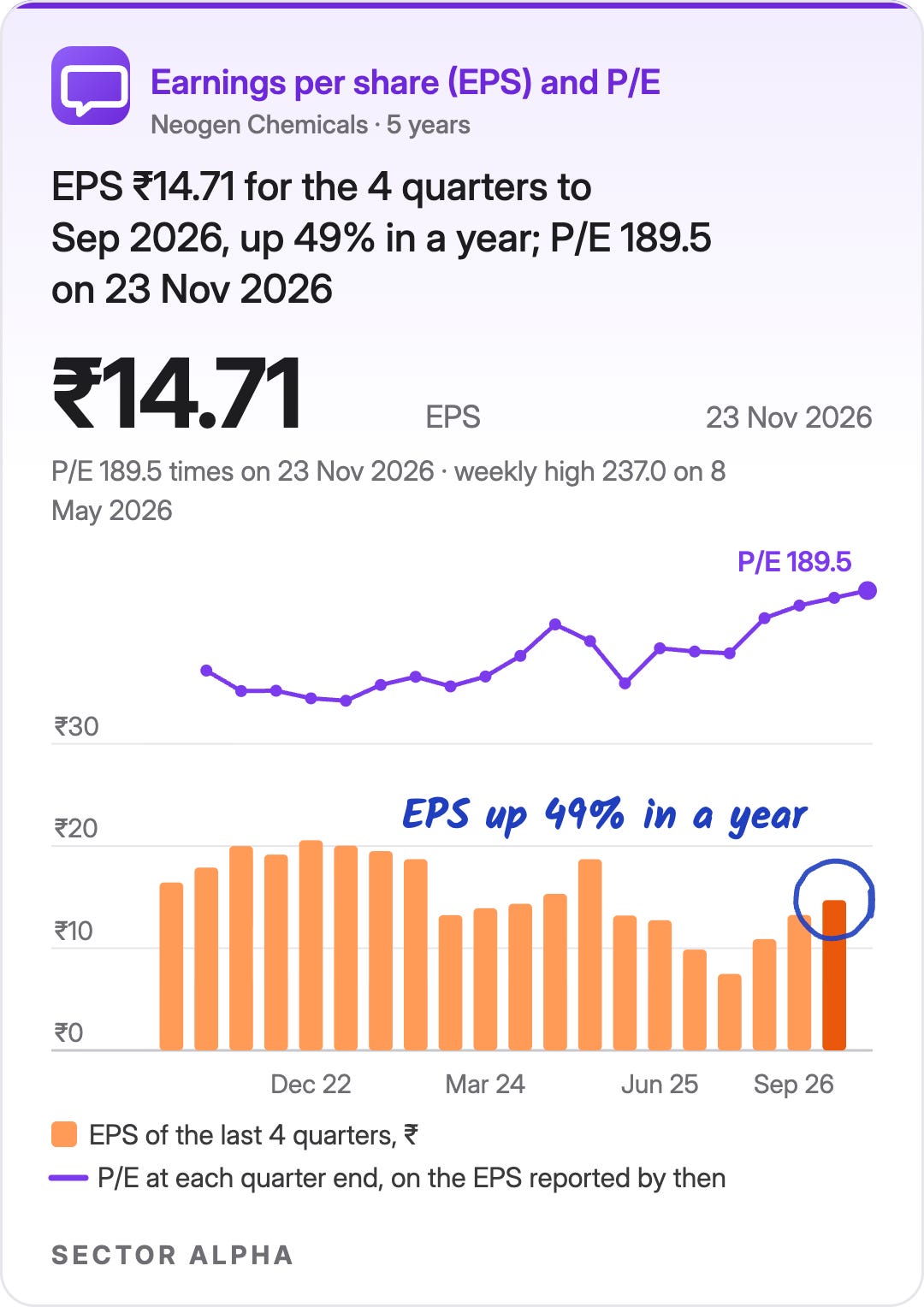
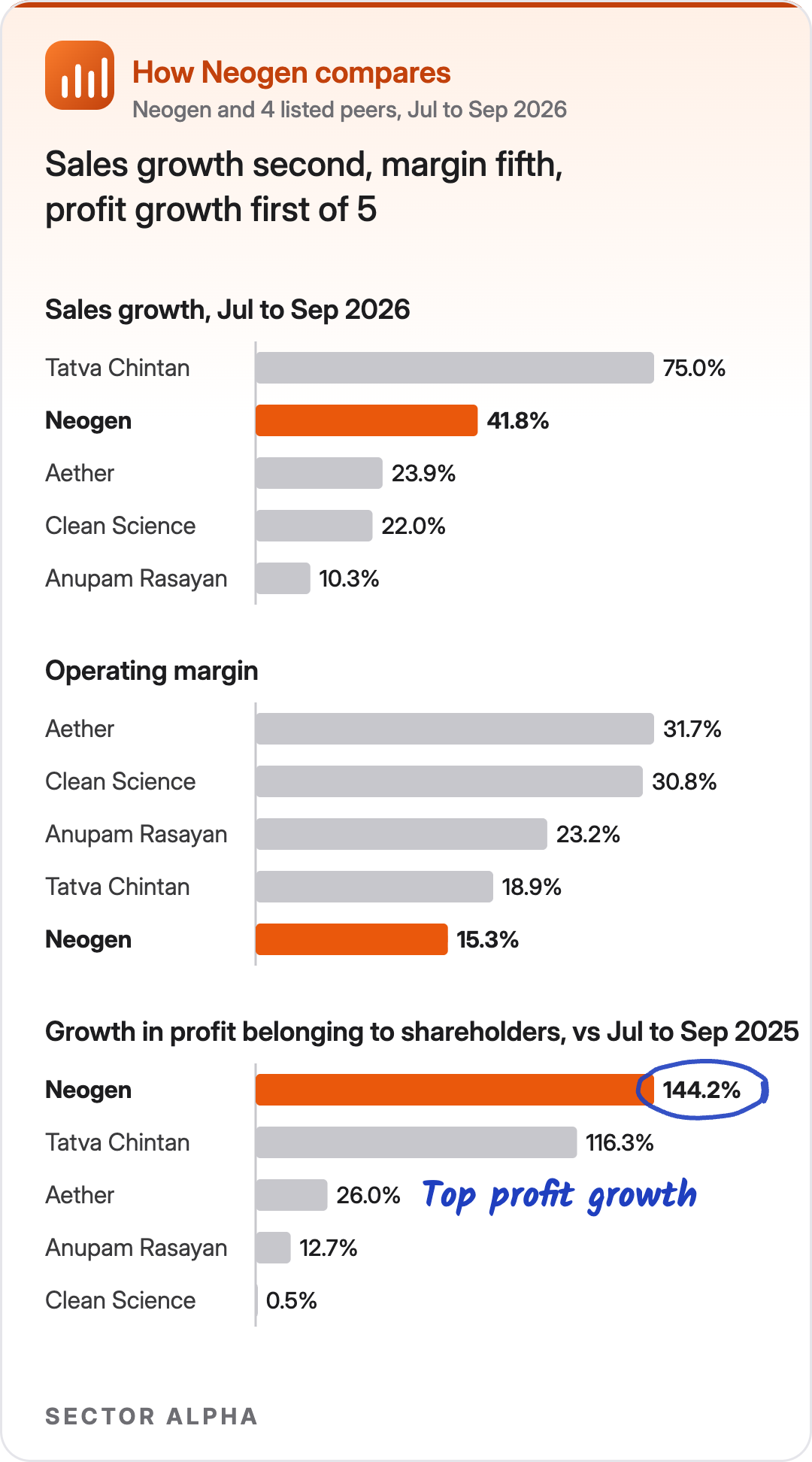
How Neogen compares
I compare Neogen with Aether, Anupam Rasayan, Tatva Chintan and Clean Science. Here are Neogen's own figures:
Sales: up 41.8% in Jul to Sep 2026 on a year.
Operating margin: 15.3% in Jul to Sep 2026.
Net profit: up 144.2% in Jul to Sep 2026 on a year, from ₹3.37 crore.
The deep dive
What is happening
Sales rose against both Apr to Jun 2026 and a year earlier. Profit rose on the year but fell on the quarter. What management said on the 2 Nov 2026 call:
More volume. The finance head said Neogen sold larger quantities across its core products, helped by organolithium, a family of lithium-based chemicals, and by the battery arm.
Start-up costs. The whole group made ₹45 crore of profit before interest, tax and depreciation. The parent company alone made ₹54 crore. He put the gap down to fixed plant costs at the battery arm before its plants fill up. Temporary costs of the Dahej rebuild and of paying outside plants added to it.
Interest. Interest cost rose to ₹27.78 crore from ₹20.81 crore in Apr to Jun 2026. He tied it, and higher depreciation, the part of equipment cost charged to each period, to the plant spending.
No one-offs. The results show no exceptional items in Jul to Sep 2026. Insurance money for the fire is not in this profit.
What it makes
Neogen reports one business segment. Its results presentation splits sales into organic and inorganic chemicals.
Its subsidiary Neogen Ionics makes electrolyte, the liquid inside a lithium-ion cell, and the lithium salts that go into it.
Both groups grew on a year. Battery chemicals sit inside those two figures, not on top of them. They rose from ₹5.4 crore in Jul to Sep 2025.
The managing director said on the 2 Nov 2026 call that Neogen swiftly pivoted towards uses with better demand visibility and higher volumes.
Neogen is doubling its organolithium plant from 300 to 600 tonnes a year.
Each quarter vs a year earlier
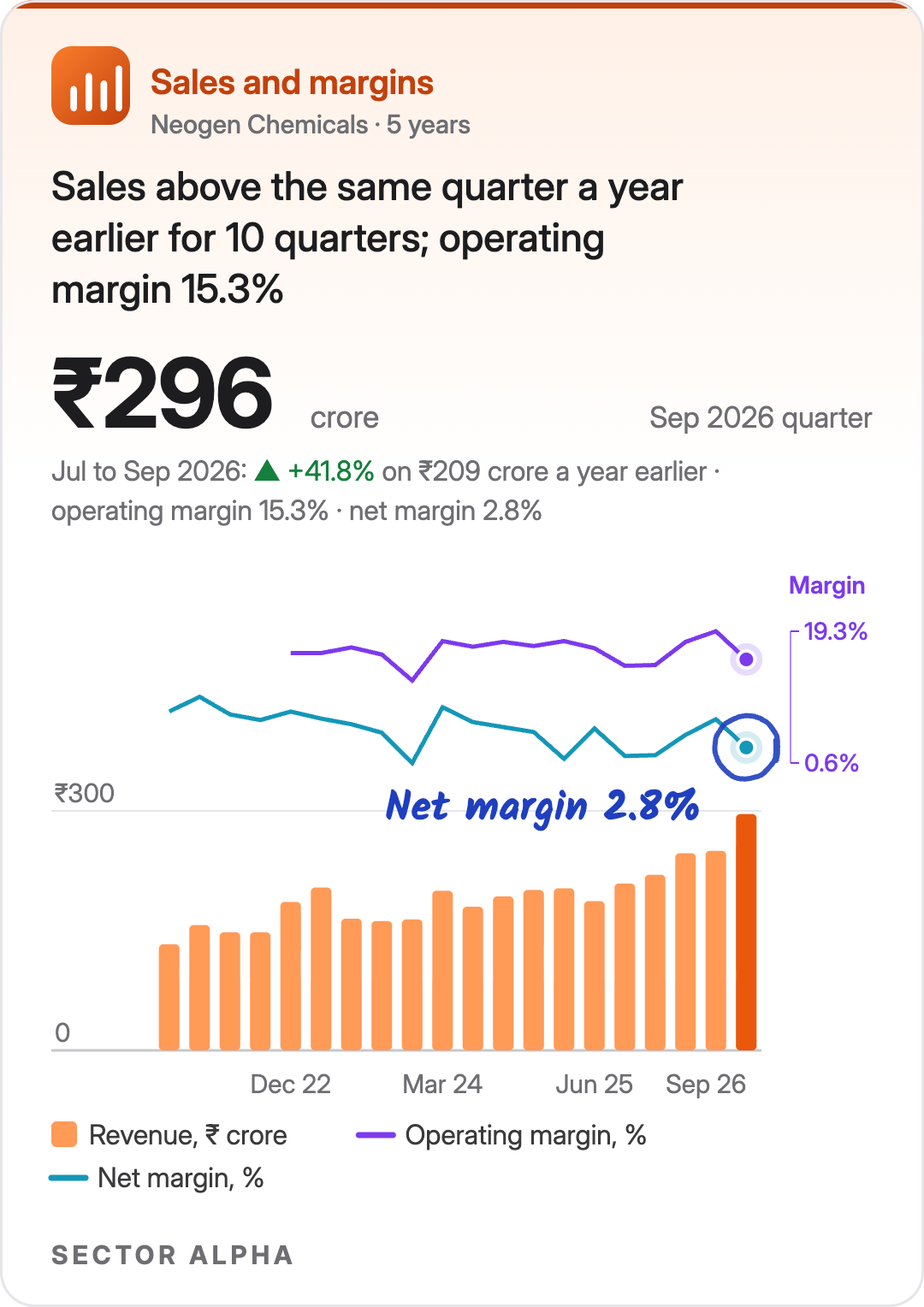
Sales: beat the same quarter a year earlier in all of the last ten quarters, from Apr to Jun 2024.
Margin: operating margin, the share of sales left after running costs, beat a year earlier in four of the last eight quarters. By my read, the fire forced Neogen to pay outside plants, and new plants carry costs before they earn.
Profit: above a year earlier in four of the last eight. Interest was the drag the finance head named on 2 Nov 2026.
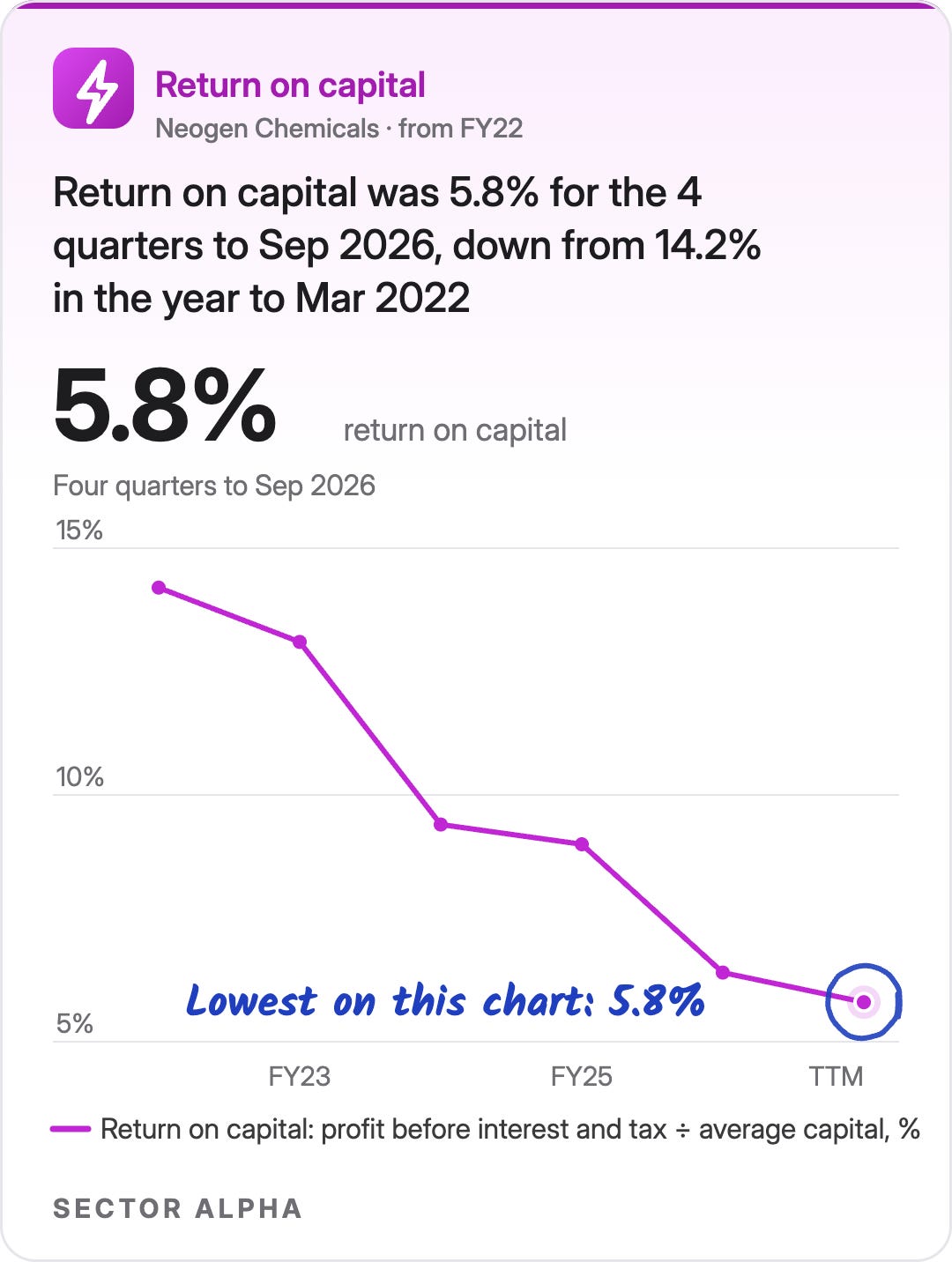
Return on capital is profit before interest and tax divided by the average money tied up in the business. It fell to 5.8% for the four quarters to Sep 2026 from 14.2% in FY22. By my read, part of the reason is money sitting in unfinished plants: ₹1,187 crore on 30 Sep 2026.
Cash and debt
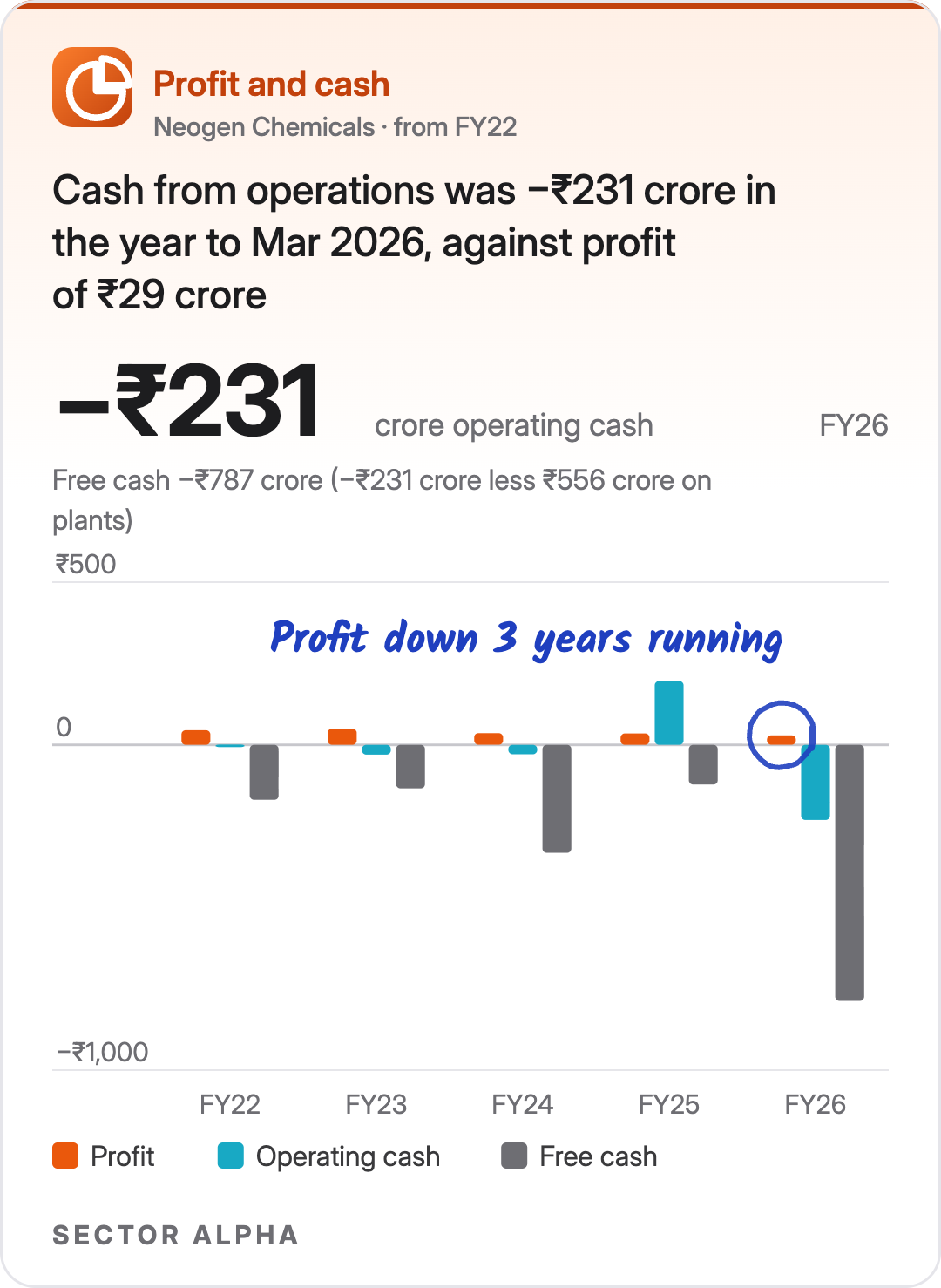
I see cash as the weak spot. In FY26 the day-to-day business used ₹231 crore of cash instead of bringing it in.
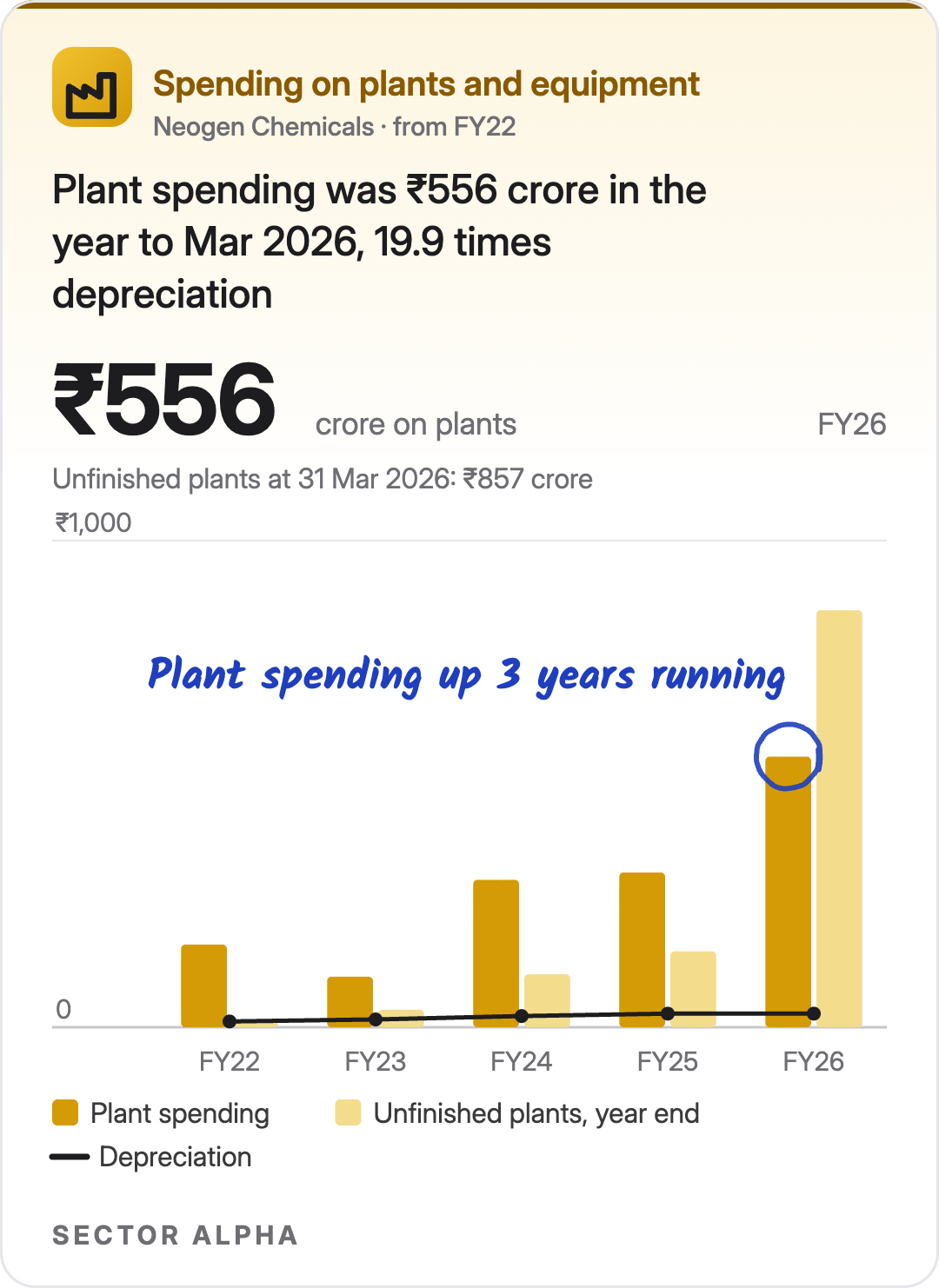
In FY26 Neogen paid ₹555.71 crore for property, plant and equipment, including plants still being built.
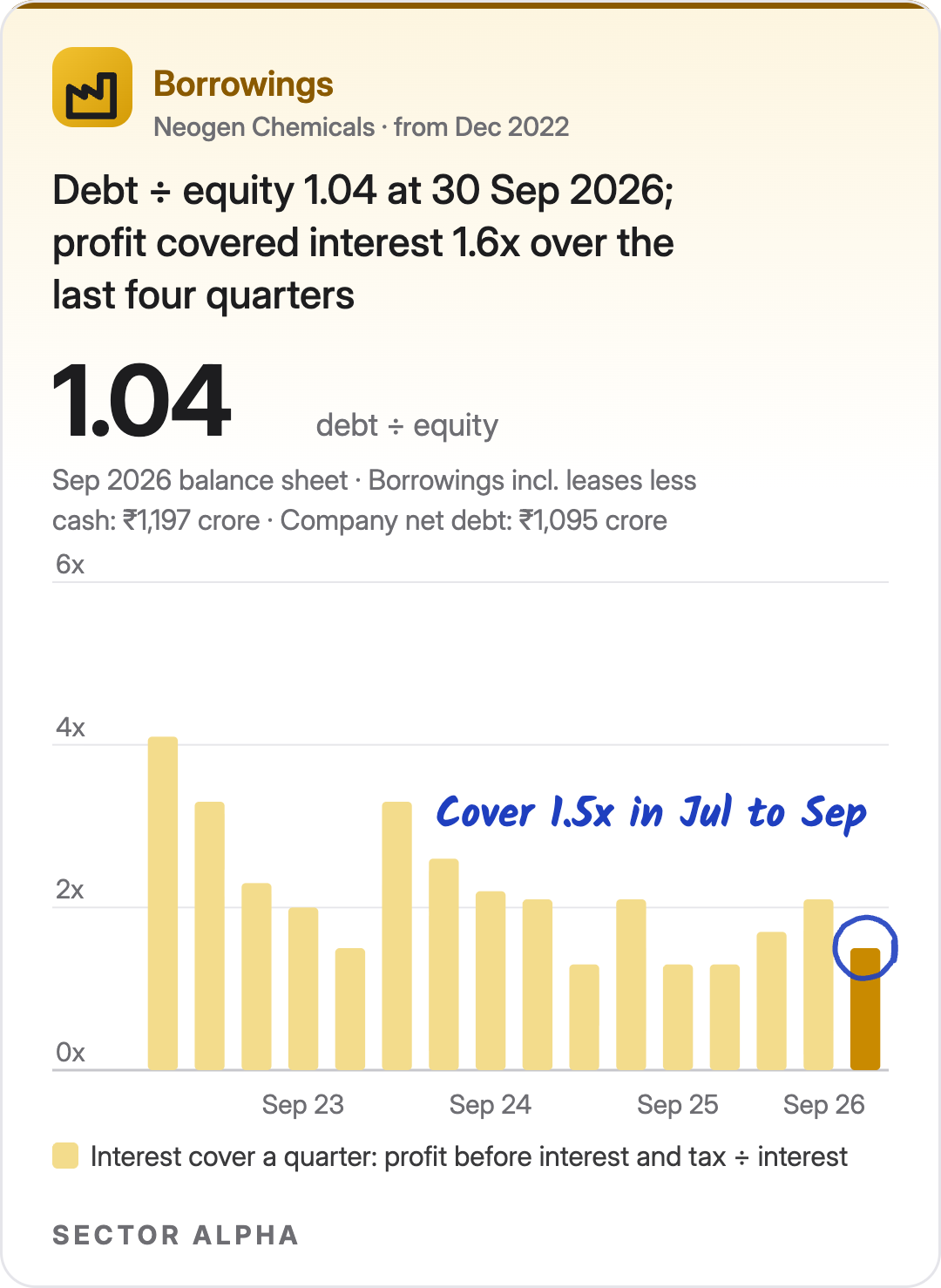
Debt to equity, borrowings divided by shareholders' funds, fell from 1.71 in Mar 2026 to 1.04 in Sep 2026. The reason is new equity: a ₹600 crore share sale to institutions on 16 Sep 2026. Borrowings themselves rose.
Net debt on 30 Sep 2026 depends on what is counted. The finance head said ₹1,095 crore: loans of ₹1,560 crore, without leases, less ₹465 crore of cash and deposits.
By my math, borrowings of ₹1,641 crore, including ₹81 crore of leases, less ₹444 crore of cash give ₹1,197 crore, the figure on my card.
The company's ₹465 crore counts ₹21 crore more than that cash line.
Cash was also tied up for longer during FY26. Stock on hand rose from 267 to 445 days of materials used. Customers took 161 days to pay, against 94 a year earlier.
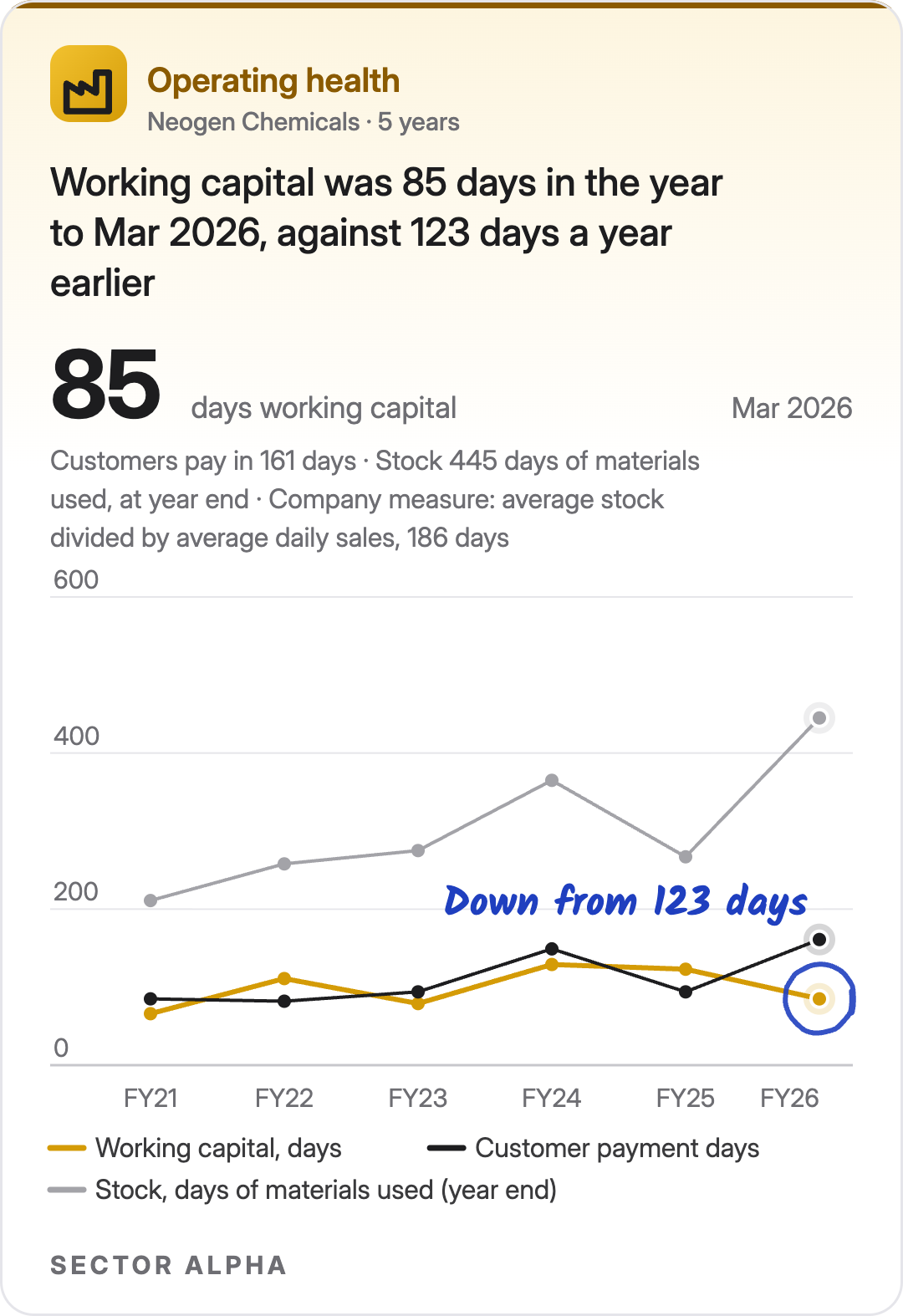
The parent company held 214 days of stock in Jul to Sep 2026, up from 162 a year earlier. Management aimed for about 180 days by Mar 2027.
Who owns Neogen
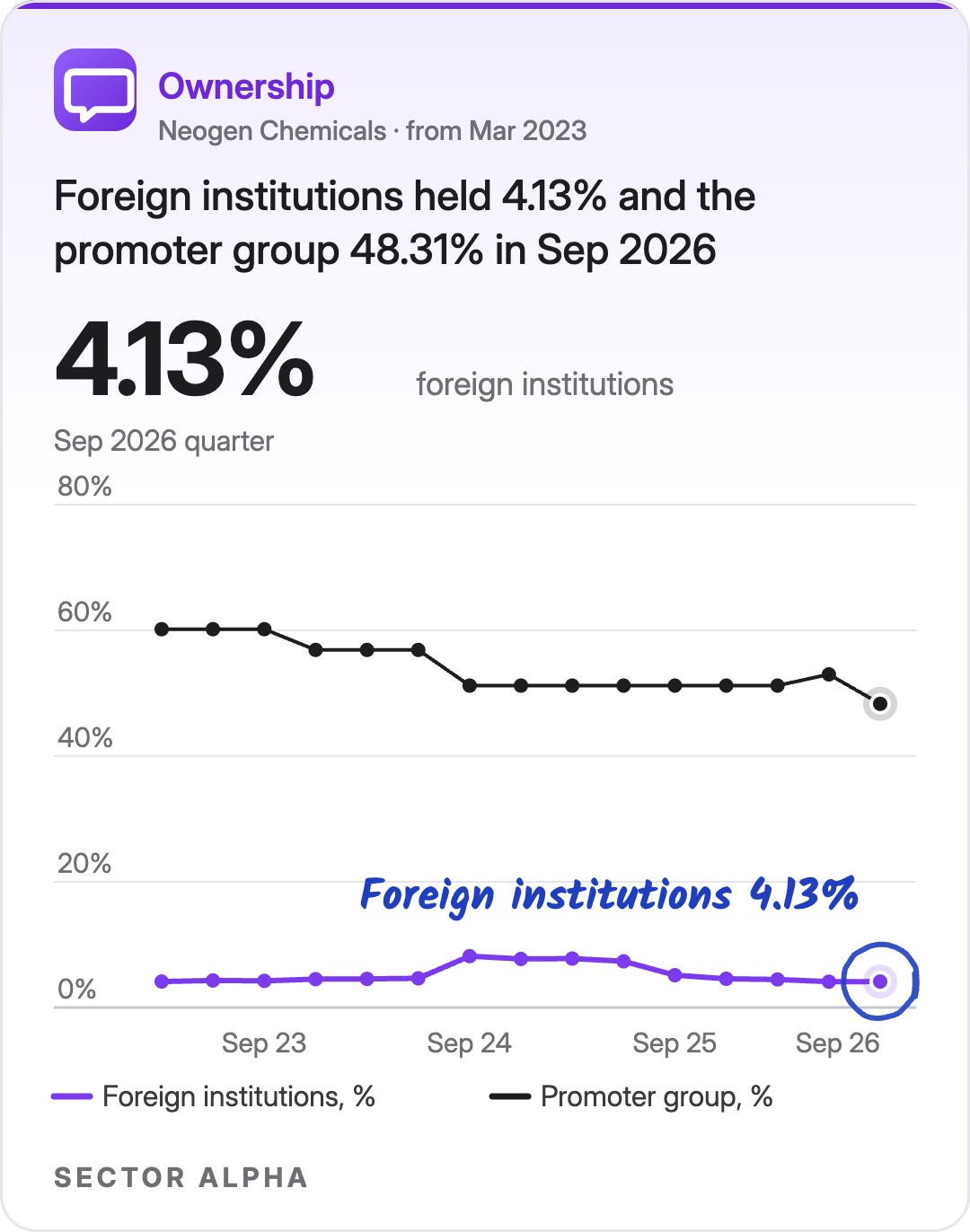
I noticed the share sale changed the owner mix. The promoter group held 53.00% in Jun 2026 and 48.31% in Sep 2026, after the sale.
Domestic institutions held 23.48% in Sep 2026.
The number of shareholders rose from 45,710 in Sep 2025 to 71,908 in Sep 2026.
What management said, what happened
Still in trials. The rebuilt Dahej plant was due to start commissioning in June 2026. Trial runs were confirmed by 2 Nov 2026. Their start date was not given. Commercial production is now expected before the year ends in Mar 2027.
Missed. Commercial electrolyte production was aimed at Apr to Sep 2026. On 2 Nov 2026 assembly was done and trial runs had begun.
Cut. Battery revenue for FY27 was guided at ₹300 crore plus. The new range is ₹250 crore to ₹300 crore.
Raised. The managing director said his previous FY27 guidance for the base business was ₹950 crore to ₹1,050 crore. On 2 Nov 2026 he expected ₹1,100 crore plus.
Started. Salt supply from Dahej was due to start by July or August 2026. Supply to two international customers was confirmed by 2 Nov 2026. The company did not give the first shipment date.
Why is this happening
Two building jobs at once. Neogen is rebuilding a burnt plant and building a battery business, and pays for both before either runs fully.
Interest arrives first. Interest is paid every quarter. Plants can make sales during start-up while still earning too little to cover their fixed costs.
Lithium passes through. The managing director said lithium cost is passed to customers, so by my read a lithium price move shifts sales more than margin.
…temporarily impacted by higher interest and depreciation charge tied to ongoing capex initiatives.
Gopikrishnan Sarathy, Chief Financial Officer, Neogen Chemicals Limited, 2 Nov 2026
What he means: profit is held down for a while by the cost of building, not by weak sales.
…we are committed that the main purpose will be to deleverage the balance sheet.
Dr. Harin Kanani, Managing Director, Neogen Chemicals Limited, 2 Nov 2026
What he means: paying down debt comes first.
The filed plan sets ₹265 crore of the ₹580 crore raised after costs for repaying loans. It sets ₹175 crore for long-term working capital and ₹140 crore for general corporate purposes.
What to track
Dahej: does the rebuilt plant move from trial runs to commercial production by Mar 2027?
Battery revenue: does FY27 land in management's new range?
Electrolyte: do the trial runs turn into regular commercial production?
Insurance: has Neogen received the ₹152 crore insurance settlement it accepted on 29 Oct 2026?
Debt: is the share-sale money used to cut debt, as the managing director said?
Cash: does the day-to-day business start bringing in cash again?
All of Neogen's numbers, every quarter, are on my page: sectoralpha.in/stocks/neogen-chemicals-ltd
— Roshan, Sector Alpha