


Not SEBI registered. Not investment advice. For your own research only.

NHPC is a government-owned company that builds and runs hydro plants, which make electricity from flowing water.
Its plants made 17% more electricity in Jul to Sep 2026 than a year earlier.
The reason: a big new plant, Subansiri Lower, started up unit by unit, and two plants that were weak or shut a year earlier came back.
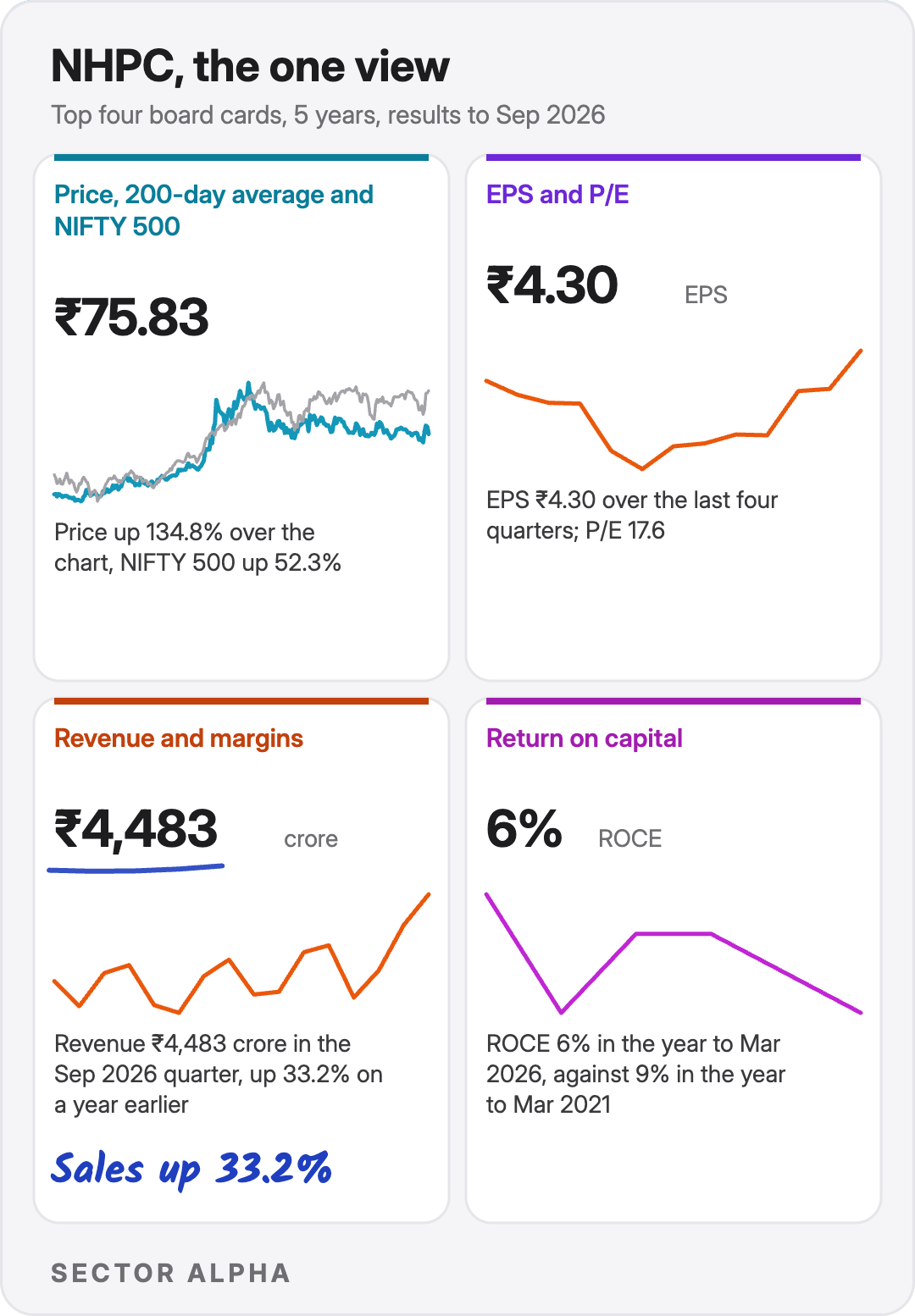
NHPC’s share price fell 5.6% from 14 Nov 2025 to 13 Nov 2026, against a 0.4% fall in the NIFTY 500.
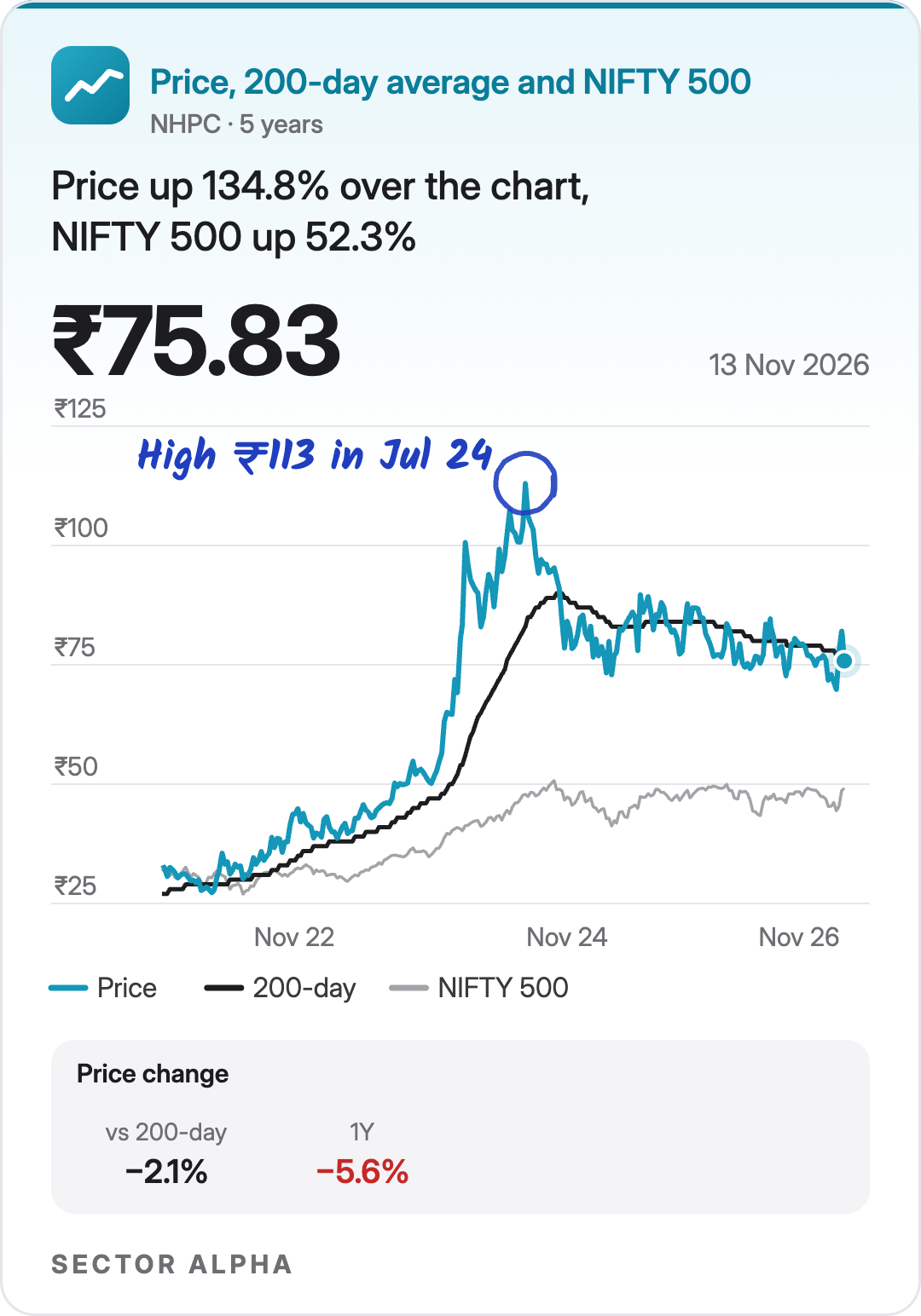
Earnings and P/E
Earnings per share, last four quarters: up 36%. Share price, same year: down 5.6%.
Earnings rose while the price fell, so P/E dropped from about 25 on 14 Nov 2025 to 17.6 on 13 Nov 2026.
How NHPC compares
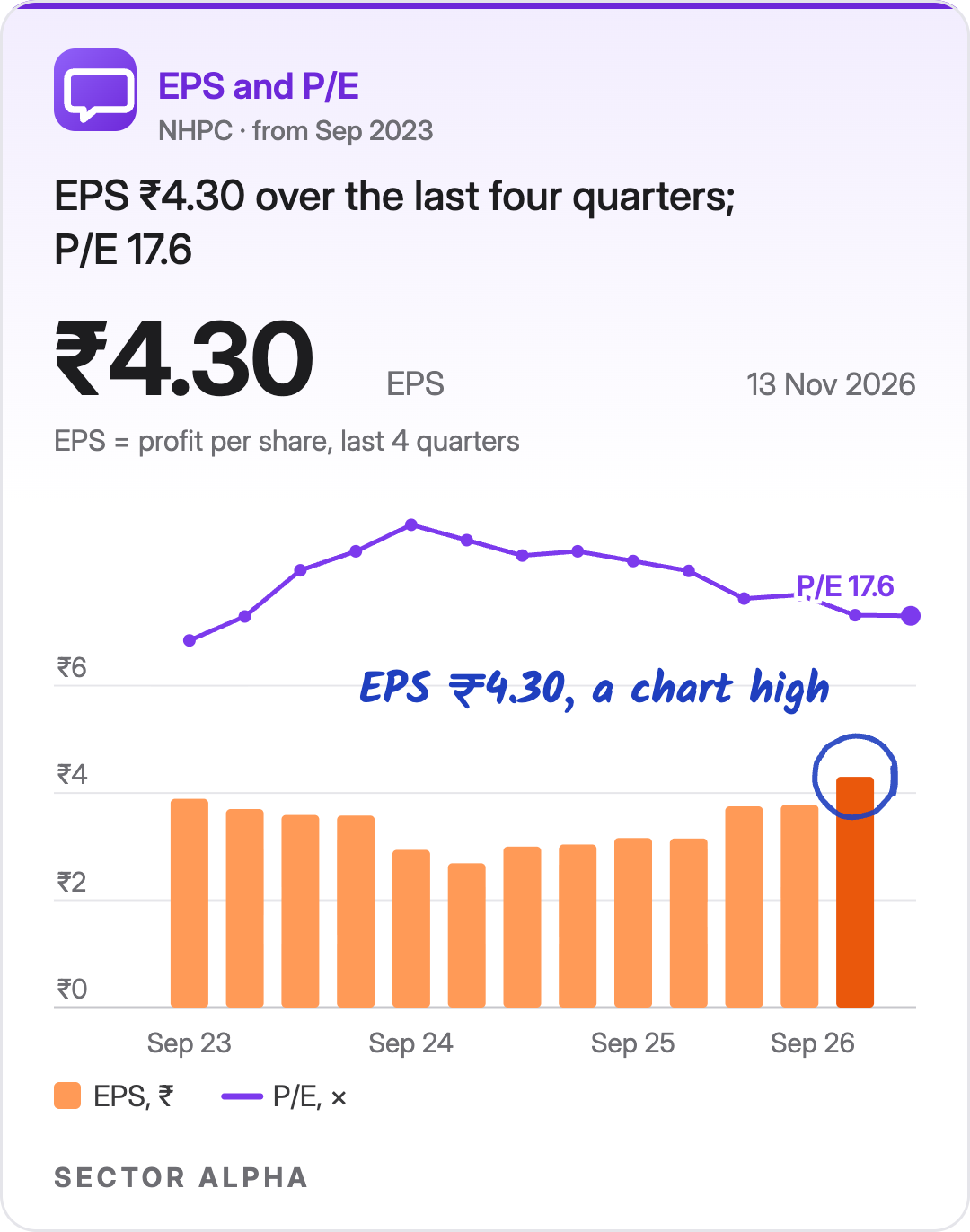
I compare NHPC with four other power producers: SJVN, NTPC, NLC India and JSW Energy.
Second in sales growth and second in margin, both behind SJVN.
Last of the five in profit growth.
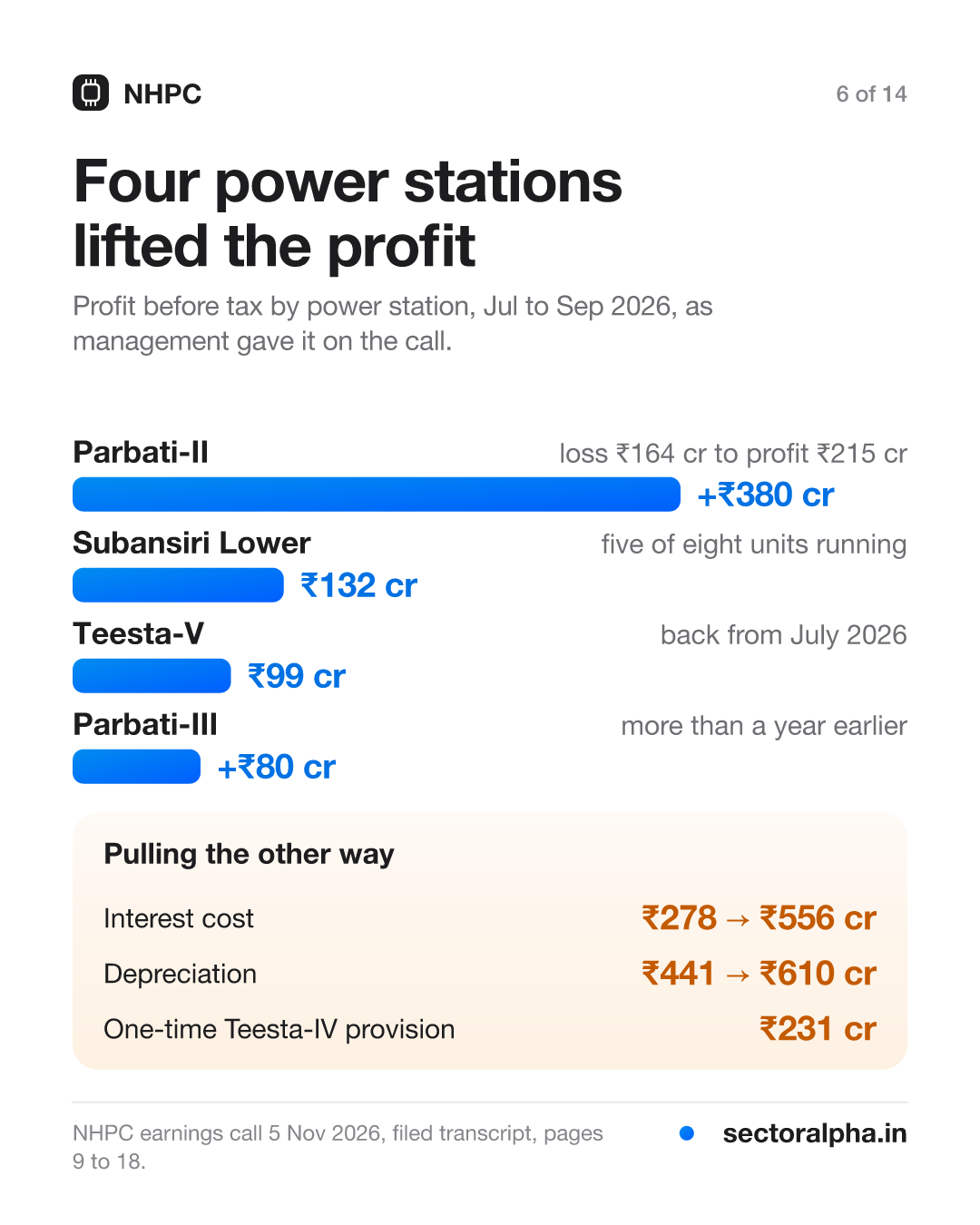
Why profit lagged sales: new plants bring new interest and wear-and-tear costs, and NHPC set aside ₹231 crore for its Teesta-IV project. More below.
By my read, NHPC keeps far more of each sale than NTPC and NLC India because its plants run on water, so there is no fuel to buy, while theirs mostly burn coal or lignite.
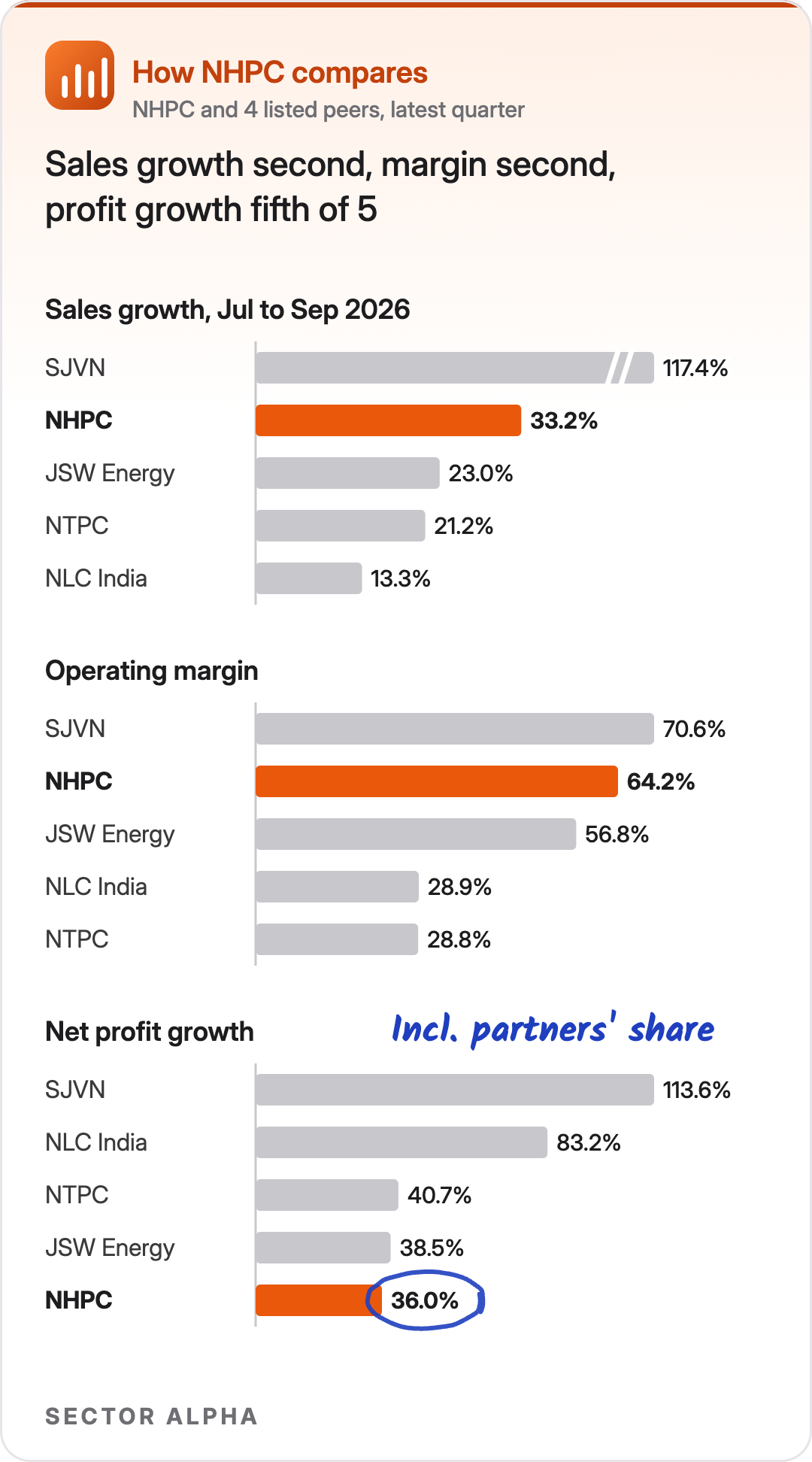
The deep dive
What is happening
Sales and profit rose against both Apr to Jun 2026 and a year earlier. Management gave three reasons on the 5 Nov 2026 call:
More electricity made. Subansiri Lower ran five of its eight units by 23 Oct 2026, and Parbati-II and Parbati-III made more over Apr to Sep 2026, management said.
Plants ready more of the time. Plant availability, the share of time plants were ready to run, rose to 92.24% in Jul to Sep 2026 from 78.58% a year earlier. Subansiri, Parbati-II and the return of Teesta-V drove the rise over Apr to Sep 2026, management said.
Lower water tax. Generation costs fell. Plants in J&K paid less water cess, and a court ruled that plants in Uttarakhand owe none.
Two things pulled the other way. Incentive income, extra pay for beating set targets, fell from ₹253 crore to ₹59 crore. And a year earlier, other income included an insurance claim.

What it makes
Electricity, from 31 power stations, mostly hydro.
How it earns: the power regulator, CERC, sets the selling price from what a plant cost to build. Management said that price gives a 17% yearly return on the company’s own money in the plant, plus incentives on top.
So a plant earns nothing while it is being built, and profit arrives once it runs. Management expects Subansiri Lower alone to earn about ₹1,500 to ₹1,600 crore of profit a year when fully running, from FY29.
Where the extra profit came from
Four plants did most of the work, the 5 Nov 2026 call said.
Parbati-II turned from loss to profit. It generated more and was ready to run more often. Parbati-III gained along with it, management said.
Subansiri Lower beat its share. With only some units running, each unit gets more water than normal, so it made about 300 million units more than planned.
Teesta-V came back in Jul 2026, after repairs from the Oct 2023 flash flood.
Against that: when part of a new plant starts, its loan interest and wear-and-tear start counting against profit. Before, they sat inside the building cost. That is why interest and depreciation jumped.
The ₹231 crore Teesta-IV provision, money set aside for a possible loss, was a one-time hit. Management did not say what it covers.
Each quarter vs a year earlier
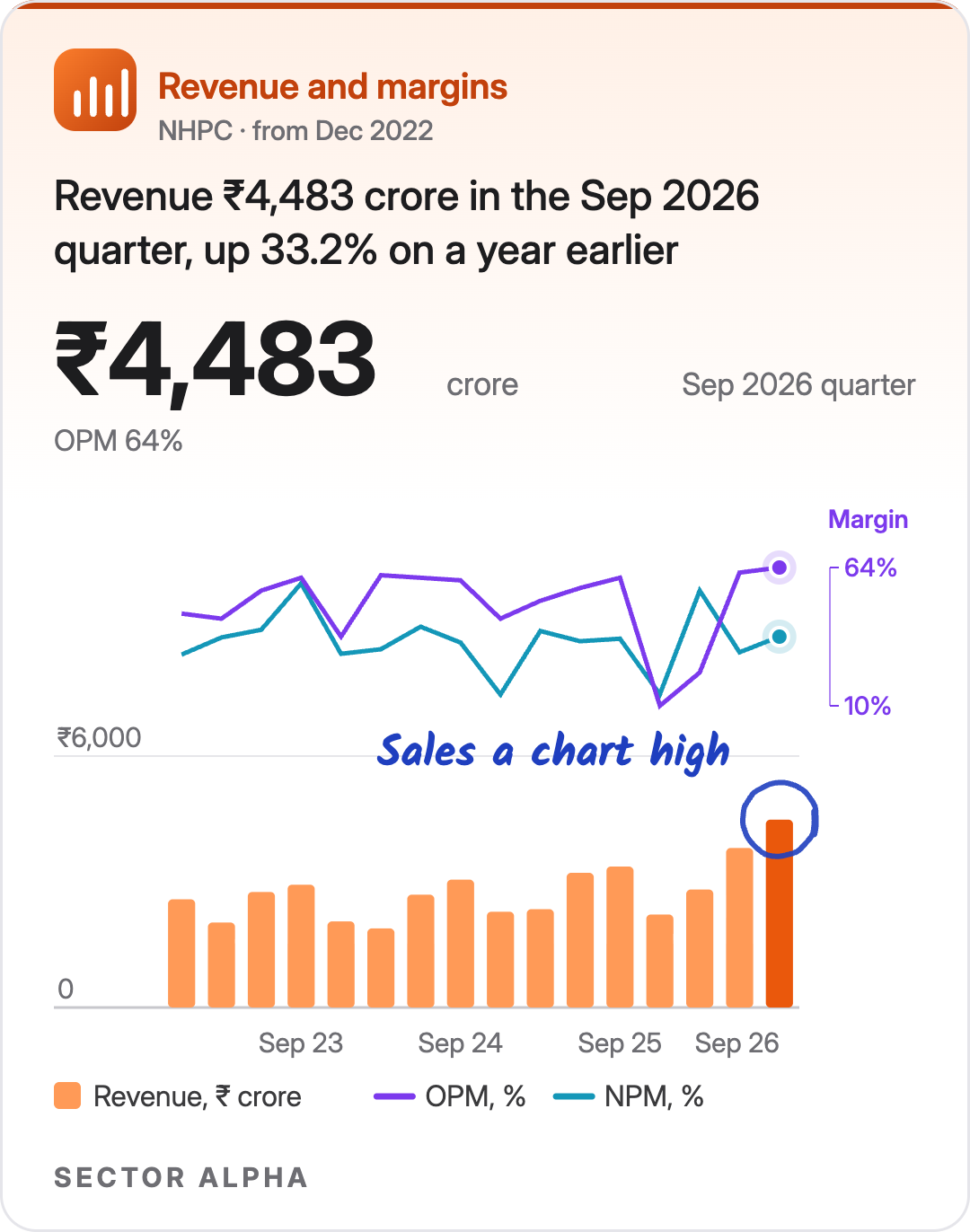
Sales: up on a year in 7 of the last 8 quarters. The lever is more plants running: Subansiri Lower units one by one, Parbati-II working well, Teesta-V back.
Margin: up on a year in only 4 of 8. About 70% of a year’s power comes in Apr to Sep, management said. By my read, margins swing with the water. In Jul to Sep 2026 they rose because sales grew while generation costs fell.
Profit: up on a year in 6 of 8. By my read, interest and depreciation from new plants hold it back until those plants run at full size.
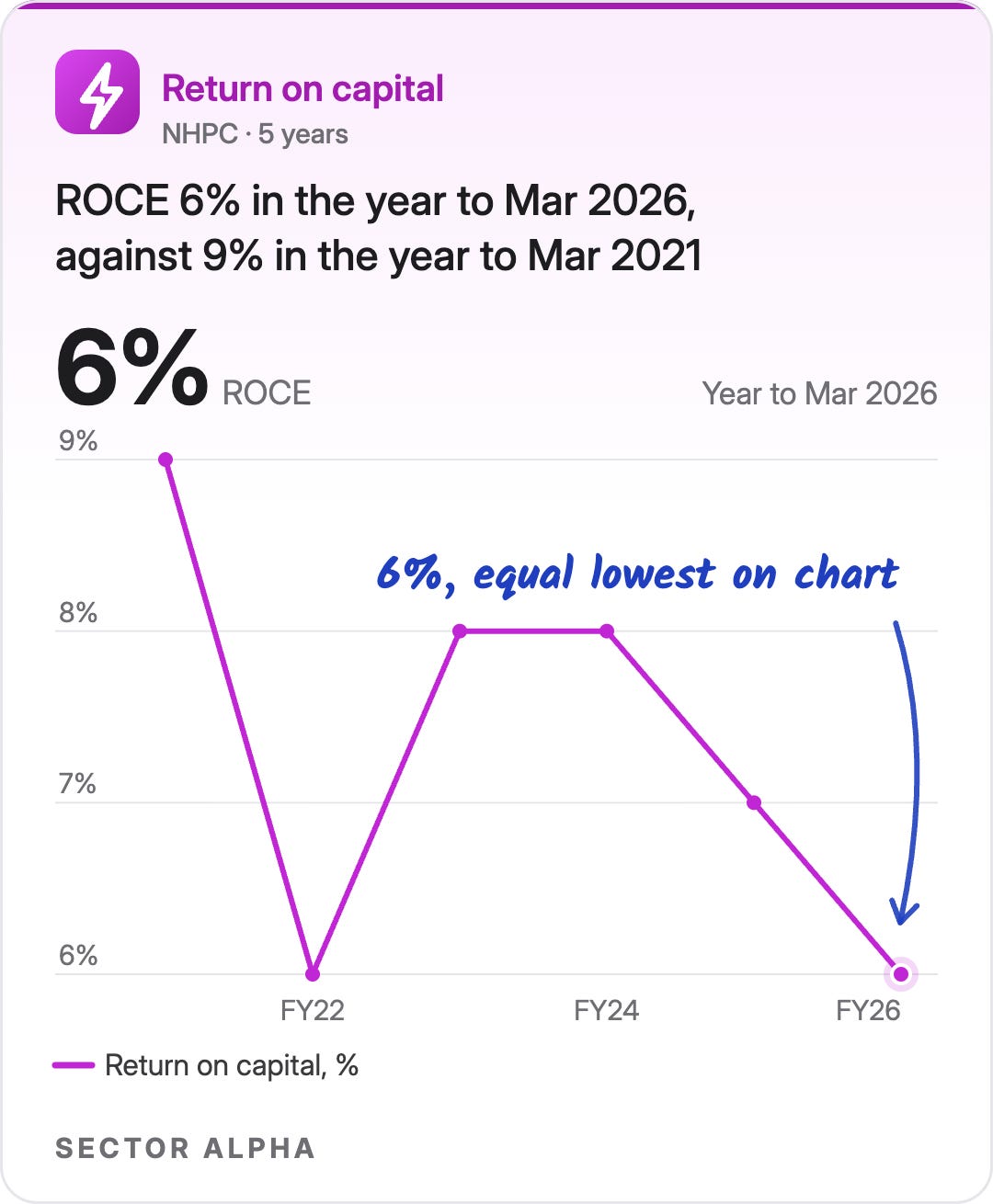
Return on capital sits at the low end of the chart. By my read, a lot of money is tied up in plants still being built, which earn nothing until they start.
Cash and debt
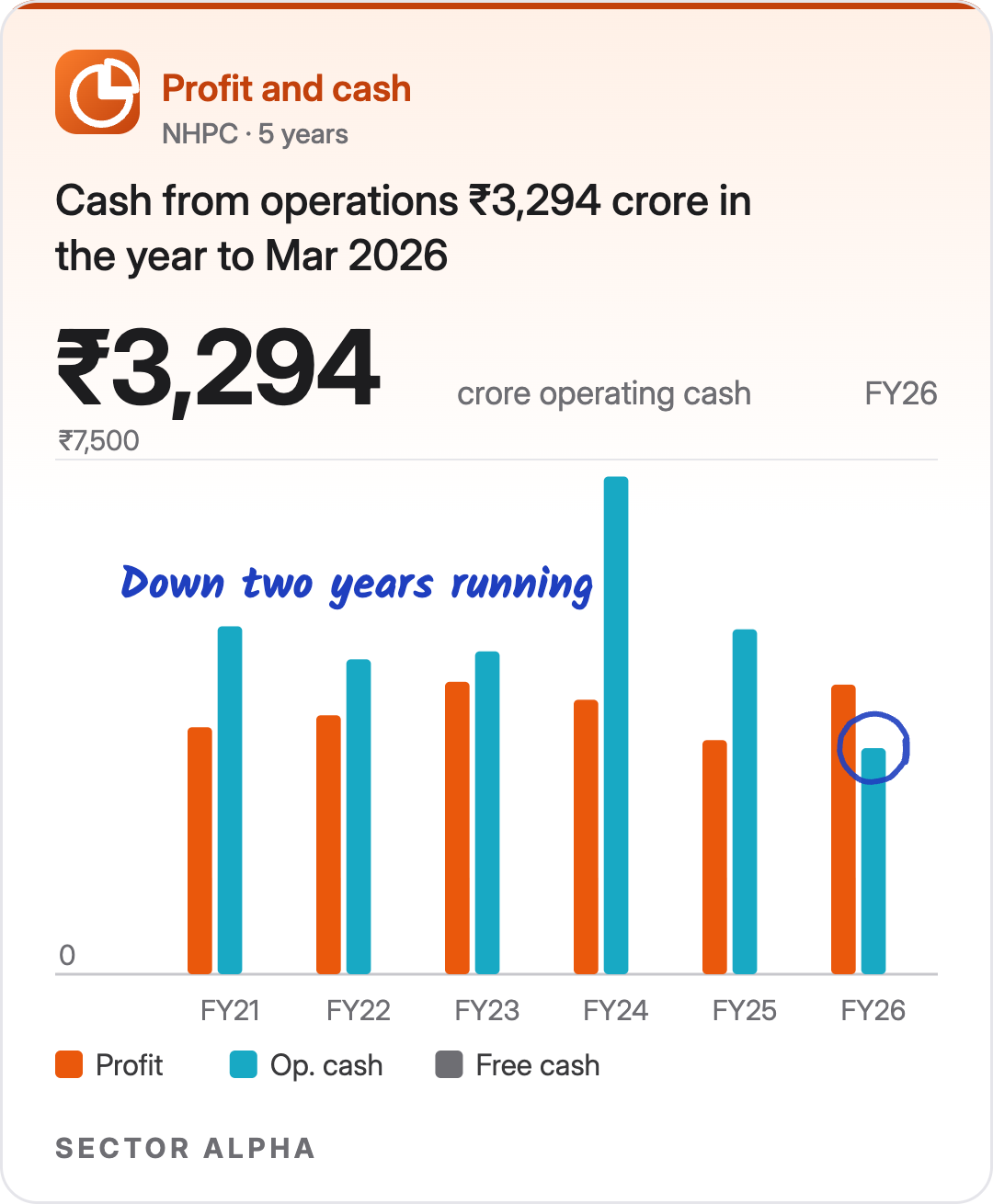
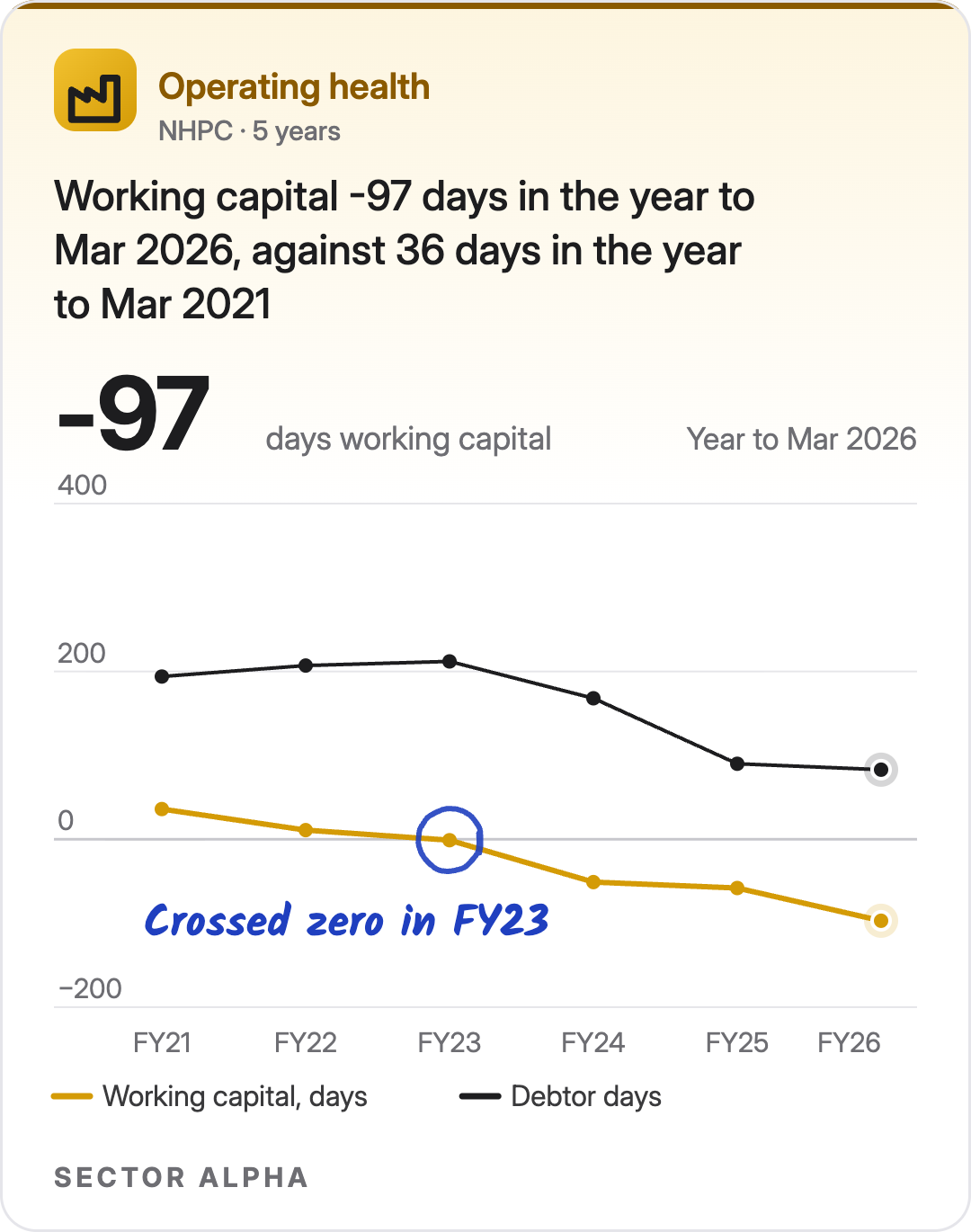
Cash from day-to-day business fell two years running, while spending on new plants kept rising. So in FY25 and FY26 NHPC spent more on plants than its business brought in.
Why spending rose: it is building many plants at once. Capital spending was about ₹13,700 crore in FY26, management said, against a ₹13,000 crore target.
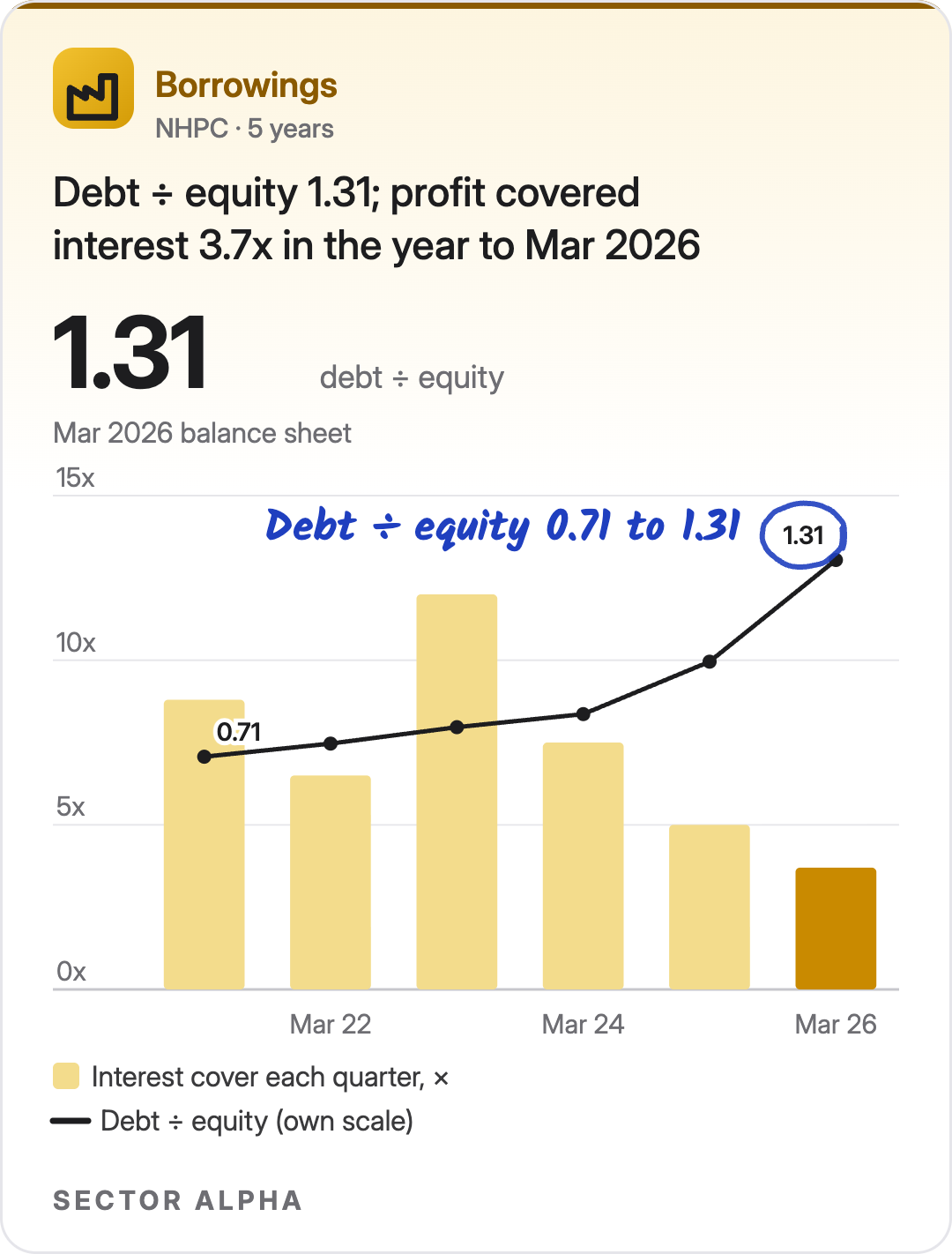
Debt is rising for the same reason: NHPC borrows to build, on its own balance sheet rather than project by project. Management put group debt at about ₹59,000 crore on 5 Nov 2026.
The company’s own filed debt to equity, debt divided by net worth, was 1.31 in Mar 2026 and 1.36 in Sep 2026.
Why management is relaxed: it expects yearly operating profit to rise from about ₹6,000 to ₹7,000 crore to about ₹10,000 crore once Subansiri Lower, Pakal Dul and the other new plants run. It says no fresh equity is needed.
Projects being built
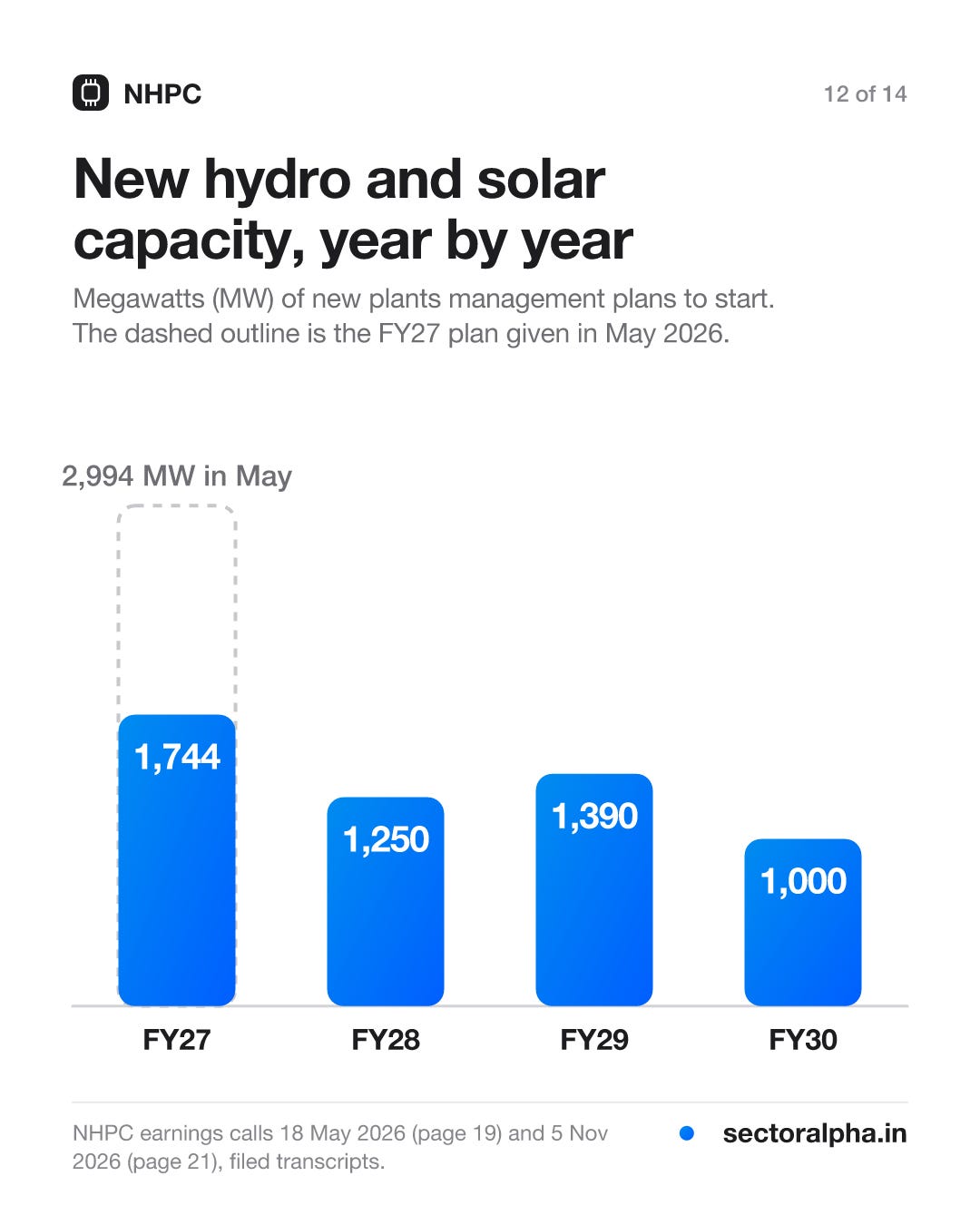
The FY27 plan for new capacity was cut from 2,994 MW in May 2026 to 1,744 MW by Nov 2026. MW, megawatts, measures how much power a plant can make at once.
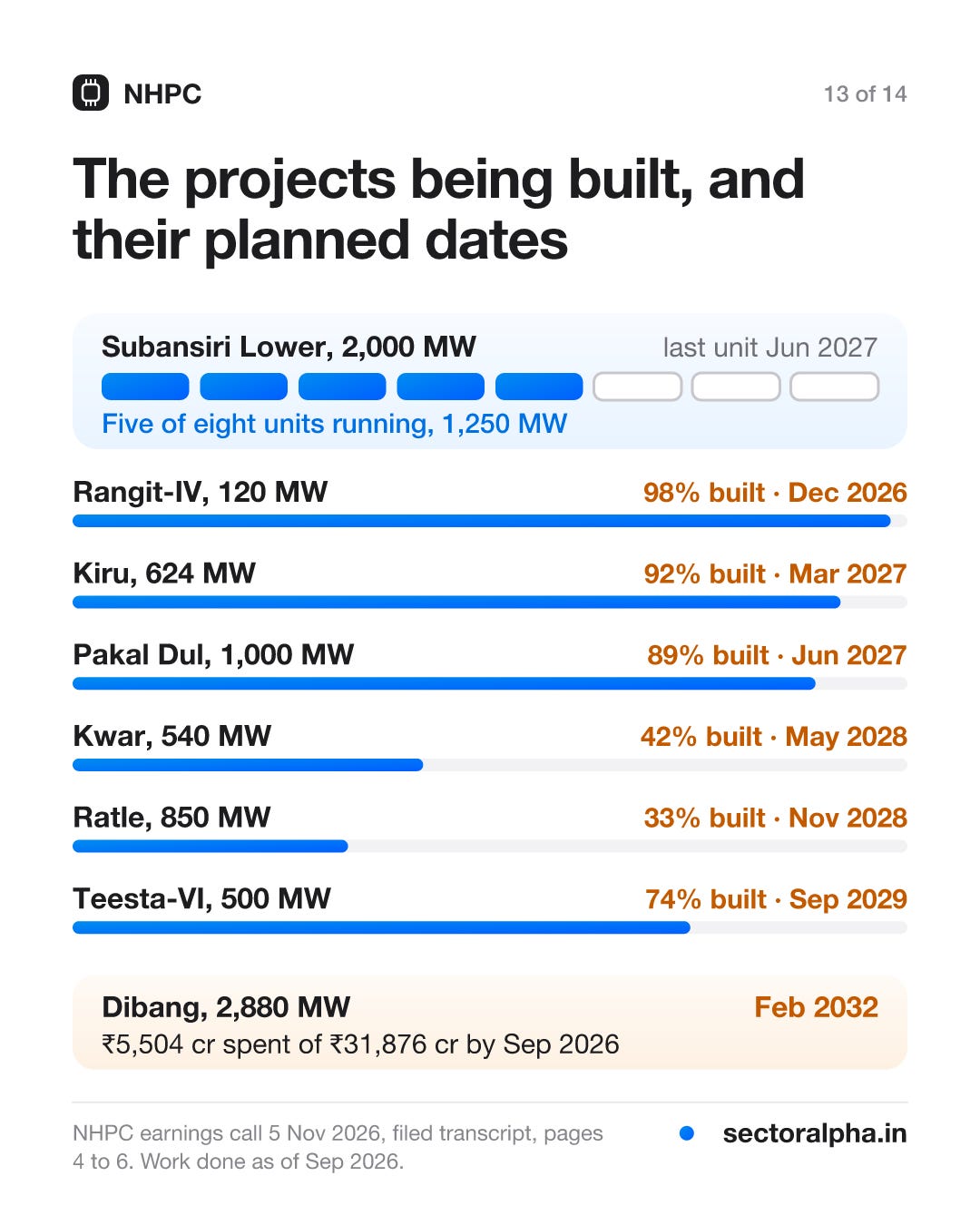
Why: two starts moved into FY28. Pakal Dul is to get two units by Mar 2027 and the rest by Jun 2027. Subansiri Lower’s last unit also moved to Jun 2027.
Most slips are a few months, not years. The biggest plant, Dibang, is due in Feb 2032, and management said it is “100% sure” of that date.
Next in line, still waiting for government approval: Etalin and Sawalkot.
The FY27 spending plan is ₹14,300 crore. Most of it usually comes in Oct to Mar, management said.
Who owns NHPC
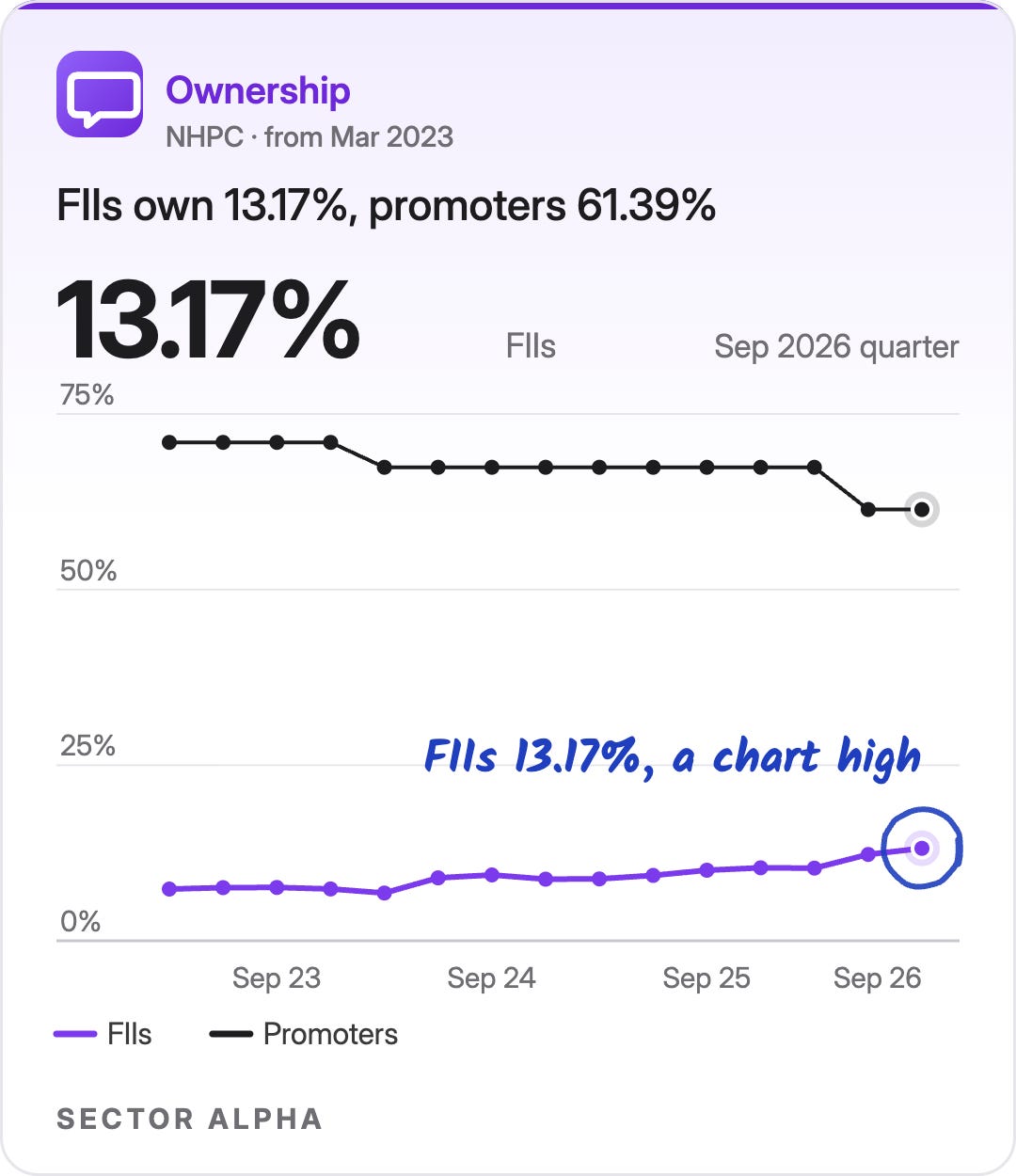
The government is still the largest owner, but holds less than a year ago. Domestic and foreign institutions own more.
By my read, institutions took up most of what the government gave up: promoter share fell about 6 points and institutions rose about 7.
The call did not discuss ownership.
What management said, what happened
I compared the 18 May 2026 call with the 5 Nov 2026 call.
Cut. FY27 new capacity: 2,994 MW down to 1,744 MW.
Why is this happening
New plants pay once they run. Subansiri Lower is the big one. Its full effect shows in FY28, and the full year of profit from FY29, management said.
Prices are not final yet. Subansiri Lower and Parbati-II book only 80% of the price NHPC asked the regulator for. Parbati-II’s hearing was set for 11 Nov 2026, and Subansiri’s interim order is awaited.
Water decides the season. About 70% of a year’s power comes in Apr to Sep. Oct 2026 to Mar 2027 is the lean half, management said.
One-off cost. The Teesta-IV provision was the only provision made in Jul to Sep 2026, management said.
With this, Subansiri will become the biggest hydro project in India. Bhupender Gupta, Chairman and Managing Director, 5 Nov 2026
What he means: once all eight units run, planned for Jun 2027.
So beyond 75 days, we don’t have a single penny pending. Mahesh Kumar Sharma, Director (Finance), 5 Nov 2026
What he means: customers pay on time. Government payment rules from 2023 let suppliers cut power to buyers who fall behind.
What to track
Subansiri Lower: do the last three units start by Jun 2027?
Pakal Dul and Kiru: do they start on the new dates?
Price orders: does the regulator confirm Subansiri and Parbati-II prices, and what happens to the 20% held back?
Payments: does nothing stay overdue past 75 days?
Spending: does FY27 reach the ₹14,300 crore plan?
Debt: does profit from new plants grow fast enough to carry it?
All of NHPC’s numbers, every quarter, are on my page: sectoralpha.in/stocks/nhpc-ltd
— Roshan, Sector Alpha