


Not SEBI registered. Not investment advice. For your own research only.
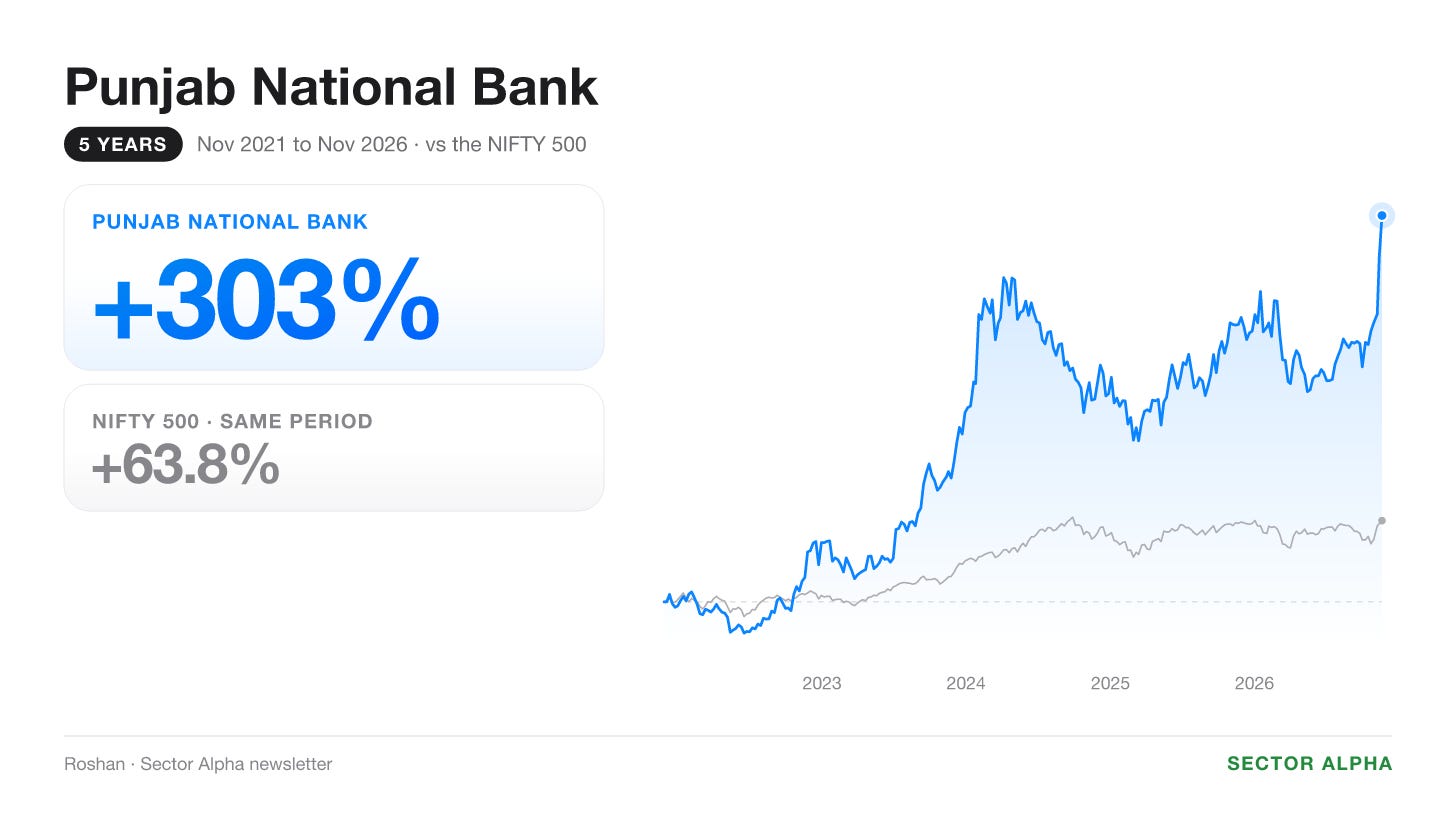
PNB, Punjab National Bank, is a lender owned mostly by the government. It takes deposits and lends them to families, farmers, small firms and companies.
In Jul to Sep 2026 the bank alone made a profit of ₹5,532 crore, up 12.8% on a year.
The main reason: PNB alone earned ₹1,132 crore more interest after funding costs than in Jul to Sep 2025.
PNB also released ₹798 crore it had set aside earlier against one account held as an investment, the bank said on its 16 Oct 2026 call.
The drag: treasury income, profit from trading bonds and currencies, fell 57.4%.
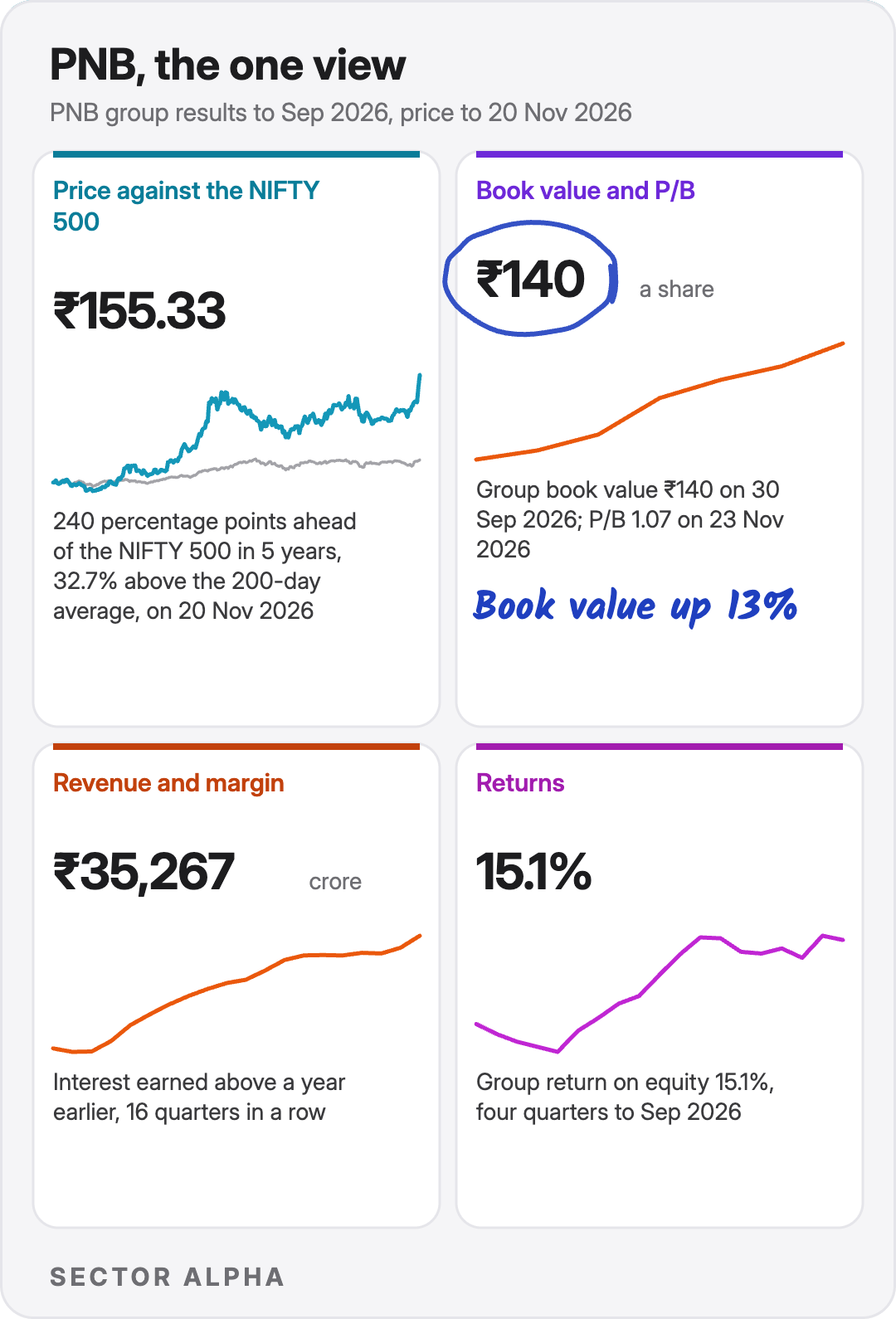
PNB's share price rose 26.9% from 21 Nov 2025 to 20 Nov 2026. The NIFTY 500 rose 1.3% over the same dates.
Book value and P/B
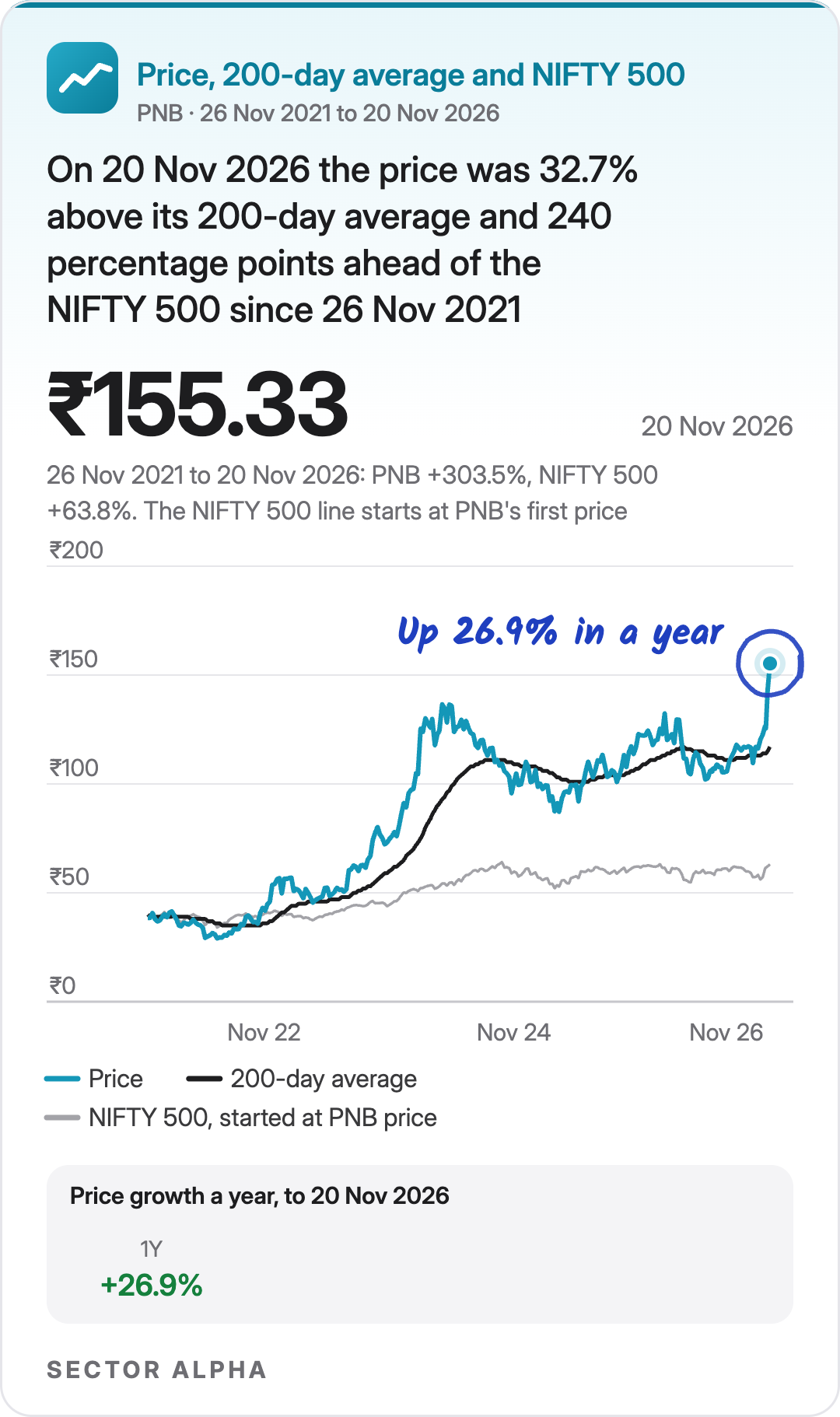
Book value per share for the PNB group, what it owns minus what it owes, for each share: ₹140 on 30 Sep 2026, up 13.2% in a year.
PNB alone reported ₹111.94 a share on 30 Sep 2026, a narrower measure that also leaves out intangible assets.
Share price, 21 Nov 2025 to 20 Nov 2026: up 26.9%.
The price rose faster than book value. So P/B, the price divided by group book value per share, was about 0.99 on 21 Nov 2025. It was 1.07 on 23 Nov 2026.
How PNB compares
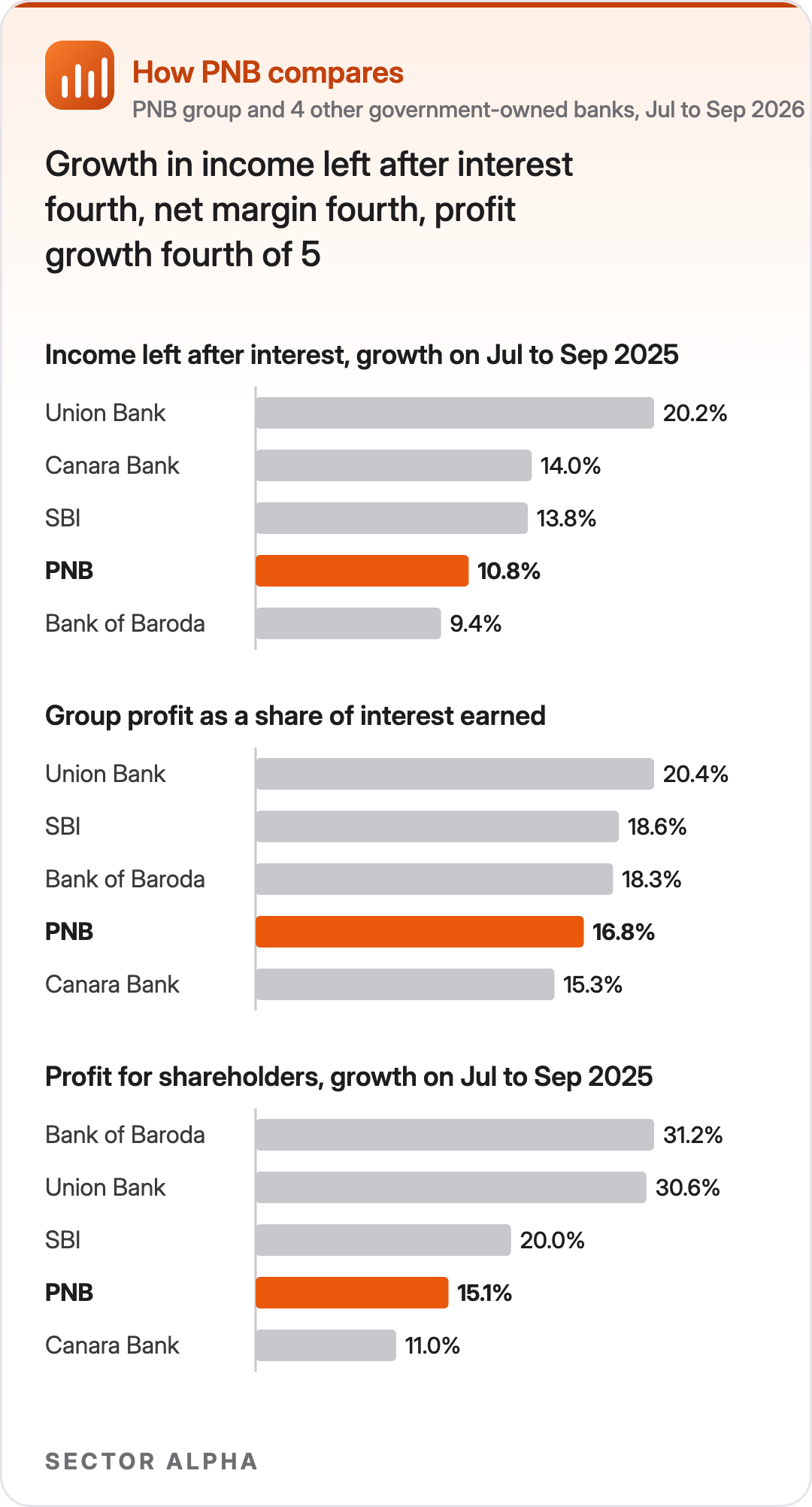
I compare PNB with four other large government-owned banks: State Bank of India, Bank of Baroda, Canara Bank and Union Bank.
Each bank's figures are for its whole group, for the same quarters as PNB's.
Growth in income left after paying interest: fourth of five, ahead of Bank of Baroda only.
Group profit as a share of interest earned: fourth of five, ahead of Canara Bank only.
Growth in profit for shareholders: fourth again, ahead of Canara Bank only.
The deep dive
What is happening
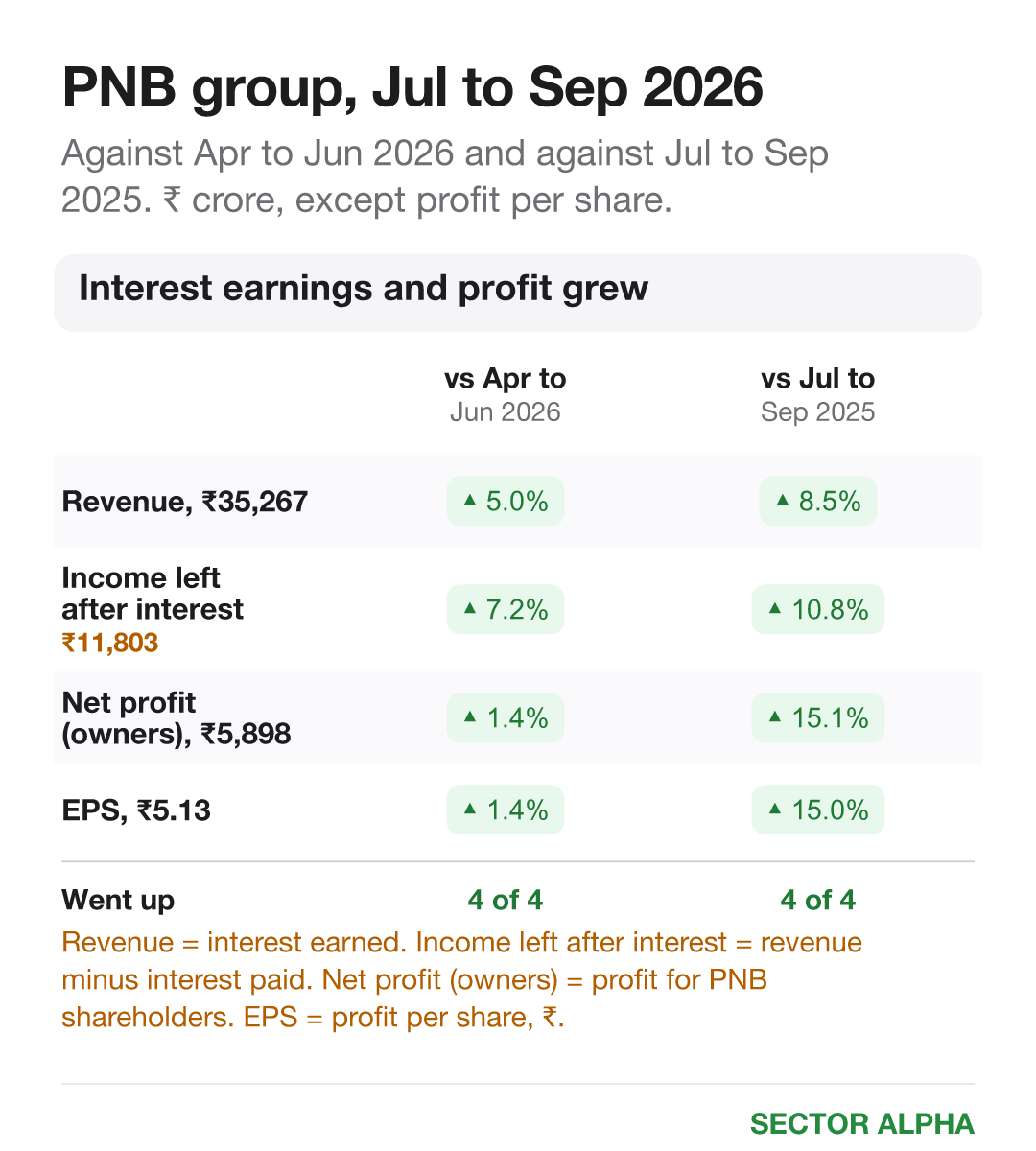
Group profit for shareholders was ₹5,898 crore in Jul to Sep 2026, up from ₹5,125 crore a year earlier.
The bank's reasons, from its filings and the 16 Oct 2026 call:
More interest after funding costs. For PNB alone, net interest income was ₹11,601 crore in Jul to Sep 2026, up ₹1,132 crore on a year. That is interest earned minus interest paid. For the group it was ₹11,803 crore.
The margin recovered from Apr to Jun 2026. Net interest margin, what the bank earns on loans and bonds after paying for deposits, rose to 2.58% from 2.50%. A year earlier it was 2.60%.
Low provisions. Provisions other than tax were ₹97 crore, against ₹643 crore a year earlier. PNB said on its 16 Oct 2026 call that the ₹97 crore is after a ₹798 crore release on one security it held.
Bad loans needed more. The bad-loan part alone was ₹817 crore in Jul to Sep 2026, against a release of ₹639 crore a year earlier.
Treasury income fell 57.4%. It fell to ₹753 crore from ₹1,769 crore. Bond yields rose, so the bonds the bank holds lost value, managing director Ashok Chandra said on 16 Oct 2026.
What it makes
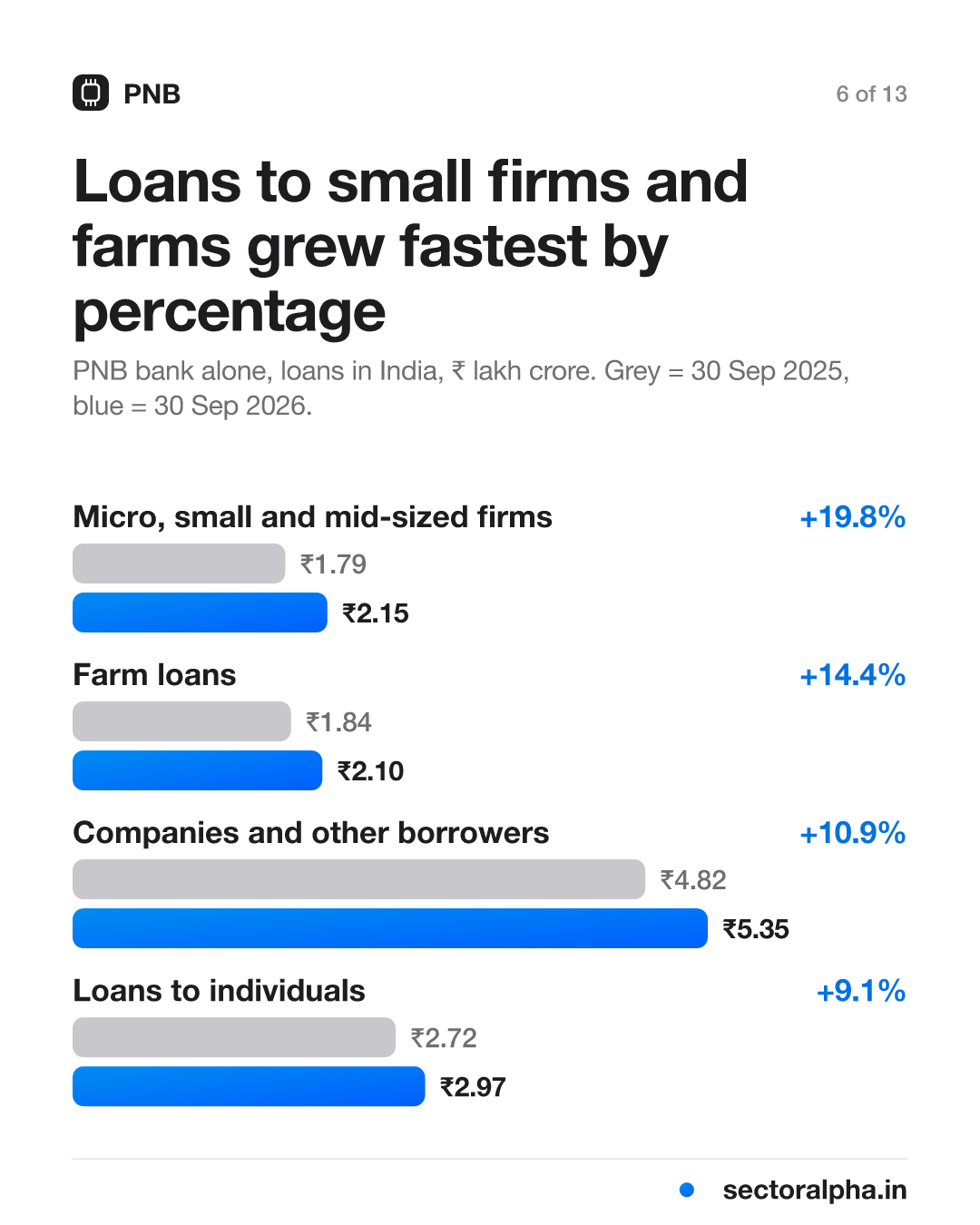
PNB lends to four groups of borrowers in India: individuals, farmers, micro, small and mid-sized firms, and companies and other borrowers. Companies and other borrowers are the largest group, at 42.6% of loans in India at 30 Sep 2026.
Loans to individuals grew 9.1% in the year to Sep 2026. Leave out loans bought through other banks, and they grew 16.3%.
Across the whole bank, PNB cut loans bought through other banks by ₹23,700 crore in that year, the managing director said on 16 Oct 2026.
Gold loans about doubled in a year, to about ₹36,000 crore from ₹18,300 crore, he said. 74% of them are farm loans.
On 18 Jul 2026 he said 3,400 more branches had started offering gold loans, on top of the 3,000 that already did.
On that call he also said online loan checks based on cash flow, plus outreach events, lifted loans to micro, small and mid-sized firms. The bank did not say how much each added.
What moved profit
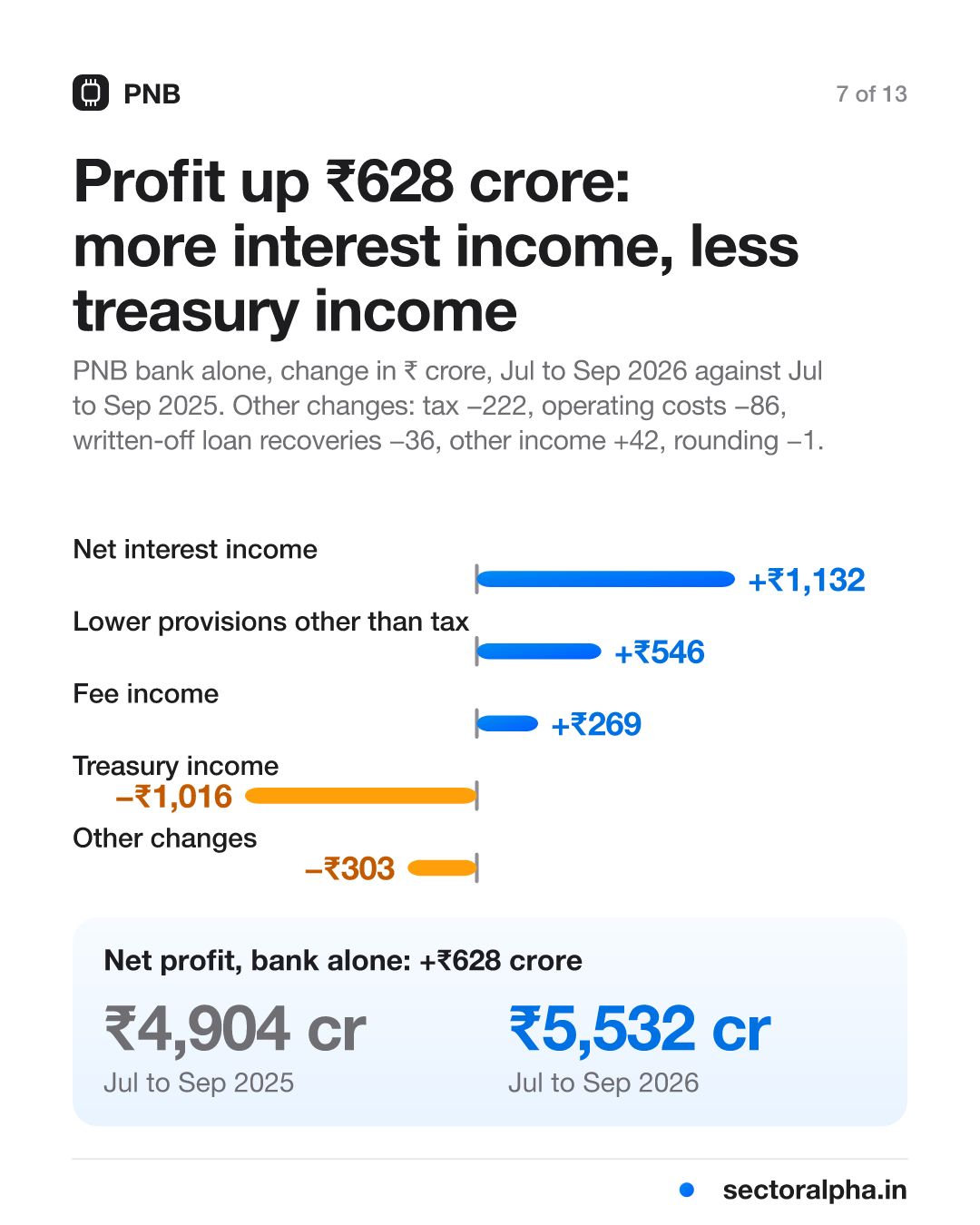
The bank alone made ₹5,532 crore in Jul to Sep 2026, against ₹4,904 crore a year earlier.
Net interest income added ₹1,132 crore. Lower provisions other than tax added ₹546 crore. Fee income added ₹269 crore.
Treasury income took away ₹1,016 crore.
Profit on sales of securities fell to ₹394 crore from ₹1,040 crore.
Gains from changes in the value of securities fell to ₹32 crore from ₹574 crore.
Profit on currency trading rose to ₹327 crore from ₹156 crore. The three parts for Jul to Sep 2025 add to ₹1,770 crore; PNB reported the total as ₹1,769 crore, a rounding gap.
Other changes took away ₹303 crore. Higher tax was ₹222 crore of that.
Leave out treasury income and money recovered from old written-off loans, and operating profit grew 29.4%, the managing director said on 16 Oct 2026.
The ₹798 crore release on one security is a one-time help, on my reading.
Each quarter vs a year earlier
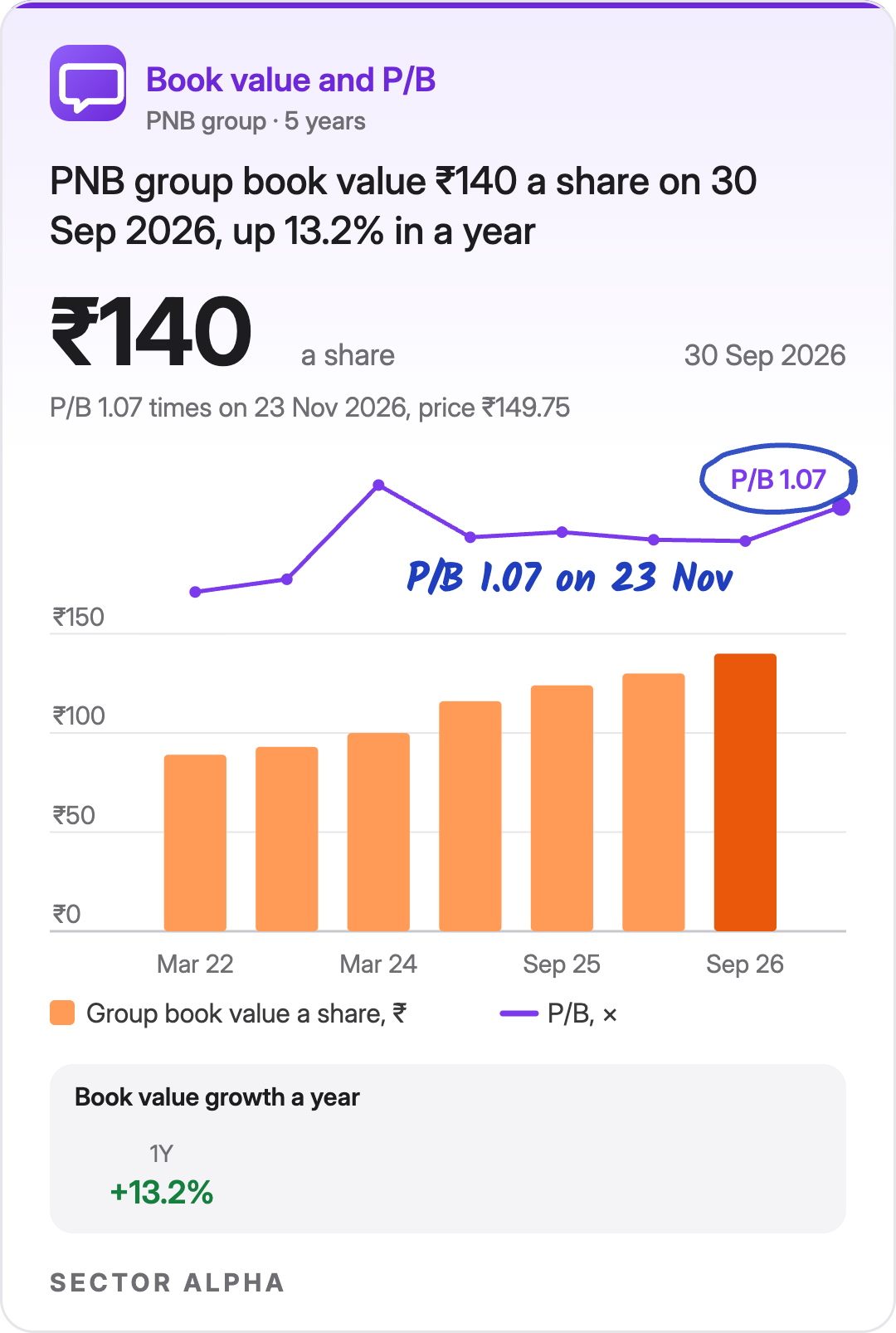
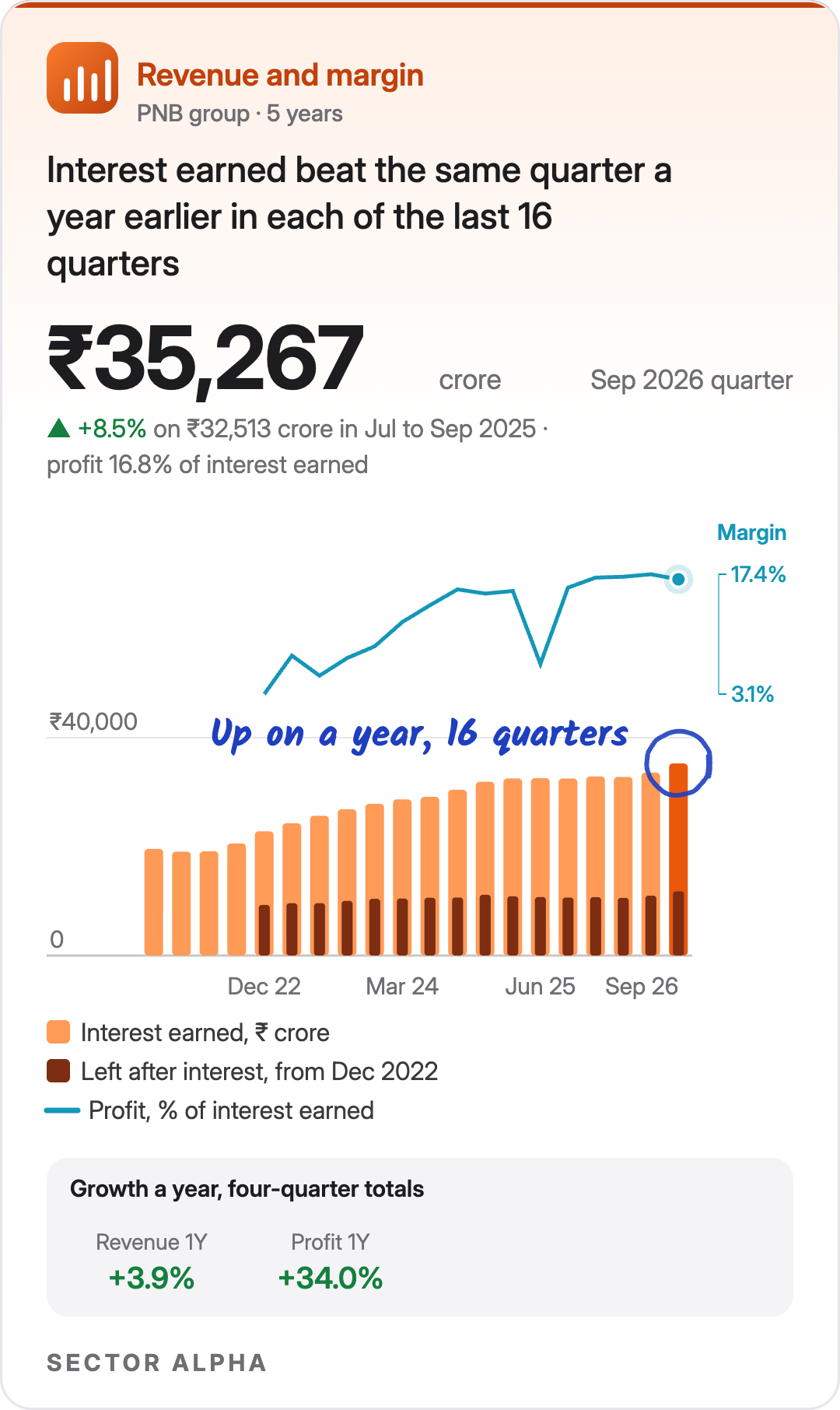
Interest earned: for the group, above the same quarter a year earlier in each of the 16 quarters from Oct to Dec 2022 to Jul to Sep 2026.
Income left after interest: above a year earlier in five of the last eight quarters.
Profit: above a year earlier in seven of the last eight quarters.
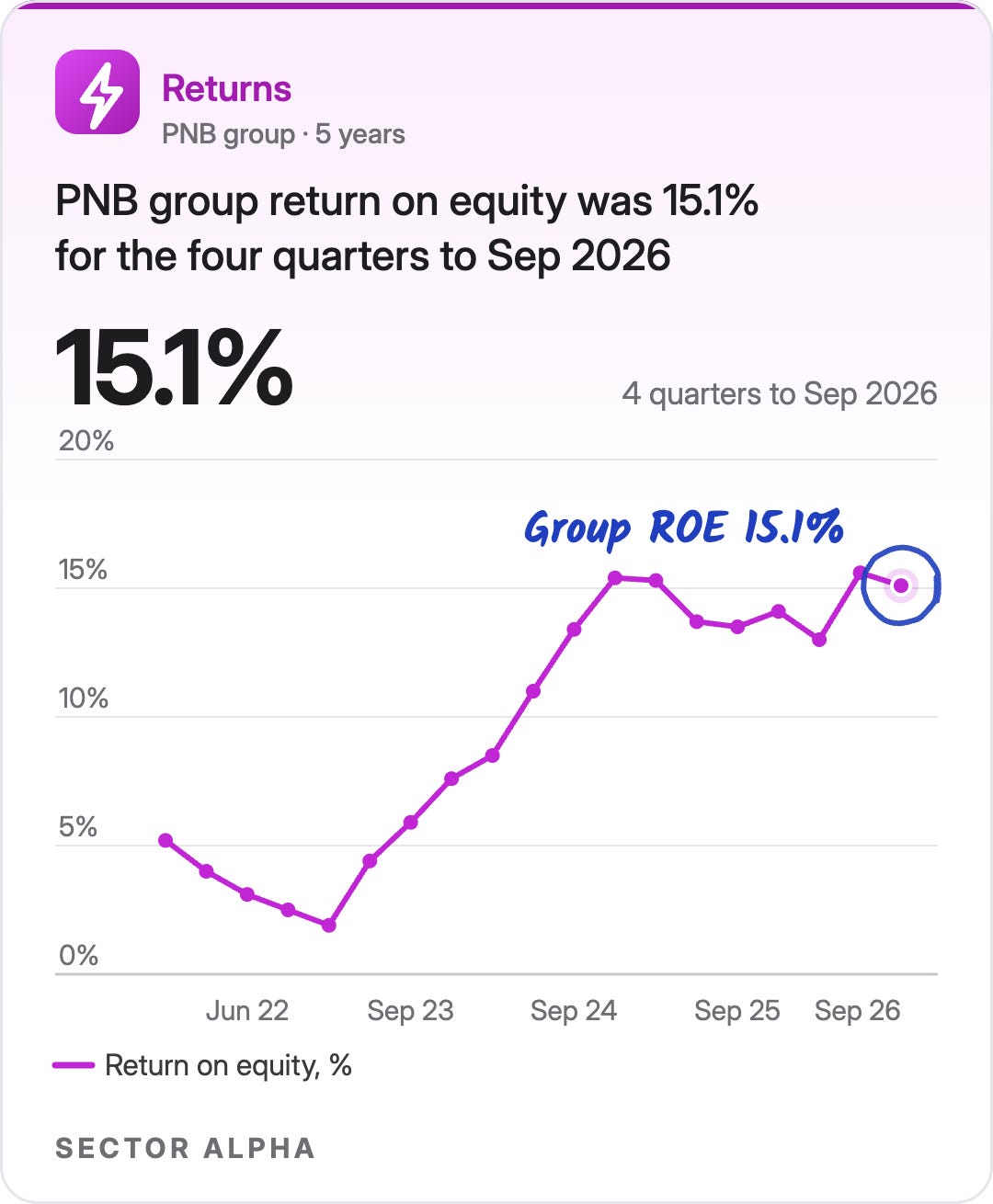
Return on equity, group: 15.1% over the four quarters to Sep 2026.
Return on tangible equity, bank alone: 17.32% for Jul to Sep 2026, on a yearly basis. Tangible equity leaves out intangible assets, so this is a different measure from the group figure.
On 16 Oct 2026 the managing director said return on equity would stay at about 15% to 17% at the minimum.
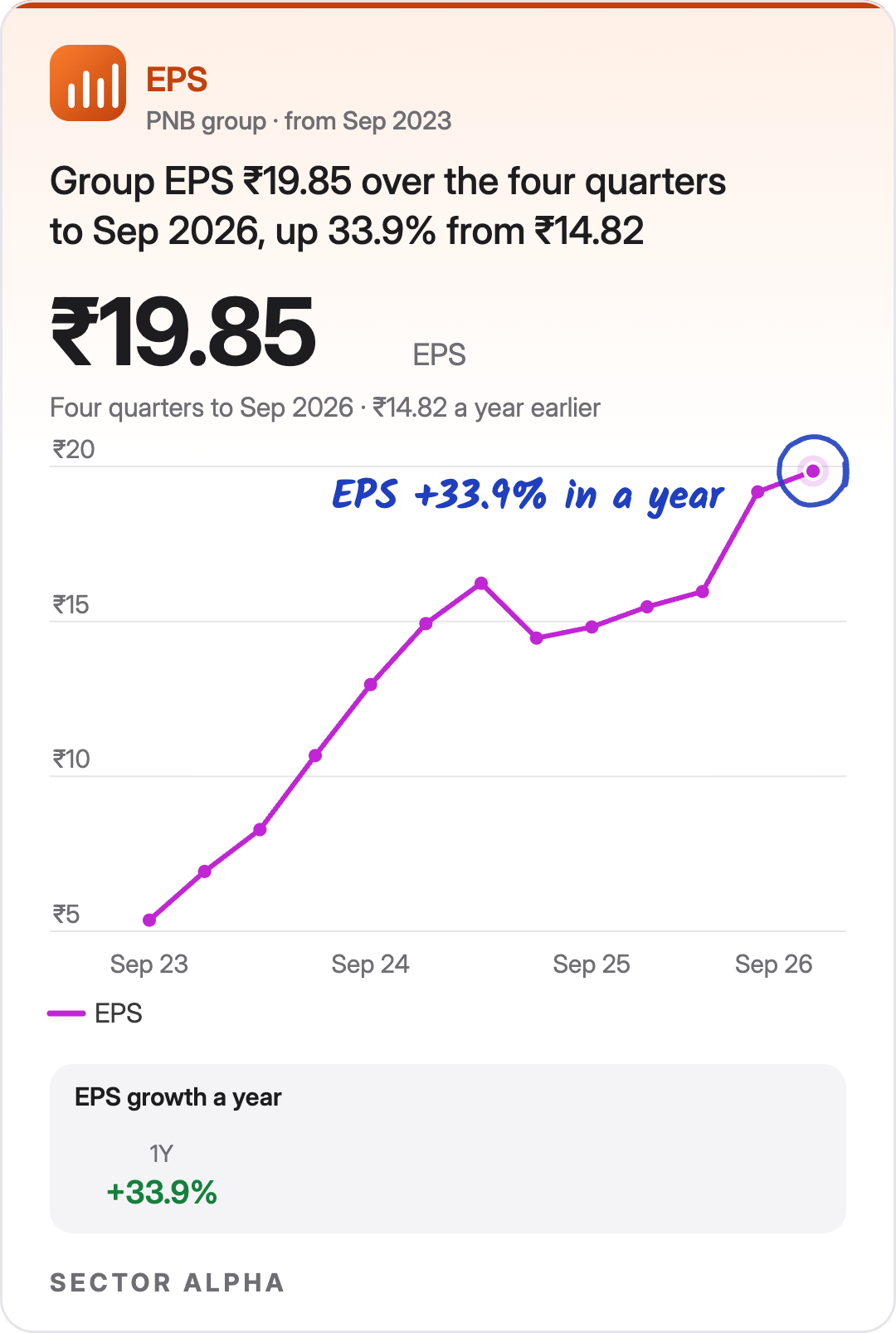
Earnings per share, group: ₹5.13 in Jul to Sep 2026, up from ₹4.46 a year earlier.
Over four quarters: ₹19.85 to Sep 2026, up 33.9% from ₹14.82. These add up the EPS PNB filed for each quarter.
Why the four-quarter rise is so big: tax took 74% of group profit before tax in Apr to Jun 2025, against 25% in Apr to Jun 2026. Group earnings per share in Apr to Jun 2025 were only ₹1.84.
Bad loans: gross bad loans fell to 2.55% of loans at 30 Sep 2026, from 3.45% a year earlier. After money set aside, net bad loans were 0.25%.
Credit cost, bank alone: bad-loan provisions were 0.25% of loans in Jul to Sep 2026, on a yearly basis. Its limit for the year to Mar 2027 is 0.4%.
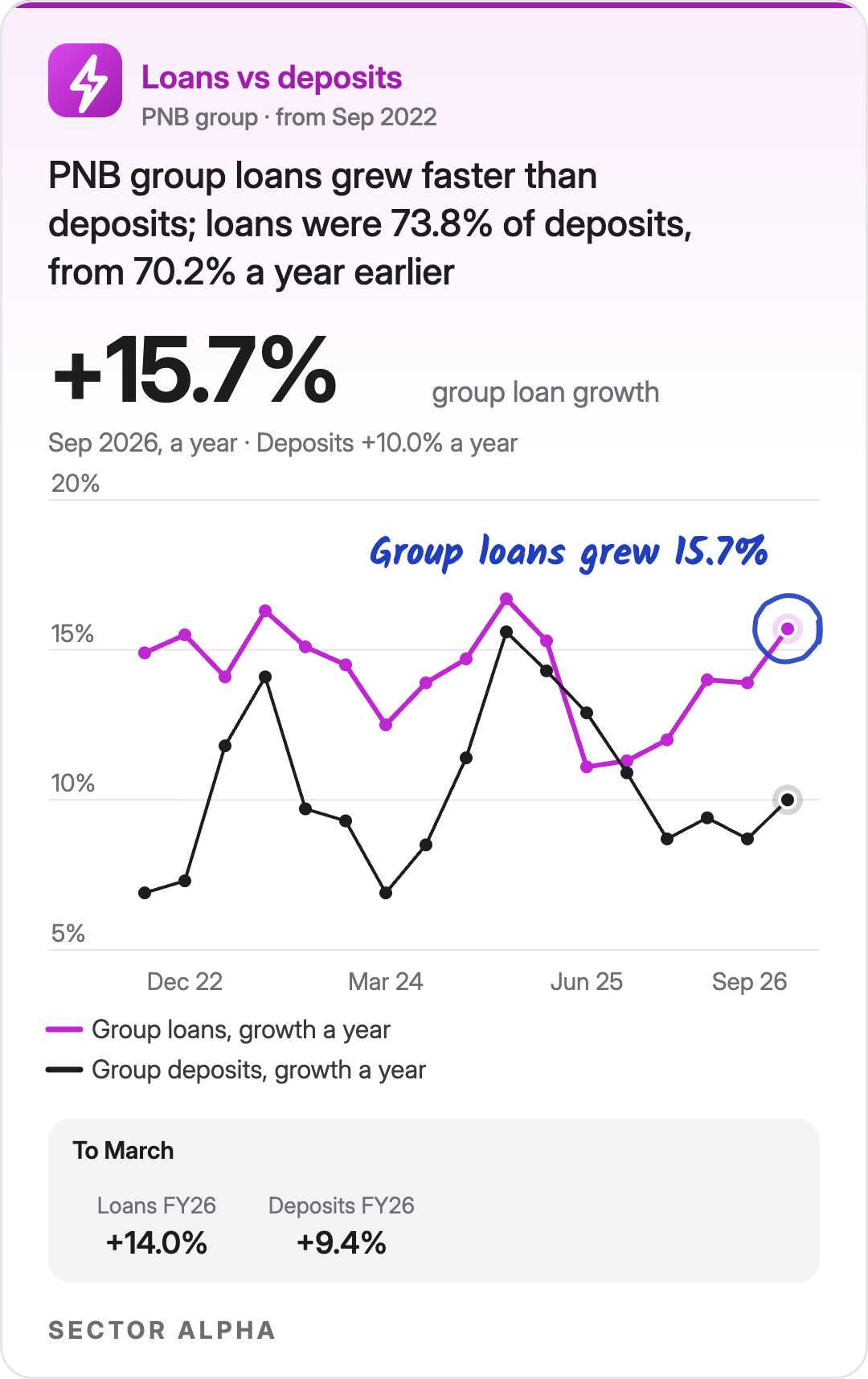
Loans vs deposits, bank alone: in the year to Sep 2026 loans grew 14.7% and deposits 9.9%. Loans were 75.5% of deposits.
Loans vs deposits, group: the card below shows loans up 15.7%, deposits up 10.0%, and loans at 73.8% of deposits, from 70.2% a year earlier.
Cash and debt
For a bank, cash flow swings with deposits taken and loans given, so it tells me little about profit.
What I check instead is capital. PNB's capital was 17.95% of its risk-weighted exposures on 30 Sep 2026, up from 17.19% a year earlier.
Why more money will be set aside: new rules on expected credit loss, called ECL, require banks to recognise expected loan losses earlier. Its one-time need for the loan book is about ₹8,000 crore, the managing director said.
He said on 16 Oct 2026 that only about ₹5,000 crore of that loan-book amount is still to be set aside. Any effect on bonds held to maturity is outside it.
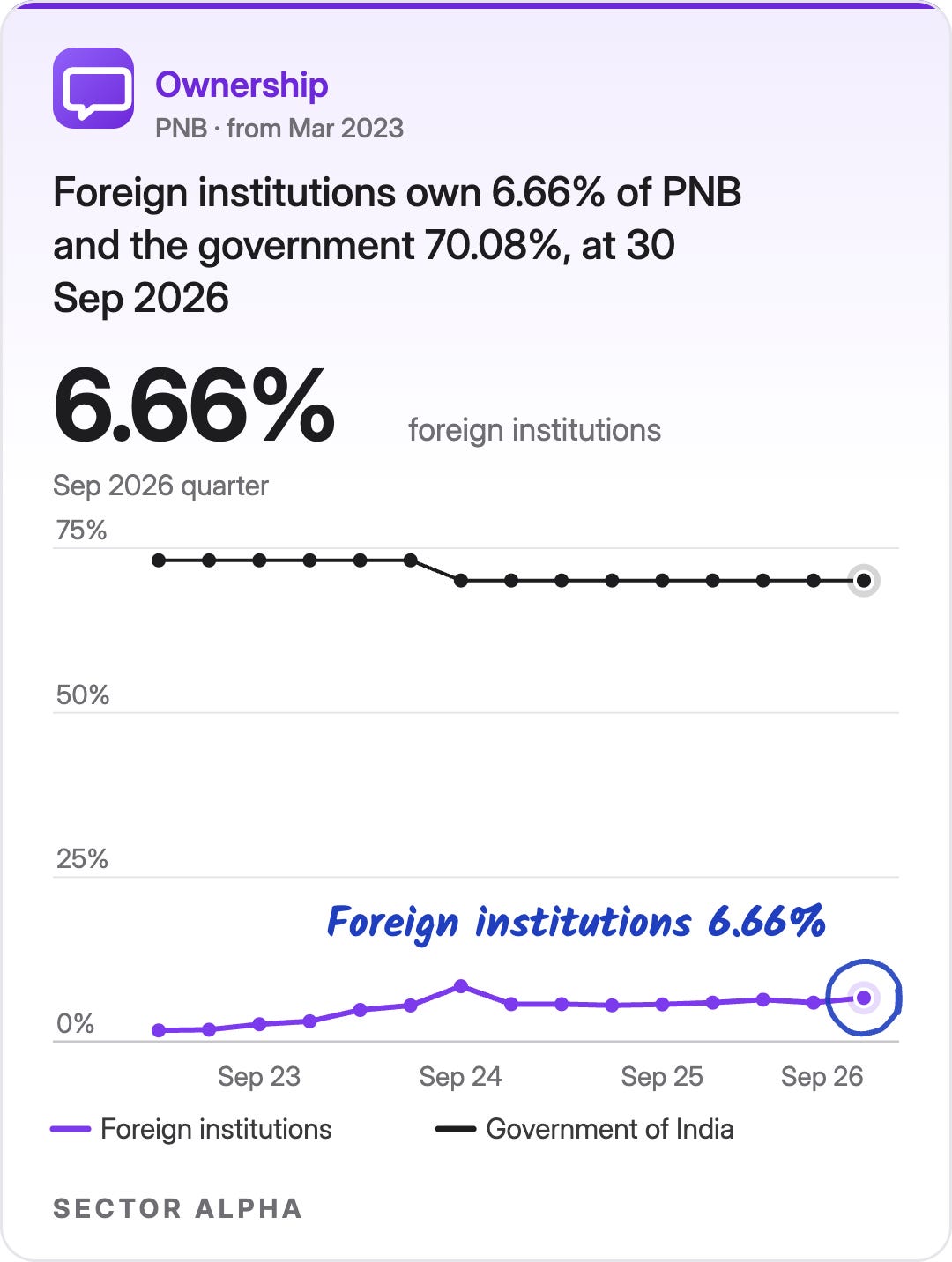
Who owns PNB
The government owns 70.08% of PNB, the same at 30 Sep 2026 as a year earlier.
Between 30 Sep 2025 and 30 Sep 2026, Indian institutions' share rose from 15.54% to 16.13%.
Foreign institutions' share rose from 5.67% to 6.66%.
Shareholders that are not institutions, a group that includes individuals, fell from 8.71% to 7.13%.
The number of shareholders fell to 21,57,907 in Sep 2026 from 24,55,484 a year earlier.
What management said, what happened
I checked what the managing director promised on the July call against the October results and call.
Margin: met. On 18 Jul 2026 he expected the margin to improve quarter after quarter. Global net interest margin was 2.58% in Jul to Sep 2026, up from 2.50% in Apr to Jun 2026.
Deposits from Indians abroad: done. On 18 Jul 2026 he planned to raise 2.5 billion US dollars of foreign-currency deposits from Indians abroad. On 16 Oct 2026 he said the bank had raised 2.7 billion US dollars.
Treasury income: missed. On 18 Jul 2026 he expected about ₹900 crore to ₹1,000 crore a quarter. Treasury income was ₹753 crore in Jul to Sep 2026.
Loans to smaller firms: not yet. On 18 Jul 2026 he expected loans to micro, small and mid-sized firms to grow about 25%. Those loans grew 19.8% in the year to 30 Sep 2026.
Recoveries: lower end of the goal cut. On 18 Jul 2026 he gave a recovery goal of ₹13,000 crore for the year to Mar 2027. On 16 Oct 2026 he said ₹12,000 crore to ₹13,000 crore. The goal in the 16 Oct 2026 presentation still says more than ₹13,000 crore. The bank recovered ₹5,594 crore in Apr to Sep 2026.
Why is this happening
The repo rise adds to loan income. 56% of PNB's loans are tied to the repo rate, the rate at which India's central bank lends to banks, the managing director said on 16 Oct 2026. Their rates change the next working day after a repo change, he said. He said the repo rise of 25 basis points, a quarter of a percentage point, would also add to the margin in Oct to Dec 2026.
The margin gain came first. He said the rise in the domestic margin in Jul to Sep 2026 came without any help from the repo rise.
Higher yields hit bonds. Bond yields rose, which cut the value of the bonds the bank holds, he said on 16 Oct 2026.
Deposits cost a lower rate. PNB's average rate on domestic deposits fell to 4.97% from 5.18% a year earlier. Across the bank, the total interest paid on deposits still rose 4.9%, to ₹21,434 crore.
Old bad loans are shrinking. In Jul to Sep 2026 the bank recovered ₹2,805 crore, counting upgrades and money from written-off loans. That was 1.17 times the ₹2,395 crore added to bad loans, and 1.26 times the ₹2,233 crore of loans that newly turned bad.
Farm loans to watch. An individual investor on the call pointed to more farm loans turning bad in Maharashtra and Andhra Pradesh. The managing director's reply on 16 Oct 2026: the stress is not there, but the bank needs to be very careful.
Going forward also, we are not going to increase the deposit rate.
Ashok Chandra, Managing Director and Chief Executive Officer, Punjab National Bank, 16 Oct 2026
Later on the same call, asked about retail deposits, he said PNB could attract deposits without raising rates that month.
Otherwise, the treasury profit would have been more than INR 1,700 crores, because last year in the same quarter, INR 1,700 crores was our treasury income.
Ashok Chandra, Managing Director and Chief Executive Officer, Punjab National Bank, 16 Oct 2026
What he means: he estimated treasury income would have been more than ₹1,700 crore without the fall in bond values.
What to track
Margin: does it reach the 2.60% to 2.70% goal for the year to Mar 2027? He expects a rise of 0.07 percentage points or more in Oct to Dec 2026.
Treasury: does it bring in the ₹700 crore to ₹800 crore he expects for Oct to Dec 2026?
Bad loans: do gross bad loans go below 2.50%, the goal for the year to Mar 2027?
Farm loans: do drought-hit districts push more farm loans into default?
ECL: when is the remaining ₹5,000 crore for the loan book set aside? Once the rules apply, he expects annual credit cost of 0.25% to 0.30%.
Deposits: the filed goal is 9% to 10% growth for the year to Mar 2027. A deliberate 8% to 9% pace is what the managing director described on 16 Oct 2026. Which one holds?
Low-cost deposits: does the share of domestic deposits in current and savings accounts reach the 38% goal for the year to Mar 2027? It was 36.6% at 30 Sep 2026.
Recoveries: does the bank reach ₹12,000 crore to ₹13,000 crore in the year to Mar 2027?
PNB's quarterly figures are on my page: sectoralpha.in/stocks/punjab-national-bank
— Roshan, Sector Alpha